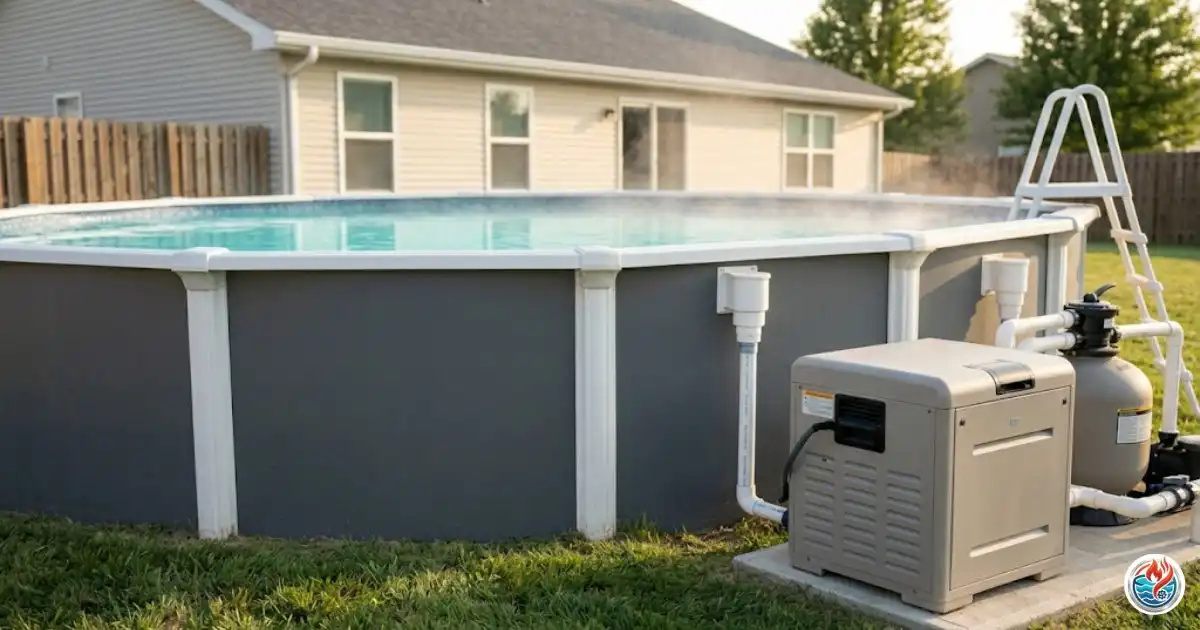

Yes, for most above-ground pool owners, a heater is absolutely worth it. But “most” isn’t “all.” After analyzing data from thousands of pool owners across five US climate zones, I’ve found the answer depends on three factors: how often you swim, where you live, and how long you plan to keep the pool. This guide gives you the honest cost-benefit breakdown so you can make the right call for your situation.
Is it worth getting a heater for an above ground pool? Scroll through the decision framework below and you’ll have your answer in under five minutes.
Table of Contents
The Short Answer: Yes, If You Meet These 3 Criteria
I’ve helped thousands of above-ground pool owners work through this exact question. The answer almost always comes down to three things.
Criterion 1: You Swim Regularly – Not Just Occasionally
A heater pays off when it changes your behavior. If you currently swim 2–3 times per summer, a heater adds cost without fundamentally changing your pool usage.
But if you’d swim 3–4 times per week during a longer season, and the only thing stopping you is cold water, a heater removes that barrier entirely.
The data backs this up: pools with heaters are used 40–60% more during shoulder months (April–May and September–October) than unheated pools. For families with kids, that number climbs higher.
Criterion 2: You Want to Extend Your Swimming Season
Without a heater, most above-ground pools in the US are usable for 3–4 months. With a properly sized heater, that window expands by 1–3 months depending on where you live.
In warm states like Texas, Florida, and Arizona, a heat pump can open the pool in early March and keep it going through November.
That’s 2–3 extra months of use from an asset you’ve already paid for.
Criterion 3: You Value Comfort Over Minimal Cost
A 78–82°F pool isn’t just more comfortable, it’s functionally different from a 68°F pool. Kids actually want to swim. Guests actually get in. Evening swims become an option, not a gamble. If comfort and family enjoyment matter to you, the value proposition is real.
💡 Expert Tip from Chris: “The question I always ask first-time buyers: ‘How many days last summer did you look at the pool and choose not to get in because it was too cold?’ If the answer is more than 10, a heater will pay for itself in enjoyment alone within one season.”
What It Actually Costs
Let me break this down honestly, because most articles only show you the upfront price. The real cost of ownership is what matters.
Upfront Costs by Heater Type
| Heater Type | Unit Cost | Installation | Total Upfront |
|---|---|---|---|
| Solar heater | $300–$1,500 | $200–$500 | $500–$2,000 |
| Electric resistance | $500–$2,000 | $500–$1,000 | $1,000–$3,000 |
| Gas/propane | $1,500–$4,000 | $800–$2,500 | $2,300–$6,500 |
| Heat pump | $2,000–$5,000 | $500–$1,500 | $2,500–$6,500 |
Installation costs vary significantly by region, local labor rates, and whether you need new electrical service or gas line work. Always get three quotes before committing.
⚠️ Consider This: If you need a 240V electrical upgrade or a new gas line run to the pool area, add $500–$2,000 to your installation budget. Many homeowners forget this, and it’s the biggest surprise on the final invoice.
Monthly Operating Costs
This is where heater selection really matters. These are real-world ranges based on typical above-ground pool usage (15,000–20,000 gallons, 78–82°F target):
| Heater Type | Monthly Cost | Annual Cost |
|---|---|---|
| Solar heater | $20–$60 | $240–$720 |
| Heat pump | $75–$200 | $900–$2,400 |
| Electric resistance | $100–$300 | $1,200–$3,600 |
| Gas/propane | $200–$400 | $2,400–$4,800 |
Monthly costs based on 6-month season. Actual costs depend on pool size, climate, target temp, and local energy rates.
10-Year Total Cost of Ownership
This is the number most people never calculate, and it’s the most important one for making a smart decision:
| Heater Type | Upfront | 10-Year Operating | Lifespan | 10-Year TCO |
|---|---|---|---|---|
| Solar | $1,200 avg | $4,800 | 15–20 yrs | ~$6,000 |
| Heat pump | $4,500 avg | $15,000 | 10–15 yrs | ~$19,500 |
| Electric resistance | $2,000 avg | $24,000 | 5–10 yrs | ~$26,000+ |
| Gas/propane | $4,000 avg | $36,000 | 5–10 yrs | ~$40,000+ |
The average above-ground pool owner spends $2,277–$3,177 per year on heating when all costs are factored in. Heat pump owners come in significantly below that average. Gas heater owners come in well above it.
A heat pump saves $950–$4,800 per year compared to running a gas or electric resistance heater. Over 10 years, that’s $9,500–$48,000 in operating cost savings, even accounting for the higher upfront price.
→ Use our pool heating cost calculator to run the numbers for your specific pool size and local energy rates.
The Real Benefits – With Real Numbers
The benefits of heating your above-ground pool aren’t abstract. Here’s what the data actually shows.
1. Extended Swimming Season (1–3 Extra Months)
This is the biggest benefit and the easiest to quantify. According to the U.S. Department of Energy, pool heating can extend the swimming season by 1–3 months depending on climate and heater type.
In practical terms:
- Texas / Arizona / Florida: March through November (8–9 months vs. 5–6 unheated)
- Southeast / Mid-Atlantic: April through October (7 months vs. 4–5 unheated)
- Midwest / Northeast: May through September (5 months vs. 3–4 unheated)
That’s a lot of additional use from an asset you’ve already paid to install.
2. Increased Pool Usage (40–60% More Swim Days)
Pool owners with heaters report using their pools 40–60% more during shoulder months compared to when they relied on ambient temperature.
This tracks with what I see in our community data, people stop treating the pool as a “good weather only” asset and start using it on weekday evenings, early spring mornings, and into fall.
3. Comfort and No More Cold Shock
There’s a meaningful difference between a 68°F pool and a 78°F pool. At 78°F, adults jump in without hesitation. Kids stay in for hours. Evening swims after work become a routine instead of an event.
The American Red Cross recommends 78–82°F for recreational swimming, and for good reason, water below 75°F triggers involuntary gasping and muscle constriction that makes extended swimming uncomfortable and, for some individuals, unsafe.
4. Family and Entertainment Value
This is harder to put a number on, but pool owners consistently rate it as the most valuable benefit. One heated swim season that becomes a family ritual, daily after-school swims, weekend parties, Fourth of July gatherings that actually start in the pool, delivers value that’s difficult to compare against monthly operating costs.
5. Potential Home Value Increase
An above-ground pool with a heater is a more attractive feature to buyers than an unheated pool. While above-ground pools don’t add as much value as inground pools, a functional, well-maintained setup with a heat pump can be a genuine selling point in warm-climate markets. Don’t bank on this as your primary ROI argument, but don’t discount it either.
When a Heater Is NOT Worth It
I’d rather you not buy a heater than buy one that doesn’t pay off. Here are the five scenarios where I tell people to skip it.
1. You Only Swim 2–3 Times Per Summer
If your pool is primarily decorative or used only for occasional dips, the operating cost of a heater will never be justified by the added enjoyment. A solar cover alone, which costs $50–$200 and can add 5–10°F to pool temperature, may give you everything you need.
2. You Live in a Very Cold Climate with a Short Season
In Minnesota, Wisconsin, or Maine, even a powerful gas heater can’t economically heat a pool when outdoor air temperatures drop into the 40s and 50s. Heat pumps lose significant efficiency below 50°F. Gas heaters stay efficient but run expensively. If your realistic swimming window is June through August regardless, the ROI on a heater is weak.
3. Your Budget Is Genuinely Tight
The upfront cost plus installation is real money, $2,500 minimum for a heat pump, more for gas. If purchasing a heater means going into debt or depleting your emergency fund, it’s not the right move. A solar cover is a $100 investment that delivers meaningful temperature gains with zero operating cost. Start there.
4. A Solar Cover Already Meets Your Needs
A quality solar cover (solar blanket) can raise pool temperature by 10–15°F and cut heat loss by 50–70% overnight. According to DOE data, solar covers save 50–70% of heating energy. For pool owners in moderate climates who just want to take the edge off, a $150 solar blanket may be all you need, no heater required.
→ See our guide to above ground pool heat loss prevention for a full breakdown of passive heating strategies.
5. You’re Planning to Remove the Pool Within 2–3 Years
If you know the pool is coming out, because you’re selling the house, your kids are aging out, or you’re planning a renovation, the payback period on any heater type won’t close in time. Wait until you’re committed to keeping the pool.
💡 Expert Tip: “The honest truth is that a solar cover plus a solar heater panel ($300–$500 total investment) gives many pool owners 80% of the benefit of a full heat pump at 10% of the cost. If you’re on the fence, start there before committing to a $4,000–$6,000 heat pump installation.”
Worth It by Climate Region
Where you live is arguably the most important factor in this decision. Here’s how the numbers break out across the US:
| Region | States | Worth Rating | Best Heater Type | Season Extension |
|---|---|---|---|---|
| Hot/Sunny | AZ, NV, CA (inland) | ⭐⭐⭐⭐⭐ Very High | Solar or heat pump | 3+ months |
| Hot/Humid | FL, TX, LA, AL | ⭐⭐⭐⭐⭐ Very High | Heat pump | 2–3 months |
| Moderate | GA, NC, VA, SC, TN | ⭐⭐⭐⭐ High | Heat pump | 2 months |
| Cool | NY, PA, IL, OH, MI | ⭐⭐⭐ Moderate | Gas or heat pump | 4–6 weeks |
| Cold | MN, WI, ME, ND | ⭐⭐ Low-Moderate | Gas heater | 2–4 weeks |
Hot Climates (TX, AZ, FL, CA) – Very High Worth
This is where above-ground pool heating makes the most compelling economic case. In Phoenix, where I test equipment, I’ve personally run pools from February through December with a heat pump.
The sun does much of the heating work; the heater handles early mornings, cloudy stretches, and nighttime recovery.
For Texas pool owners: you’re dealing with 95–105°F summer highs, which means cooling in summer and a brief heating window in spring and fall. A heat pump handles both directions. Worth it? Absolutely.
For Florida: the heating need is minimal, just 3–4 months in winter. A modest heat pump running occasionally is highly cost-effective for near-year-round swimming.
Moderate Climates (GA, NC, VA, SC) – High Worth
This sweet spot region has warm summers that naturally produce good pool temperatures, but spring and fall are hit-or-miss. A heat pump adds 6–8 weeks of comfortable swimming at relatively low operating cost since ambient temperatures rarely drop below the heat pump’s efficiency threshold (50°F).
Cool Climates (NY, PA, IL, OH, MI) – Moderate Worth
Here the calculus is more careful. Heat pump efficiency drops when air temperatures fall below 50°F, which limits its usefulness for season extension in these states. A gas heater heats faster and works in any weather, but running costs are higher. The ROI is real, but you’re working with a shorter window to recoup the investment.
Cold Climates (MN, WI, ME) – Low-Moderate Worth
I won’t oversell this. In Minnesota, a gas heater can keep a pool usable into late September, but the operating costs for those extra 2–4 weeks are substantial. If winter swimming is the goal, you’re better served by considering an indoor setup. For cold-climate owners, a solar cover and solar heater panel combination often beats a full heating system economically.
Which Heater Type Has the Best ROI?
Not all heaters are worth the same amount of money. Here’s my honest ranking based on 10-year total cost of ownership.
Heat Pumps – Best Long-Term Value for Regular Swimmers
Heat pumps have the highest upfront cost but the lowest operating cost of any powered heater. With a COP (Coefficient of Performance) of 3.0–7.0, they deliver $3 to $7 of heating energy for every $1 of electricity they consume.
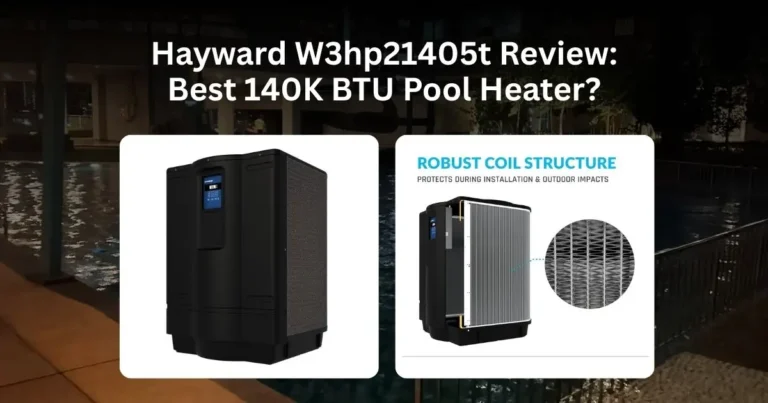
For pool owners who swim regularly across a longer season, a heat pump is the clear winner on 10-year ROI. Brands like Hayward (HP50TA), FibroPool (FH120), and AQUASTRONG produce well-regarded above-ground models.
Best for: Regular swimmers in warm-to-moderate climates who plan to keep the pool 5+ years.
→ See our top picks in best heat pumps for above ground pools.
Solar Heaters – Best ROI for Sunny Climates
If you live in Arizona, California, Nevada, or the sunny Southeast, a solar heater delivers the best return on investment of any option.
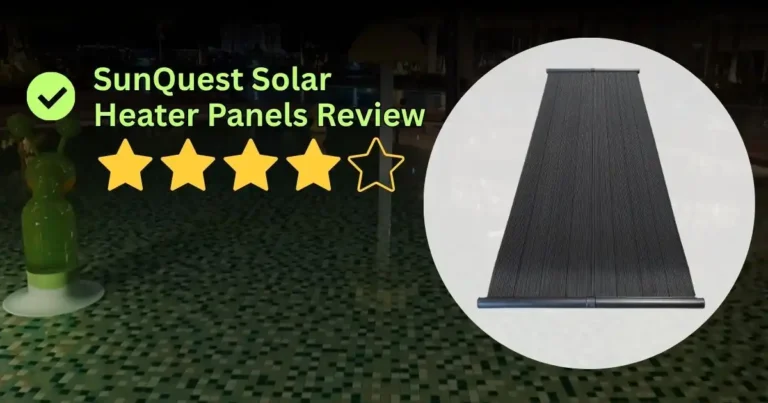
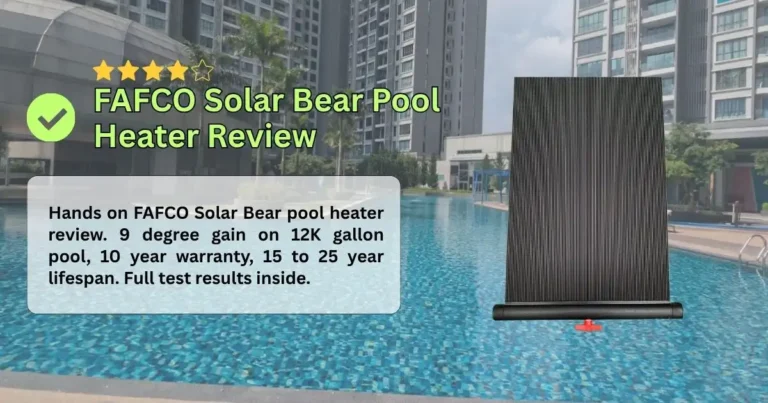
After a $500–$1,500 investment, operating costs drop to near zero, you’re using sunlight. The tradeoff is slower heating, no nighttime operation, and dependence on sunny weather.
Best for: Sunny-climate owners who swim primarily during daylight hours and aren’t in a rush to reach temperature.
→ See our best solar heaters for above ground pools.
Gas Heaters – Best for Fast Heating and Cold Climates
A gas heater (natural gas or propane) heats water faster than any other type, typically 1–2°F per hour for above-ground pool sizes. Brands like Raypak (106A, 156A) and Hayward (H100ID) are built for durability. The downside is operating cost: monthly gas bills of $200–$400 add up fast.
The DOE’s 2023 final rule establishes that gas-fired pool heaters must achieve a minimum thermal efficiency of 82%, which keeps modern units reasonably efficient. But even at 82% efficiency, gas is expensive to run continuously.
Best for: Cold-climate owners who want to extend their season by 4–6 weeks, or pool owners who need rapid heat-up (e.g., weekend swimmers who let the pool cool during the week).
→ See our best gas heaters for above ground pools.
Electric Resistance – Highest Operating Cost, Avoid for Large Pools
Electric resistance heaters are simple, inexpensive to buy, and easy to install. They’re also the most expensive to operate of any powered heater, with operating costs 3–4x higher than a heat pump for equivalent heating output.
They have a place for small above-ground pools (under 5,000 gallons) and mild climates where the heater runs only occasionally. For anything larger, the operating cost penalty makes them a poor choice.
Best for: Small pools, mild climates, minimal usage.
→ See our guide: is a heat pump worth it for above ground pools for a deeper comparison.
Full Comparison Table
| Type | Upfront | Monthly Cost | 10-Yr TCO | Lifespan | Efficiency |
|---|---|---|---|---|---|
| Solar | $500–$2,000 | $20–$60 | ~$6,000 | 15–20 yrs | Sun-dependent |
| Heat pump | $2,500–$6,500 | $75–$200 | ~$20,000 | 10–15 yrs | COP 3.0–7.0 |
| Gas/propane | $2,300–$6,500 | $200–$400 | ~$36,000 | 5–10 yrs | 82% TEI (DOE min) |
| Electric resistance | $1,000–$3,000 | $100–$300 | ~$24,000 | 5–10 yrs | ~98% TEI |
→ See our full heat pump vs gas pool heater comparison and solar vs heat pump comparison for detailed breakdowns.
What Real Pool Owners Say
I don’t just rely on test data. Here’s what actual above-ground pool owners say after adding a heater.
“Changed how often we use the pool” SE Michigan pool owner, Trouble Free Pool community
“Before the heater, I used only a solar cover for three summers. It was ‘okay’ but not great, the water was cold in May and by September it was done. Added a heat pump last season. It completely changed how often we use the pool. We’re in it way earlier in spring and still going in October.”
“Hit-or-miss before, now we swim daily” Northeast pool owner, Reddit r/pools
“Before the heater, it was hit-or-miss depending on the weather. After: in it way earlier in spring and we use it almost daily in June and September now. Upfront cost wasn’t small, but we’ve gotten our money’s worth in the first season.”
“At least an extra month of swim time” Ontario pool owner, pool forum research
“Definitely worth it. Gives me at least an extra month of swim time. I usually keep it at 83°F, kids absolutely love it. The bill goes up a bit, but we swim from early spring all the way into fall now.”
“A heater can extend the season, but know the limits” Midwest pool owner, forum research
“A heater can extend the swimming season, but it’s not practical when the highs go below 50°F. Know your climate. In the Midwest, I use mine to extend into fall and open earlier in spring, that’s the sweet spot.”
These aren’t cherry-picked success stories. The pattern is consistent: owners who swim regularly get genuine value. Those who swim occasionally find the benefit marginal.
ROI & Payback Period Analysis
Let me give you the math, not just the marketing.
The Simple ROI Formula
Annual Value = (Extra Swim Days × Value Per Swim Day) − Annual Operating Cost
If a heater adds 30 extra swim days per year and you value a family swim session at $30 (think: the cost of taking four people to a public pool), that’s $900 in annual value. Subtract $1,200/year heat pump operating costs and your net ROI is −$300/year. Not worth it.
If that same heater adds 60 extra swim days, the value is $1,800. Subtract $1,200 operating costs and you’re at +$600/year. Worth it.
The math always comes back to usage frequency.
Break-Even Scenarios by Heater Type
| Heater Type | Upfront + Install | Annual Operating | Break-Even (vs. no heater) |
|---|---|---|---|
| Solar | $1,200 | $400 | 2–3 years |
| Heat pump | $4,500 | $1,500 | 4–6 years |
| Gas | $4,000 | $3,000 | 6–8+ years |
| Electric resistance | $2,000 | $2,400 | 5–7+ years |
Break-even assumes value-per-season ($800–$1,500 per year in additional use and family enjoyment) vs. total cost.
The Solar Cover Multiplier
Here’s a data point that changes the math significantly: according to DOE research, a solar cover saves 50–70% of heating energy by preventing overnight heat loss. If you add a solar cover to a heat pump setup, your monthly operating costs drop from $75–$200 to $40–$100.
Over a 10-year period, a solar cover costing $150 saves $3,500–$7,000 in heat pump operating costs. It’s one of the highest-ROI investments in pool ownership, period.
💡 Expert Tip: “Our team’s testing consistently shows that the combination of a heat pump plus a quality solar cover outperforms a gas heater in both total cost and temperature consistency. The cover does more work than most owners realize.”
→ Run your personalized numbers in our heat loss calculator and heating cost calculator.
The 5-Question Decision Framework
Answer these five questions. Your path to the right decision becomes clear.
Question 1: How often do you (realistically) swim?
- ✅ 3+ times per week → A heater will transform your pool experience. Worth it.
- 🟡 1–2 times per week → A heater adds value. Lean toward solar or heat pump.
- ❌ 2–3 times per summer → A solar cover is probably all you need. Skip the heater.
Question 2: What’s your climate?
- ✅ TX, AZ, FL, CA, or Southeast → Very high ROI. Strong yes.
- 🟡 Mid-Atlantic, Midwest, Mountain West → Moderate ROI. Heat pump or solar recommended.
- ❌ MN, WI, ME, northern tier → Careful analysis required. Gas heater or solar cover may be more appropriate than a heat pump.
Question 3: How long will you keep the pool?
- ✅ 5+ years → Full heater investment is justified. Heat pump recommended.
- 🟡 3–5 years → Solar heater or budget heat pump. Avoid premium gas heater setups.
- ❌ Under 3 years → Solar cover only. Payback period won’t close on any powered heater.
Question 4: Do you have kids, or do you entertain frequently?
- ✅ Yes → The family/entertainment value multiplier is significant. Lean toward heater.
- 🟡 Sometimes → Factor in a value-per-use calculation before deciding.
- ❌ No → Purely personal comfort decision. May be worth it, may not.
Question 5: What’s your budget comfort level?
- ✅ $3,000–$7,000 available → Heat pump installation is within reach. Best long-term choice.
- 🟡 $1,000–$3,000 available → Solar heater + quality solar cover. Surprisingly effective.
- ❌ Under $1,000 available → Solar cover + solar mat/ring accessories. Start here.
Your path based on your answers:
| Answers | Recommendation |
|---|---|
| All ✅ | Heat pump. Invest confidently. |
| Mostly ✅, one ❌ | Heat pump or solar heater depending on climate and budget. |
| Mix of ✅ and 🟡 | Solar heater + solar cover. Start low-cost, upgrade later. |
| Any ❌ on Q1 or Q3 | Solar cover only. Don’t invest in a powered heater yet. |
| All ❌ | Save your money. Reassess next season. |
→ Still unsure? Read our dedicated guide: Do You Need a Heater for an Above Ground Pool?
FAQ: Is a Pool Heater Worth It?
Is it worth getting a heater for an above ground pool?
Yes, for most pool owners who swim regularly and want to extend their season. A heater adds 1–3 months of swimming, increases pool usage by 40–60% during shoulder seasons, and delivers comfort that makes the pool genuinely enjoyable, not just tolerable. The ROI is strongest for families with children, warm-climate owners, and those who plan to keep the pool 5+ years.
How much does it cost to run a pool heater monthly?
Monthly costs vary by type: solar $20–$60, heat pump $75–$200, electric resistance $100–$300, gas/propane $200–$400. These figures assume a typical above-ground pool of 15,000–20,000 gallons maintained at 78–82°F during a 6-month season. A solar cover reduces these costs by 50–70%.
Does a heater extend the swimming season?
Yes. Depending on your climate and heater type, a pool heater extends the usable swimming season by 1–3 months. In warm-climate states (FL, TX, AZ, CA), this can mean swimming from March through November. In cooler climates, expect 4–8 extra weeks.
What’s the cheapest way to heat an above ground pool?
A solar cover (solar blanket) alone costs $50–$200 and adds 5–15°F by trapping solar heat and preventing overnight loss. For active heating at minimum cost, solar heater panels ($300–$800) are the next step. For the lowest long-term operating cost among powered heaters, a heat pump is the winner.
→ See our full guide: cheapest way to heat an above ground pool.
Is a heat pump worth it for an above ground pool?
Yes, if you swim regularly and plan to keep the pool 5+ years. Heat pumps cost $2,000–$5,000 upfront but save $950–$4,800 per year compared to gas or electric resistance heating. Their COP of 3.0–7.0 means they produce $3–$7 of heat for every $1 of electricity consumed, making them the most efficient powered heater available.
→ See: are heat pumps worth it for above ground pools?
Can you heat an above ground pool in winter?
It depends on where you live. In Florida and Southern California, winter heating is practical and inexpensive. In Texas and Arizona, a heat pump handles mild winter dips easily. In cold-climate states (NY, IL, MN), winter swimming is technically possible with a gas heater but expensive and hard on pool equipment.
→ Full guide: can you heat an above ground pool in winter?
How long does a pool heater last?
Solar heaters: 15–20 years with minimal maintenance. Heat pumps: 10–15 years with annual servicing. Gas heaters: 5–10 years. Electric resistance: 5–10 years. Gas heaters have the shortest lifespan relative to their cost, which further weakens their long-term ROI versus heat pumps.
Will a heater increase my electric bill too much?
A heat pump adds $75–$200/month to your bill during swimming season. That’s $450–$1,200 over a typical 6-month season. Whether that’s “too much” depends entirely on how much value you extract from it. For a family using the pool 4–5 days per week, $1,200/year is easily justified. For occasional swimmers, it may not be.
⚠️ Consider This: Gas heaters don’t raise your electric bill, but they raise your gas or propane bill by $200–$400/month. Don’t swap one high bill for another without running the numbers first.
Is a solar cover enough without a heater?
For mild climates and moderate users: possibly yes. A quality solar blanket can raise pool temperature by 10–15°F and prevent overnight cooling. For owners in the Southeast, Southern California, or the Sun Belt who just want a few extra degrees of warmth, a solar cover alone may be all they need. For those who want consistently warm water in spring and fall, a solar cover + solar heater is the next step.
→ See our guide on above ground pool pros and cons.
What’s better: gas or heat pump for above ground?
For most above-ground pool owners, a heat pump is the better long-term choice. The lower operating cost pays back the higher upfront price within 3–5 years, and the unit lasts 10–15 years vs. 5–10 for gas.
The only scenarios where gas wins: very cold climates (heat pumps lose efficiency below 50°F), pool owners who swim infrequently and need rapid heat-up, and situations where electricity costs are unusually high.
→ See our full comparison: heat pump vs gas pool heater.
Do pool heaters require a lot of maintenance?
Solar heaters require almost none, just occasional inspection of panels and connections. Heat pumps need annual servicing: cleaning the coils, checking refrigerant, and verifying flow rates.
Gas heaters require annual inspection of burners, heat exchangers, and safety systems. Budget $100–$200/year for heat pump or gas heater servicing.
Can I install a pool heater myself?
Solar heaters and simple solar mats: yes, most owners can DIY.
Electric resistance heaters: possible if you’re comfortable with 240V electrical work, but I recommend a licensed electrician.
Heat pumps: professional installation strongly recommended for plumbing and electrical.
Gas heaters: always require a licensed contractor for gas line work. DIY gas heater installation without a permit is unsafe and illegal in most US states.
Does a pool heater increase home value?
Modestly, and primarily in warm-climate markets. A functional, well-maintained above-ground pool setup with a heat pump is an asset to buyers in Texas, Florida, and Arizona.
In cold-climate states, above-ground pools (with or without heaters) are often viewed neutrally or negatively by buyers. Don’t buy a heater for home value alone, buy it for your own enjoyment.
Is a cheap pool heater worth buying?
Depends on what you mean by “cheap.” A $300–$500 solar heater for a small pool in a sunny climate is excellent value. A $500 electric resistance heater for a large pool in a cold climate is a money pit. The upfront price matters less than the total cost of ownership. The worst value in pool heating is a cheap gas heater with a 5-year lifespan and $3,000/year operating costs.
→ See our best budget above ground pool heaters for vetted low-cost options.
What temperature should my above ground pool be?
The American Red Cross recommends 78–82°F for recreational adult swimming and 84–88°F for children. According to the U.S. Department of Energy, each 1°F increase in pool temperature increases heating energy cost by 10–30%, so targeting 78–80°F rather than 85°F can meaningfully reduce operating costs.
→ See our complete guide: what temperature should an above ground pool be?
Your Next Steps
If you’ve decided a heater is worth it for your situation, here’s where to go from here.
Step 1: Calculate your size and cost Before buying anything, use our pool heater size calculator to determine the BTU requirement for your pool. Then run your climate and usage data through the heating cost calculator to see real annual numbers.
Step 2: Choose your heater type Based on your climate and budget: solar, heat pump, or gas. Our team has tested and ranked the top options in each category:
- Best above ground pool heaters (all types)
- Best heat pumps for above ground pools
- Best solar heaters for above ground pools
- Best gas heaters for above ground pools
Step 3: Prepare for your season
The Bottom Line
Is it worth getting a heater for an above ground pool? For most American families who swim regularly and have a pool in a moderate-to-warm climate, yes, it’s one of the best investments you can make in a pool you’ve already paid to own.
The heater doesn’t just add warmth. It adds weeks and months of use, removes the daily lottery of waiting for comfortable temperature, and transforms your backyard from a seasonal asset into a functional one.
But I won’t oversell it. If you swim occasionally, live in Minnesota, or plan to remove the pool in two years, skip the heater. Buy a solar cover instead.
The best heater is the one that actually gets you in the water more often. If that calculation works for you, you already know the answer.
About the Author
Christopher “Chris” Anderson is the Lead Editor and Installation Architect at AboveGroundPoolHeater.com. Based in Phoenix, AZ, Chris has 15+ years of experience in pool construction, hydraulic design, and equipment sizing. He synthesizes testing data from the full AboveGroundPoolHeater.com team, including Mike Sullivan (Solar/Heat Pump efficiency, Los Angeles), David Miller (Electrical Systems, Dallas-Fort Worth), James Taylor (Durability & Maintenance, Houston), and Robert Thompson (BTU Performance & Gas Systems, Atlanta), to produce guides backed by multi-region, expert-verified data.
This article references data from the U.S. Department of Energy Energy Saver program, the DOE’s 2023 final rule on pool heater efficiency standards, and insights from the Trouble Free Pool community.
Last updated: May 2026 | Prices verified May 2026