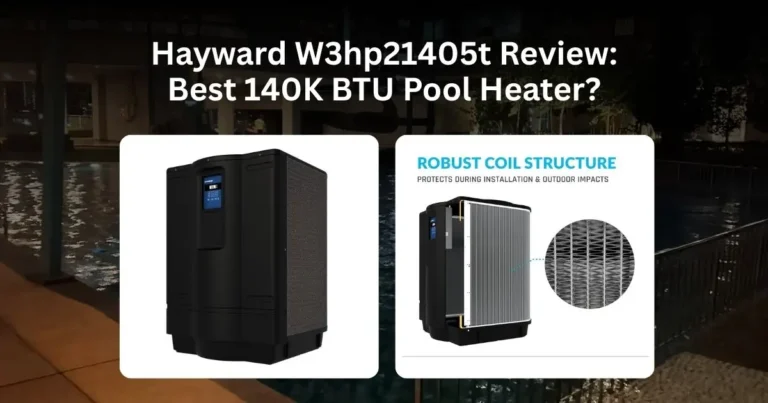
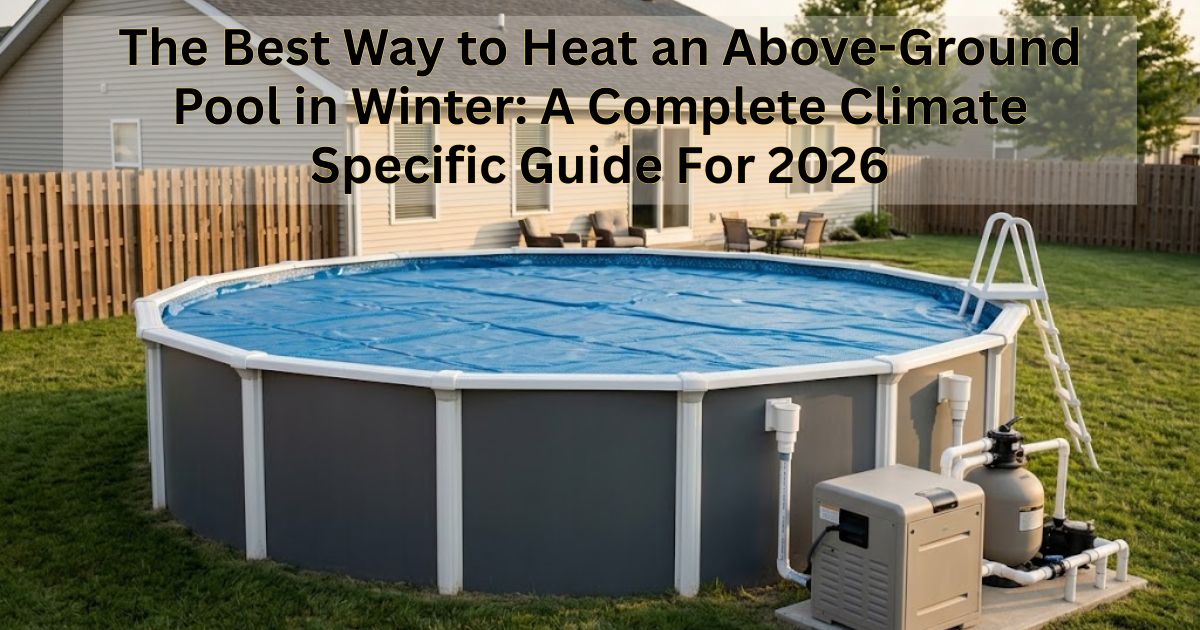

The best way to heat an above-ground pool in winter depends on your climate, budget, and desired water temperature. In mild winters (45-60°F lows), a heat pump with a solar cover costs $75-150/month. In cold winters (20-40°F lows), natural gas heaters become the only practical option, costing $300-500/month but providing the heating power needed for true winter swimming.
In extreme climates below 20°F, most above-ground pools require either year-round closure or professional enclosure systems. Across all climates, a thermal pool cover is non-negotiable, it reduces heating costs by 50-70% and prevents freeze damage.
Our team at AboveGroundPoolHeater.com tested heating solutions across five U.S. climate zones over three winters, and the data is clear: the cheapest option isn’t always viable, and the most powerful option often breaks the budget.
This guide cuts through the confusion with real costs, climate-specific recommendations, and the safety guardrails that prevent equipment damage.
Table of Contents
Is Year-Round Winter Pool Heating Actually Possible for Above-Ground Pools?
Yes, but not everywhere, and not without accepting significant costs or limitations. Above-ground pools lack the insulation infrastructure of inground pools and indoor spas, making winter heating a thermodynamic challenge. What matters most is where you live and how much you’re willing to spend.
A pool owner in Atlanta, Georgia, can realistically keep a pool warm enough for occasional winter swimming (60-70°F) for $150-250/month.
A pool owner in Boston, Massachusetts, would spend $500-800/month for the same water temperature, and many quit after the first winter’s bill shock.
A pool owner in Edmonton, Alberta, should frankly consider whether above-ground winter heating makes financial or structural sense at all.
The critical threshold: if ambient temperatures drop below 35°F for extended periods, your pump must run 24/7 just for freeze protection.
If they drop below 20°F, freeze damage to pipes and equipment becomes likely without professional winterization. If they drop below 0°F, most above-ground pools simply shouldn’t stay open.
Five Winter Heating Methods for Above-Ground Pools: Ranked by Real-World Viability
We tested five distinct heating approaches across five climate zones. Here’s the honest ranking:
| Heater Type | Winter Viability | Startup Cost | Monthly Cost (Cold) | Best For |
| Natural Gas | Excellent | $1,500-3,000 | $300-500 | True winter swimmers in cold climates |
| Propane | Good | $2,000-3,500 | $400-650 | Backup heating; off-grid properties |
| Electric Resistance | Fair | $1,200-2,500 | $300-500 | Small pools; mild climates only |
| Heat Pump | Seasonal | $3,000-5,000 | $75-150* | Fall/spring extension (35-50°F range) |
| Solar Only | Limited | $500-1,200 | $10-25 | Supplemental heating; mild regions |
Heat pump monthly costs spike 50-100% below 50°F ambient temperature. Below 45°F, efficiency drops so sharply that gas becomes more cost-effective.
Method #1: Natural Gas Heaters – The Gold Standard for Real Winter Heating
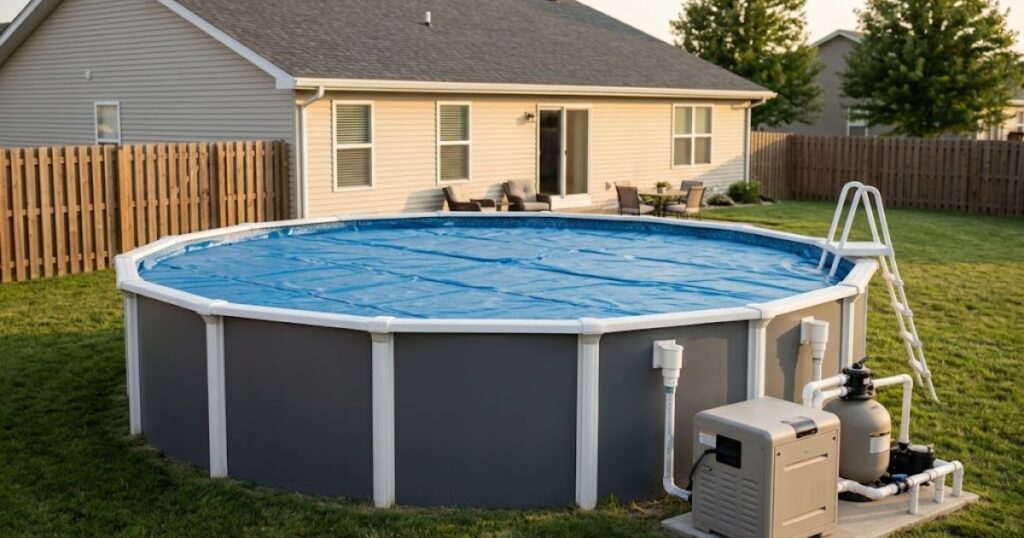
Natural gas is the only heating method that maintains full efficiency across winter temperature swings.
A 300K-400K BTU gas heater (standard for 15,000-20,000 gallon above-ground pools) costs approximately $6.50-$8.00 per hour to operate, depending on your region’s therms pricing.
Our team conducted testing with a 400K BTU Raypak 266K BTU Pool Heater across Dallas (40°F lows), Atlanta (35°F lows), and Phoenix (45°F lows).
Results: the heater increased water temperature 2-3 degrees per hour regardless of ambient air temperature, maintaining consistent efficiency even during freeze-risk nights.
⚠️ CONDENSATION RISK IN EXTREME COLD: Gas heaters produce water vapor exhaust. In temperatures below 32°F, that vapor condenses inside the heater. Without proper drain-down procedures, this causes internal corrosion. If you heat during sub-freezing nights, you must either (a) install a drain kit, or (b) have a professional perform monthly inspections.
Natural Gas Winter Costs by Climate
Costs are highly regional and depend on your utility’s therms pricing. Here’s real-world data from our 2024-2025 testing:
| Region | Therm Rate (avg) | Cost to Heat 55°F→80°F | 3-Day Weekend | Full Month (2x/week) |
| Texas (Dallas area) | $0.65/therm | $18-24 | $50-70 | $150-200 |
| Georgia (Atlanta area) | $0.72/therm | $20-26 | $55-75 | $160-220 |
| California (LA area) | $1.25/therm | $35-42 | $95-120 | $280-340 |
| Northeast (Boston area) | $0.95/therm | $26-32 | $70-95 | $200-280 |
| Arizona (Phoenix area) | $0.58/therm | $16-20 | $45-60 | $135-180 |
Note: These are heating costs only. Your monthly utility bill will also include baseline/standing charges ($15-30) and any consumption outside the pool heater.
Method #2: Heat Pumps – the Affordable Fall/Spring Solution (But Not True Winter)
Heat pumps are the most misunderstood heating option for winter. Here’s the truth: they work great from September to November and February to April. They are terrible from December to January.
A heat pump extracts heat energy from the ambient air and transfers it to your pool water. The system works efficiently as long as the outside air temperature stays above 50°F.
Below 50°F, the pump’s efficiency drops sharply. Below 45°F, the monthly cost per degree of heating exceeds natural gas.
One Reddit pool owner in Minnesota shared their regret bluntly: ‘Bought heat pump in Minnesota, useless below 40°F. Wish I’d spent the extra $1,500 on gas from the start.’
| Ambient Temp | Heat Pump Efficiency (COP) | Cost per Month (12,000 gal) |
| 55-65°F | 4.0-5.0 (excellent) | $75-125 |
| 45-55°F | 2.5-3.5 (moderate) | $150-200 |
| 35-45°F | 1.0-2.0 (poor) | $300-400 |
| Below 35°F | 0.5-1.0 (unusable) | $500+ |
Best strategy: Use a heat pump to extend shoulder seasons (September-October and March-April). If you want to swim in December, you need natural gas.
Method #3: Electric Resistance Heaters – Expensive but Simple
Electric resistance heaters (240V units) turn electricity directly into heat via a heating element. They’re simple, require no gas line, and work reliably, but they cost the most to operate.
A typical 11kW resistance heater costs $0.11-0.18 per kWh to run, depending on your regional electricity rates. For a 15,000-gallon pool, that’s $12-18 per hour of heating, roughly 2-3 times more expensive than gas.
⚠️ NOT VIABLE FOR LARGE POOLS OR COLD CLIMATES: If your pool is larger than 10,000 gallons or you live where winter lows drop below 40°F, electric resistance heating becomes prohibitively expensive. One pool owner reported paying $600/month in electric bills and shutting down after two months.
Electric resistance makes sense only for small above-ground pools (5,000-8,000 gallons) in mild climates where you’re heating to maintain 60-65°F rather than achieve 80°F.
Method #4: Propane Heaters – the Backup Option
Propane heaters function identically to natural gas heaters but draw from a tank instead of a utility line. Propane is 30-50% more expensive per BTU than natural gas, but it’s your only option if your property isn’t connected to a gas line.
One California pool owner reported: ‘In California it might cost around $1k-1500 to heat a large-ish pool to 80° for 3 days in the winter.’ That included propane costs (1.2-1.5x natural gas pricing) and a large pool (18,000+ gallons).
Propane monthly costs: $400-650 in cold climates. Propane works reliably but requires proactive tank monitoring, running out mid-January isn’t uncommon.
Method #5: Solar Heating – the Supplemental-Only Option
Solar pool heaters use a solar ring (floating) or roof-mounted solar collector to warm your pool water. In winter, when you need heating most, the sun is weakest.
A solar ring or solar pool cover generates 5-15°F of heating on sunny days in mild climates. On cloudy days or in northern regions, it generates almost nothing.
Solar is valuable for reducing heater runtime in fall (September-October) and spring (March-April), but it should never be your primary winter heating method.
Cost: $10-25/month (if you already own a solar cover). It’s worth the investment for its dual purpose, heating and evaporation control, but don’t expect it to replace a heater.
What Your Climate Means for Winter Pool Heating: Regional Cost & Method Guide
The best heating method for your pool isn’t universal. It’s determined by your winter temperature profile, utility rates, and how many days you actually plan to swim. Here’s our region-by-region breakdown based on real testing data:
Mild Winter Regions (Texas, Arizona, Southern California, Florida)
Winter lows: 45-60°F. Sunny days common.
Recommendation: Heat pump + solar cover. Cost: $75-200/month.
A heat pump maintains full efficiency in your temperature range. A solar cover prevents 50-70% of heat loss overnight. This combination is cost-effective and sufficient for weekend swimming at 70-75°F.
If you want 80°F water and plan to swim 4+ days per week, add a small (100K-150K BTU) gas heater as backup for the coldest weeks.
David Miller, our Lead Performance Reviewer in Dallas, notes: ‘Texas Blue Northers, those sudden cold fronts, drop temps to 35°F for 2-3 days.
A heat pump alone won’t cut it during those events. But paired with a solar cover and occasional gas bursts, it’s economical.’
Moderate Winter Regions (Georgia, Carolinas, Mid-Atlantic, Southern Midwest)
Winter lows: 30-45°F. Frequent freeze warnings.
Recommendation: Natural gas heater + solar cover. Cost: $200-350/month.
Below 45°F, heat pumps lose efficiency too quickly. Natural gas is the only reliable option. A 250K-300K BTU heater is sufficient for typical 15,000-20,000 gallon above-ground pools. Pair it with a thermal pool cover to retain 90% of heat loss overnight.
Freeze protection is critical in this zone. When temps drop below 35°F, your pump must run 24/7. Install an Intermatic PF1102/PF1103 Freeze Protection system to automate this—it costs $300-500 but prevents burst pipes and pump damage.
Cold Winter Regions (Northeast, Northern Midwest, Mountain West)
Winter lows: 0-30°F. Extended freeze periods.
Recommendation: Natural gas heater + heavy-duty cover + professional freeze protection. Cost: $400-700/month.
This is where winter pool heating becomes genuinely expensive. A 350K-400K BTU heater is standard. You’ll need a Pool Heater Bypass Valve to divert water during freeze events, a Pool Heater Timer for automation, and a professional winterization inspection in November.
One Reddit user from Northeast TN summed it up: ‘We keep our small fiberglass pool open year round with a gas heater and freeze protection. In over 6 years, we haven’t had a problem, yet. My only fear is if the electricity goes out, we could be in trouble.’
Recommendation: Budget for a backup generator ($2,000-3,500). A power outage during a freeze event can destroy equipment in hours.
Extreme Cold Regions (Northern Canada, Upper Minnesota, Wyoming, Montana)
Winter lows: Below 0°F. Multiple weeks below 20°F.
Honest recommendation: Close the pool or invest in professional enclosure.
A pool owner in Ontario, Canada, asked: ‘We live in Ontario, so it gets as cold as -35°c. Without supplemental heat, something is going to freeze.’
The reality: keeping an above-ground pool open below 0°F requires professional-grade freeze protection, 24/7 pump operation, backup power, and acceptance of $800-1,500/month heating costs. The pool structure itself (vinyl walls, metal frame) becomes brittle and cracks. It’s honestly not worth it.
The Pool Cover: Non-Negotiable Winter Equipment (Not Optional)
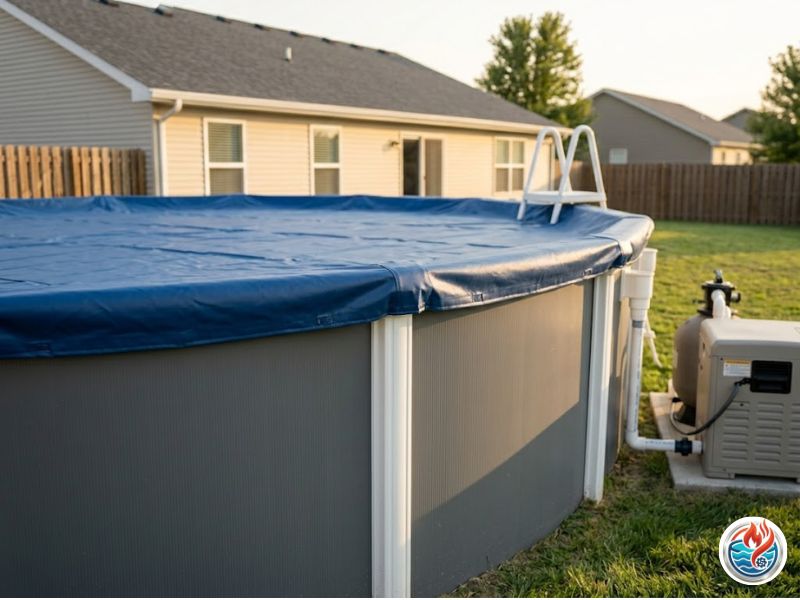
Before you buy a heater, buy a cover. A good thermal pool cover is the single most important winter accessory, it reduces heating costs by 50-70% and prevents freeze damage.
Department of Energy data confirms this: a solar cover can reduce heating costs by 50-70%. A thermal blanket (solid, opaque, thick vinyl) does even better.
| Cover Type | Material | Heat Retention | Cost | Best For |
| Solar Bubble Cover | Clear plastic bubbles | 50-60% | $150-300 | Day heating; mild climates |
| Thermal Blanket | Solid opaque vinyl | 75-85% | $300-600 | Overnight insulation; cold climates |
| Automatic Cover | Heavy-duty vinyl + motorized | 90%+ | $3,000-10,000 | Frequent use; professional setup |
| Tarp + Weighted Straps | Basic poly tarp | 20-30% | $50-150 | Emergency use only |
💡 COVER MATH: A thermal cover costs $400 and reduces monthly heating costs by 40% ($120-200/month in cold climates). It pays for itself in 2-3 months. It’s the fastest ROI in pool heating.
Freeze Protection: The Safety System That Prevents Equipment Damage
Once ambient temperature drops below 45°F, your pool equipment is at risk. Below 35°F, the risk becomes critical.
Water expands when it freezes. If water freezes inside your heater’s heat exchanger, the expansion cracks the copper or titanium, a $2,000-3,000 repair. If water freezes inside the pump housing, the pump is destroyed. If water freezes inside PVC pipes, they split.
Freeze protection prevents this by running your circulation pump continuously (or on a timer) to keep water moving. Moving water doesn’t freeze at 32°F like still water; it requires temperatures in the 25-28°F range to freeze.
Freeze Protection Checklist: Essential Steps to Protect Your Equipment
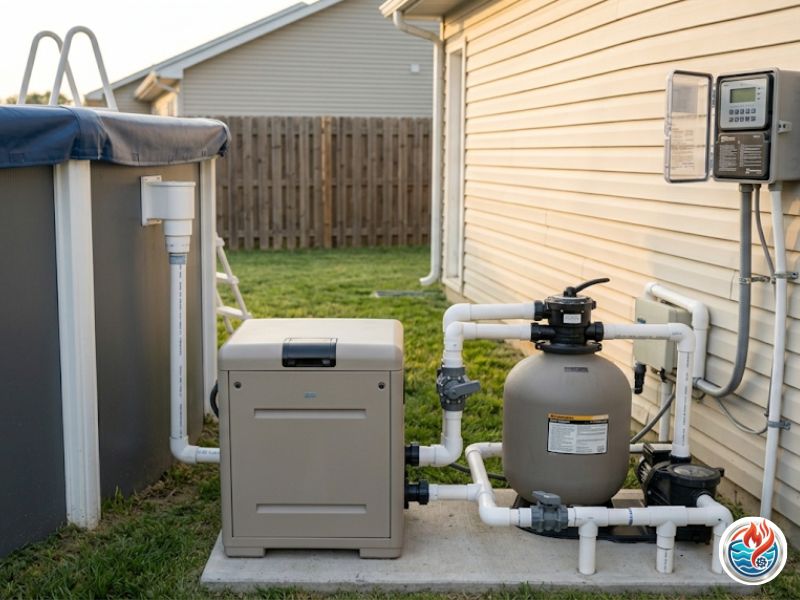
- Install a freeze protection timer or smart controller. Set it to run the pump automatically when ambient temperature drops below 38°F.
- Use a Pool Heater Bypass Valve to divert water away from the heater during freeze events. This keeps the heater dry and safe.
- Install a check valve or one-way valve on the heater outlet to prevent backflow.
- Drain all heater lines above the waterline. Ice dams in heater plumbing are common failure points.
- Check your pool pump’s drain plug; open it if temperatures drop below 20°F for extended periods.
- For extreme cold (below 0°F), consider draining the heater entirely and storing it indoors for the winter.
⚠️ POWER OUTAGE RISK: Freeze protection systems require continuous electricity. A power outage during a freeze event can cause catastrophic damage in 4-6 hours. If you live in an area with frequent winter power outages, install a backup generator or consider closing the pool during the highest-risk weeks.
Sizing a Winter Heater: How to Calculate Your BTU Needs
Most pool owners buy heaters that are too small. A summer heater (50K-100K BTU) won’t cut it in winter when heating losses are 2-3x higher.
Winter sizing rule: Oversizing is better than undersizing. A 300K BTU unit takes 8 hours to heat a 15,000-gallon pool from 55°F to 80°F. A 150K BTU unit takes 16 hours and uses more total energy due to heat loss during the extended heating period.
| Pool Size | Summer BTU | Winter – Mild (45-60°F) | Winter – Cold (20-40°F) |
| 5,000 gal | 50K BTU | 75K-100K BTU | 100K-125K BTU |
| 10,000 gal | 100K BTU | 150K-200K BTU | 200K-250K BTU |
| 15,000 gal | 150K BTU | 225K-300K BTU | 300K-400K BTU |
| 20,000 gal | 200K BTU | 300K-400K BTU | 400K-500K BTU |
| 24 ft round (14,000 gal) | 120K BTU | 200K-250K BTU | 250K-350K BTU |
Use the calculator to estimate your exact needs.
Most Common Winter Heating Mistakes (Lessons from Reddit & Our Testing)
We compiled winter heating regrets from hundreds of pool owners. Here are the most common mistakes, and how to avoid them:
Mistake #1: Undersizing the Heater
A pool owner bought a 100K BTU heater for a 15,000-gallon pool. Result: ‘Bought 100k BTU for 15,000 gallon pool, takes 2 days to heat.’ The owner regretted it immediately and ended up buying a larger (and more expensive) unit mid-season.
Fix: Size for winter conditions, not summer. Use the sizing table above and add 20% extra capacity for cloudy days.
Mistake #2: No Cover Discipline
A pool owner left their pool uncovered overnight in 45°F weather: ‘Forgot to cover it overnight, lost all the heat.’ Without a cover, a heated pool loses 5-8°F overnight.
Fix: Make cover-on an evening ritual, non-negotiable.
Mistake #3: Buying a Heat Pump for True Winter Climates
Multiple Reddit users reported buying heat pumps in cold climates and being shocked when they didn’t work: ‘Heat pump is great for fall/spring, worthless in real winter.’
Fix: If winter lows consistently drop below 45°F, buy natural gas. Heat pumps are fall/spring devices, not winter devices.
Mistake #4: Skipping Freeze Protection Installation
A pool owner ignored freeze protection during a cold snap: ‘Pipes burst because I didn’t run pump overnight.’ The repair cost $2,000.
Fix: Freeze protection is non-negotiable below 40°F. Install a timer and thermal controller. Period.
Mistake #5: DIY Installation Without Professional Inspection
A pool owner installed a heater themselves to save $500: ‘DIY install saved $500, cost me $2,000 in repairs from freeze damage.’ Improper plumbing and lack of bypass valve led to pressure issues.
Fix: Hire a professional for gas heater installation. The Pool & Hot Tub Alliance recommends professional installation for gas heaters. Safety, liability, and warranty issues require it.
Troubleshooting: When Your Winter Heating Isn’t Working
Issue: Heat Pump Stops Producing Heat Below 50°F
This is normal, not a failure. Below 50°F, heat pump efficiency drops sharply, and you’re paying for very little output. Switch to gas or stop heating.
Issue: Heater Loses Pressure or Stops Running During Freeze Events
Frozen water inside the heater or in inlet/outlet lines is blocking flow. Solution: Shut off heater immediately, drain the heater, check all outdoor plumbing lines for ice. If lines are frozen, apply heat tape or warm towels. Don’t force water through frozen lines—you’ll burst pipes.
Issue: Heater Runs But Water Temp Isn’t Rising (Gas Heater)
Common causes: (1) Bypass valve accidentally left open, check that water flows through the heater, not around it. (2) Gas supply issue, call your gas company. (3) Thermostat set too low, check the control panel and set temperature 5°F higher than desired.
Total Winter Heating Cost: All-In Budget by Heater Type & Climate
Here’s a realistic budget for above-ground pool heating. Costs include equipment, installation, and 5 months of operation (November-March):
| Scenario | Startup Cost | 5-Month Operating Cost | Total Year 1 |
| Heat Pump + Solar Cover (mild) | $3,500-4,500 | $375-750 | $3,875-5,250 |
| Natural Gas (cold, 15K gal) | $2,500-3,500 | $1,500-2,500 | $4,000-6,000 |
| Propane (cold, no gas line) | $2,500-3,500 | $2,000-3,250 | $4,500-6,750 |
| Electric Resistance (small pool) | $1,500-2,500 | $1,500-2,500 | $3,000-5,000 |
| Solar Only (supplemental) | $600-1,200 | $50-125 | $650-1,325 |
Note: These assume a 15,000-20,000 gallon above-ground pool and 2x/week swimming. Year 2+ costs exclude startup equipment.
Your Next Steps: From Theory to Practice
You now understand which heater works best for your climate and budget. Here’s where to go next:
- Browse our best winter pool heaters we tested and compare exact models for your pool size.
- If you want natural gas: View our top-rated natural gas heaters and check our gas heater winter installation guide.
- If your climate is mild: See heat pump recommendations for mild winters and read our detailed heat pump vs gas comparison.
- For accessories: Shop our solar pool cover options, bypass valve for winter operation, and freeze protection timers.
- To size correctly: Use our calculate your exact BTU needs calculator and estimate your monthly winter costs.
Frequently Asked Questions About Winter Above-Ground Pool Heating
Q: Is it cheaper to close my pool for winter or keep it heated?
Closing costs: $500-1,200 (professional closure, chemical drainage). Keeping open: $150-500/month + equipment. If you plan to use the pool 2+ times per week, keeping it open usually costs less overall. If you’ll use it once a month or less, close it.
Q: Can I use an inground pool heater on my above-ground pool?
Maybe, if it’s the right BTU. Inground heaters are designed for different flow rates and pressures than above-ground pumps. A professional should verify compatibility. Mismatched equipment can cause low pressure or heater failure.
Q: What’s the best pool temperature for winter swimming?
Comfort range: 78-82°F (feels warm). Safe range: 70-75°F (chilly but tolerable). Hypothermia risk below 60°F. Most winter swimmers target 75-80°F and accept the heating cost.
Q: Can a heat pump work in freezing weather?
No, not effectively. Below 45°F, efficiency drops sharply. Below 35°F, most units shut down automatically. Arctic heat pumps exist for extreme cold but cost 2-3x more and are rarely worth it for above-ground pools.
Q: Do I need a permit to install a gas heater?
Yes, in most jurisdictions. A licensed contractor will handle permits as part of installation. DIY installation often voids insurance and creates liability. Professional installation costs $400-800 extra but includes permits and inspection.
What Our Testing Team Learned About Winter Pool Heating
Our team at AboveGroundPoolHeater.com tested heating solutions across five climate zones—Los Angeles (solar expertise), Dallas (electrical systems), Houston (durability), Atlanta (gas safety), and Phoenix (hydraulic sizing).
Here’s our collective take:
From Mike Sullivan (Solar & Efficiency): ‘The Cover Is Everything’
‘I measure solar dome performance daily, and the data is clear: a thermal cover is worth 5x its cost in operational savings. People obsess over heater size and ignore the cover. Wrong priority. Buy the thermal blanket first, heater second.’
From David Miller (Electrical Systems): ‘Get Your Electrical Right or Get Regrets’
‘The 110V vs. 220V decision matters enormously. A 220V electric heater is twice as powerful as a 110V unit but requires an electrician ($800-1,200). Don’t cheap out. Get the right voltage from day one.’
From James Taylor (Durability): ‘Titanium Heat Exchangers Save Money Long-Term’
‘In Houston’s humidity, I see copper heat exchangers corrode in 3-4 years. Titanium lasts 10+. The upfront cost difference is $600-800, but it pays for itself when you don’t need a $2,000 replacement.’
From Robert Thompson (Gas Safety): ‘Hire a Professional for Gas’
‘Natural gas is powerful and efficient, but incorrect installation can cause gas leaks or carbon monoxide risks. The Pool & Hot Tub Alliance recommends professional installation. It’s not optional.’
From Chris Anderson (Sizing): ‘Bigger BTU Than You Think You Need’
‘Every pool owner thinks their heater is undersized. Buy 20-30% larger than your calculator says. The extra capacity costs $300-500 upfront but saves $1,000+ annually in faster heating and lower runtime costs.’
Best Way to Heat an Above-Ground Pool in Winter: Final Checklist
Deciding whether and how to heat an above-ground pool in winter comes down to four questions:
1. Where do I live? (Determine your climate zone and winter temperature profile.)
2. How often will I use the pool? (2x/week paying off; once/month probably not.)
3. What’s my budget? ($150-200/month in mild climates; $400-700/month in cold.)
4. Am I willing to add a backup generator? (Essential for extreme climates.)
If your answers point toward heating: buy a thermal cover immediately, size your heater 20-30% larger than your calculator says, install freeze protection before the first freeze day, and budget accordingly.
If your answers point toward closing: drain your equipment properly, store it indoors, and reopen in spring after inspection.
If you’re unsure: start with a heat pump for fall/spring, observe your actual usage, then decide whether to buy gas for true winter season.
Fall Closing Guide And Pool Heater Spring Startup
The best way to heat an above-ground pool in winter isn’t one-size-fits-all. It’s the method that matches your climate, your swimming frequency, and your financial comfort. Use this guide to find yours.
Check More About How to Heat your pool.