
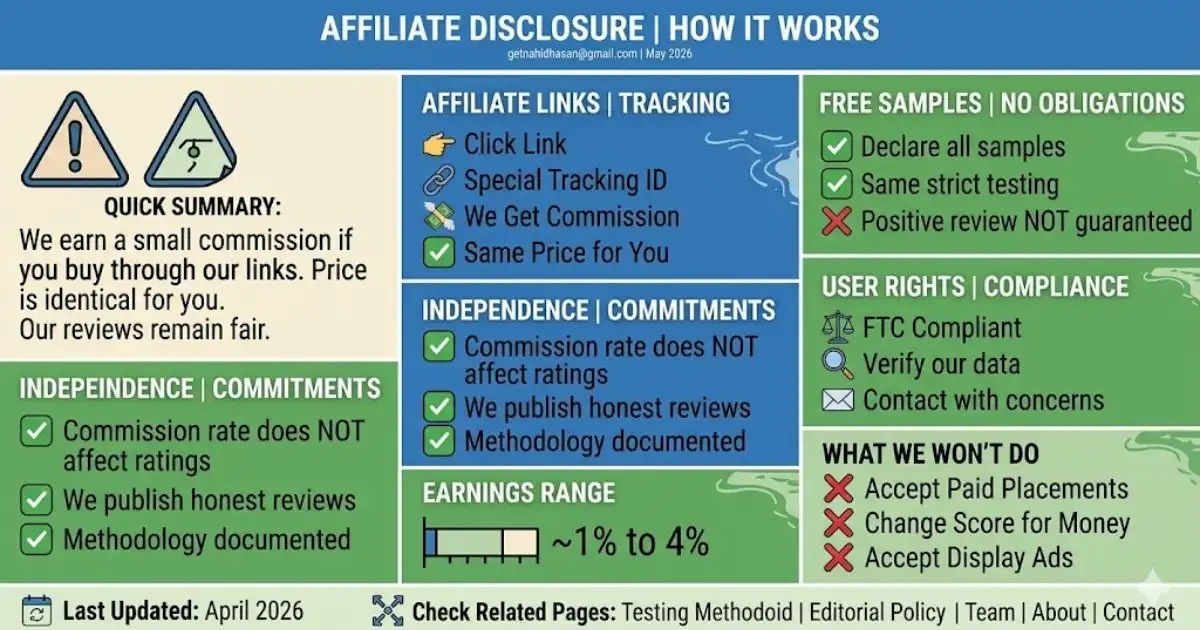

TL;DR: We earn Amazon affiliate commissions when you buy through our links. Commission rates range from 1% to 4%. Your price is the same either way. Commission rate has zero influence on our rankings. No brand has paid to appear on this site.
⚠ Affiliate Disclosure: This site participates in the Amazon Associates Program. We earn a small commission if you purchase through our links, at no extra cost to you. No brand has paid to appear in our content. Rankings are based solely on independent testing data.
Table of Contents
What Is an Affiliate Link?
What Exactly Happens When You Click a Link on This Site?
| When you click a product link on AboveGroundPoolHeater.com and make a purchase on Amazon within 24 hours, we receive a commission between 1% and 4% of the sale price. You pay the same price you would pay going directly to Amazon. We receive nothing if you do not purchase. |
Here is the complete step-by-step of what happens when you click one of our links:
- You click a product link on AboveGroundPoolHeater.com. The link contains a tracking ID (our Amazon Associates tag) that identifies this site as the source of the referral.
- You land on Amazon’s product page. The price you see is identical to the price you would see if you navigated to Amazon directly. Our affiliate relationship does not add any cost to your purchase.
- If you purchase within 24 hours, Amazon credits us with a commission ranging from 1% to 4%, depending on the product category. If you close the browser, the tracking cookie expires, and we receive nothing.
- If you do not purchase, we receive nothing. There is no click fee. There is no impression fee. There is no data fee. We earn only when you buy.
Amazon Associates is the largest affiliate program in the world. Millions of websites use it. The mechanics are identical across all participating sites. The difference between sites is what they do, or do not do, about the influence that commission structure creates on their recommendations. We address that directly in Section 2.
The Conflict of Interest – And How We Handle It
Does Earning Commissions Influence Which Products We Recommend?
| No. Commission rate is not a scoring input in our Warm Water Data Lab testing process. We have recommended products that pay us 1% over products that pay 4% when the lower-commission product outperforms in our testing. We have published negative findings about products for which we earn commissions. Our scoring criteria are documented publicly on the Testing Methodology page. |
We understand that stating ‘we are unbiased’ is not enough. Any site can make that claim. What makes the claim verifiable is the transparency of the process behind it.
Here is how we make our independence checkable rather than just claimable:
The Five Commitments We Make to Independence
- Commission rate is not a variable in our scoring formula. Our review scores are a weighted composite of Heating Efficiency (30%), Durability (25%), Safety & Electrical (20%), Value/Cost-per-Degree (15%), and Installation (10%). None of these inputs is connected to what Amazon pays us.
- We publish negative findings even when we earn commissions on that product. If a product fails our durability inspection, the failure is documented in the review regardless of whether we have an affiliate link to that product.
- We do not accept payment from brands to appear in our content. No brand has paid to be featured, ranked, or mentioned on this site. There are no ‘featured placement’ positions available for purchase.
- We do not change published review scores based on brand feedback. If a brand contacts us about a negative finding, we re-verify the data. If the data support the finding, the score does not change.
- Our testing methodology is fully documented. Every scoring criterion, every test protocol, and every threshold is published at abovegroundpoolheater.com/about/testing-methodology. If our recommendation contradicts our methodology, that contradiction is visible.
Why We Still Recommend Products Despite Earning Commissions
The affiliate model is how this site funds the real-world, multi-climate testing that makes our recommendations credible. Without revenue, we cannot pay five specialists across four U.S. states to test heaters for 2 to 6 months.
The commission model only works long-term if readers trust the recommendations enough to act on them, which means the recommendations have to be accurate. Our financial incentive is aligned with accuracy, not with pushing the highest-commission product.
Commission Rate Transparency | Affiliate Disclosure
What Commission Rates Do We Earn on Different Product Types?
| Amazon Associates commissions for pool and home improvement products typically range from 1% to 4%. We publish these ranges because most affiliate sites do not. You can verify Amazon’s current category commission rates directly at affiliate-program.amazon.com. |
| Product Category | Typical Commission Range | Notes |
| Pool Heaters (heat pumps, gas, electric) | 1% – 3% | Varies by category and season |
| Pool Accessories (covers, fittings, timers) | 2% – 4% | Home improvement category |
| Maintenance Tools (multimeters, test kits) | 2% – 4% | Tools & Home Improvement |
| Solar Products (solar covers, rings, mats) | 2% – 4% | Home & Garden category |
One practical implication of this structure: electric resistance heaters, the lowest-performing heater type for most U.S. pool owners, often have similar or higher commission rates than heat pumps. If our rankings were commission-driven, we would push electric resistance heaters more aggressively.
We do not. For most pools over 5,000 gallons, we recommend against electric resistance heaters regardless of commission rate, because they consistently fail our Heating Efficiency scoring criteria.
Free Product Policy
What Happens When a Brand Sends Us a Free Product?
| Occasionally, brands send us product samples for testing consideration. When this occurs, we declare it in the review header. The same 5-stage Warm Water Data Lab testing process applies regardless of how the product was acquired. A free product that fails our durability or safety criteria receives the same failing score as a product we purchased ourselves. |
This is how we handle free product samples:
- Every review header clearly states ‘Free Sample Received’ when applicable.
- Receiving a free product does not obligate us to publish a positive review or any review at all.
- The same scoring criteria, testing protocol, and publication standards apply to all products.
- If a brand conditions a free product on a guaranteed positive review, we decline. That has happened. We have declined.
What We Will Never Do
What Are the Hard Lines We Do Not Cross?
| Eight practices are permanently off the table, regardless of the financial incentive involved. We document them here because you should be able to hold us accountable to them. |
- Accept payment from any brand to appear in a recommendation, guide, or review.
- Offer ‘featured placement’ positions in buying guides, at any price.
- Change a published review score in response to a brand complaint or inquiry.
- Use commission rate, product price, or brand reputation as scoring inputs.
- Publish reviews written by brand representatives without full disclosure and independent verification.
- Remove a negative finding from a review after receiving a brand inquiry, unless the finding was factually wrong.
- Write a positive conclusion about a product that failed any stage of our testing protocol.
- Run display advertising or any other form of advertising that would create pressure to favor certain brands.
Third-Party Links
Do All Links on This Site Earn Us a Commission?
| No. We link to non-affiliate sources, government data, manufacturer documentation, independent research, and comparison resources, throughout our content. These links are editorial references, not monetized links. We identify the source type (Amazon, third-party, government data) in the context of each link. |
Examples of non-affiliate links we use regularly:
- U.S. Department of Energy pool heater efficiency standards and test procedure documentation
- California Energy Commission appliance database (for COP verification)
- EPA WaterSense pool efficiency guidelines (cited in our solar cover testing methodology)
- AHRI pool heater performance certification database
- Manufacturer installation documentation when referencing installation requirements
Your Rights as a Reader
What Can You Do If You Think We Have Violated This Disclosure?
| Contact us directly at abovegroundpoolheater.com/contact with the subject line ‘Disclosure Concern.’ We respond to all substantive inquiries within 2 business days. If you believe a specific recommendation is influenced by financial considerations, point us to the recommendation and explain your concern. We will review it and respond with our testing data. |
You also have the right to verify our independence claims independently.
Here is how:
- Compare our rankings against Amazon commission tiers. Amazon’s Associate Program commission rates are publicly available. If our top-ranked products consistently correspond to the highest-commission tier, that would be evidence of bias. It does not.
- Check our Testing Methodology page. Every scoring criterion and test threshold is published. If a recommendation cannot be justified by our stated methodology, that disconnect is visible at abovegroundpoolheater.com/about/testing-methodology.
- Read our negative findings. Every product review on this site that received a score below 3.0 stars has a documented failure against at least one testing criterion. If we were purely commission-driven, those reviews would not exist.
Legal Compliance
What Federal Regulations Does This Disclosure Comply With?
This affiliate disclosure is made in compliance with the Federal Trade Commission’s Guides Concerning the Use of Endorsements and Testimonials in Advertising (16 C.F.R. Part 255), which requires clear and conspicuous disclosure of any material connection between a content publisher and a product seller when that connection could affect the weight or credibility a reader gives to a recommendation.
The FTC requires that disclosures be:
- clear,
- conspicuous,
- placed near the recommendation they relate to.
- written in plain language that readers can understand without legal expertise.
To meet these requirements, we place affiliate disclosures: on this dedicated disclosure page, in the header or footer of every page containing affiliate links, and in the opening of every buying guide and product review. We do not place disclosures only in privacy policies or terms of service pages where readers are unlikely to see them.
| Last Reviewed This Affiliate Disclosure was last reviewed and updated: April 2026. Material changes to our affiliate relationships, commission structure, or disclosure practices will be reflected with an updated date. If you have a question about our current practices, contact us. |
Related Pages on AboveGroundPoolHeater.com