
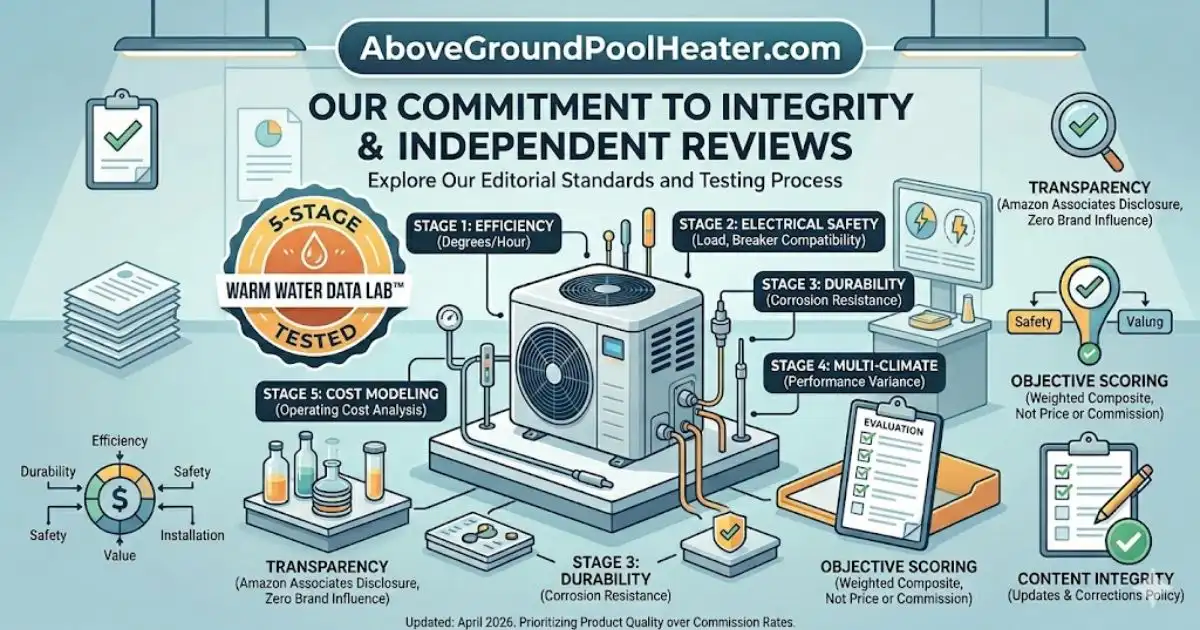

TL;DR: We make money through Amazon affiliate links. Commission rate has zero effect on our rankings. No brand has paid to appear on this site. Every review goes through a 5-stage independent testing process before we publish a single recommendation. Here’s the full breakdown.
Most “editorial policy“ pages are legal boilerplate. This one is a working document, specific rules, real examples of how we apply them, and the exact criteria we use to rank every heater we review.
- Last reviewed: April 2026
Table of Contents
How We Make Money
How Does AboveGroundPoolHeater.com Make Money?
We earn commissions through the Amazon Associates Program when readers purchase products through our affiliate links. Commission rates range from 1% to 4% depending on product category. These commissions fund our testing operations, team compensation, and site infrastructure, at zero additional cost to you.
Vague disclosures don’t help you evaluate whether to trust a site. Here’s exactly how our revenue model works:
| Revenue Source | How It Works | Influences Rankings? |
|---|---|---|
| Amazon Associates | We earn 1–4% commission when you click our link and purchase within 24 hours | No |
| Brand sponsorships | We do not accept these | N/A – not accepted |
| Paid product placement | We do not offer these | N/A – not offered |
| Display advertising | Not currently running on this site | No |
| Free product samples | Occasionally received; declared in review header when applicable | No – same testing criteria applied |
⚡ The Inconvenient Truth About Affiliate Sites
Most affiliate sites rank the highest-commission product first. We don’t, but we understand why you’d assume we do. The only thing that separates us from those sites is the transparency of our testing process and the consistency with which we publish negative findings. We recommend products that pay us less commission when those products outperform higher-commission alternatives. You can verify this by cross-referencing our rankings with Amazon commission tiers.
Independence Rules | Editorial Policy
What Are the Exact Rules That Keep Our Reviews Independent?
Seven non-negotiable rules govern every piece of content we publish. These are not guidelines, they are hard requirements. Any content that violates them does not get published on this site.
✅ What We Always Do
- Disclose affiliate relationships on every page that contains affiliate links
- Publish negative findings about a product even when that product is sold through our links
- Apply identical testing criteria to every heater regardless of brand, price, or commission rate
- Attribute every review to the specific team member who conducted the evaluation
- Update reviews when a product is discontinued, a new version is released, or our test data changes
- Declare in the review header if we received a free product sample from a brand
- Rank products by composite test score, not by price, commission rate, or Amazon popularity
✗ What We Never Do
- Accept payment from any brand to feature, rank, or mention their products
- Offer “featured placement” positions in buying guides for any amount
- Change a published review score based on brand feedback or complaints
- Remove a negative finding from a review after receiving a brand inquiry
- Write a positive conclusion about a product that failed any stage of our testing
- Use the commission rate as a factor in determining which products to include in a buying guide
- Publish reviews written by brand representatives without full disclosure
Real Example – Independence Policy Applied
In 2024, Jim Taylor’s internal inspection of a heat pump from a brand paying 4% Amazon commission found a titanium-coated copper heat exchanger misrepresented as solid titanium in the product listing.
We published the findings in full. The brand contacted us requesting we “reconsider the language.” We did not change the finding.
That heater now carries a “Not Recommended for Humid Climates” notice. It does not appear in our top picks for buyers in Houston, Atlanta, or coastal markets, despite its above-average commission rate.
The full criteria behind that finding are documented in our Testing Methodology page.
Testing Standards
What Testing Standards Apply to Every Product We Review?
Every heater reviewed on this site completes all 5 stages of the Warm Water Data Lab™ before we publish a recommendation. No stage can be skipped. A product that passes 4 stages but fails one does not receive an “Editor’s Choice” or “Best Buy” designation.
Here is what each stage evaluates, who conducts it, and what it measures:
| Testing Stage | Conducted By | What We Measure |
|---|---|---|
| Stage 1: Efficiency | Mike Sullivan – Los Angeles, CA | Actual degrees gained per hour vs. rated BTU output; real-world COP for heat pumps; solar panel output in measured sun hours |
| Stage 2: Electrical Safety | David Miller – Dallas, TX | Actual circuit load vs. rated draw; 110V/240V real-world performance gap; breaker compatibility; cold-weather output drop |
| Stage 3: Durability | Jim Taylor – Houston, TX | Heat exchanger material verification; casing corrosion resistance; O-ring and gasket quality; projected service life in 80%+ humidity |
| Stage 4: Multi-Climate | Full team – all 4 locations | Performance variance across dry heat, coastal, cold-front, and humid conditions; climate-specific failure modes |
| Stage 5: Cost Modeling | Rob Thompson – Atlanta, GA | Daily, monthly, and seasonal operating cost at current U.S. energy prices; propane vs. natural gas cost differential by region |
What About Products We Haven’t Physically Tested?
Some lower-cost accessories and niche heater models have not gone through all 5 physical stages. In those cases, we apply a secondary evaluation method:
- Input from at least one team member with direct category expertise
- Manufacturer specification verified against independent third-party test data
- Structured analysis of verified Amazon purchaser reviews, minimum 50 reviews, 6-month+ ownership period
- Cross-reference with published ENERGY STAR, AHRI, or relevant certification body data
✅ Content Labeling Standards
- “Tested” – product completed all 5 Warm Water Data Lab stages
- “Evaluated” – assessed via secondary method; specific criteria listed in review
- “Free Sample Received” – declared in review header when applicable
- “Not Recommended” – product failed one or more testing criteria
- “Updated [Date]” – review was materially revised after initial publication
Scoring Criteria
How Do We Calculate Our Review Scores?
Our final review score is a weighted composite of 5 criteria, each scored on a 10-point scale. Efficiency and durability are weighted most heavily because they have the greatest real-world impact. Commission rate and product price are not scoring inputs.
- 30% Heating Efficiency: Degrees/hour vs. rated BTU. Real-world COP for heat pumps.
- 25% Durability: Heat exchanger quality, casing materials, projected service life.
- 20% Safety & Electrical: Circuit compatibility, code compliance, cold-weather performance.
- 15% Value (Cost/Degree): Operating cost per degree of heating across the swim season.
- 10% Installation & Use: Setup complexity, plumbing compatibility, documentation quality.
What Does a Star Rating Mean on This Site?
- ★★★★★ 5.0 | Editor’s Choice – top 5% of tested products in category
- ★★★★★ 4.5 | Best Buy – strong across all 5 criteria, excellent value
- ★★★★☆ 4.0 | Recommended – performs well with minor trade-offs
- ★★★☆☆ 3.0–3.5 | Situational – good in specific contexts, not for general use
- ★★☆☆☆ 2.0–2.5 | Not Recommended – failed one or more critical criteria
- ★☆☆☆☆ 1.0–1.5 | Avoid – significant safety or durability issues identified
Content Updates
How Often Do We Update Our Reviews and Buying Guides?
We update content when a product is discontinued, when a new model version is released, when our test data changes, or when reader-reported field data contradicts our findings. Every material update is dated and logged. We do not silently revise reviews.
Pool heater models change faster than those in most other product categories. A manufacturer can update a heat exchanger material, change firmware, or discontinue a model without a public announcement. We monitor changes through four sources:
- Amazon product listing change monitoring, automated, weekly
- Reader-submitted field reports via our contact form
- Direct manufacturer communications when new model versions are released
- Annual full-cycle re-testing for top-ranked products in each category
Sample Update Log – How We Document Changes
| Apr 2026 | Updated heat pump COP ratings across /heat-pumps/ – new ambient temperature test data from Dallas cold front series. |
| Mar 2026 | Added “Not Recommended for Humid Climates” notice to 2 heat pump models following Jim Taylor’s internal inspection findings. |
| Feb 2026 | Revised Best 120V Heater guide – 2 products discontinued, 1 new model added, and tested by David Miller. |
| Jan 2026 | Revised Best 120V Heater guide – 2 products discontinued, 1 new model added, and tested by David Miller. |
Every page on this site displays a “Last Updated” date. Pages not updated in more than 12 months are flagged with an “Under Review” notice until content is verified current.
Corrections Policy
What Happens When We Get Something Wrong?
We correct factual errors within 48 hours of verification, document the correction at the bottom of the affected page, and notify the reader who reported it by email. We do not delete incorrect content; we correct it in place with a timestamped notation.
“The correction matters more than the original error. How a site handles being wrong tells you more about its credibility than how it handles being right.”
— Chris Anderson, Lead Editor
To report a factual error, use our contact form with the subject line “Correction Request” – include the URL of the affected page and the specific error. We respond to all correction requests within 2 business days.
✅ Our Corrections Commitment
- Factual errors corrected within 48 hours of verification
- Correction documented at the bottom of the affected page, original text, corrected text, and date
- The reader who reported the error was notified by email upon correction
- No silent revision, every change is logged
- Corrections are applied regardless of whether the error favors or disfavors a brand