
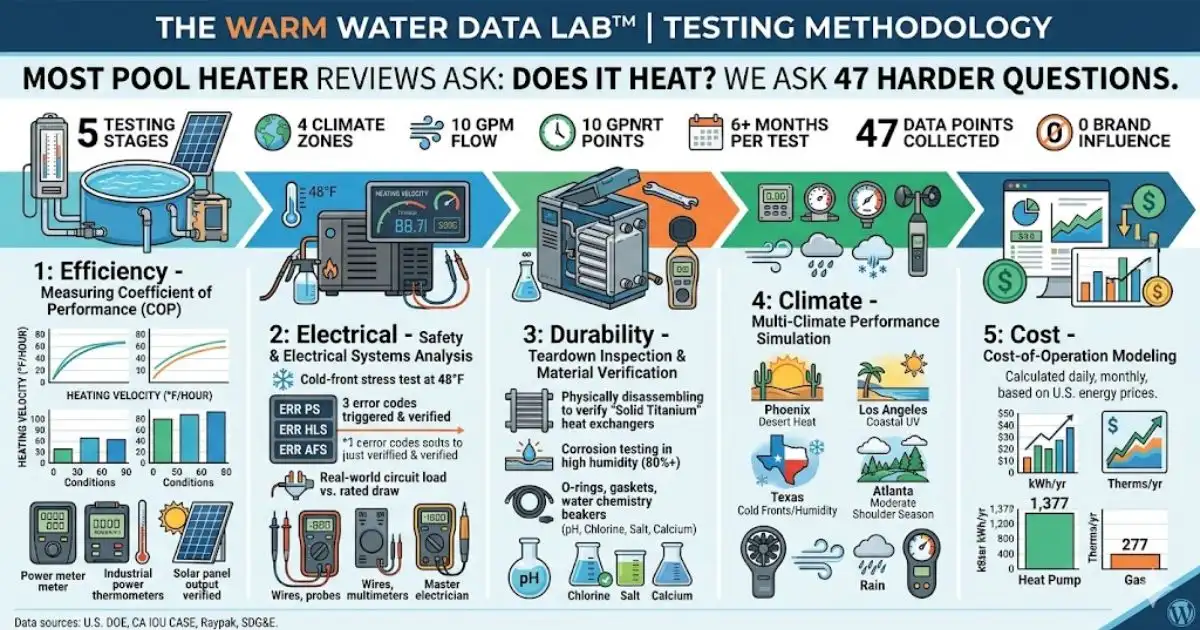

TL;DR: Every heater we recommend completes 5 stages across 4 U.S. climate zones: hydraulic TDH measurement at 10 flow rates, real-world COP testing at 2 temperature conditions, safety sensor calibration under intentional failure scenarios, physical teardown of internal components, and 6-month water chemistry resilience monitoring. Here’s exactly how it works.
This page documents the complete Warm Water Data Lab™ process, the criteria, the tools, the thresholds, and the findings that determine every recommendation on this site.
✓ Last reviewed: April 2026
By the numbers:
- 5 Testing Stages
- 4 Climate Zones
- 10 GPM Flow Points
- 6+ Months Per Test
- 47 Data Points Collected
- 0 Brand Influence
Table of Contents
Our Philosophy
Why Do Most Pool Heater Reviews Get It Wrong?
Most reviews measure whether a heater heats, not whether it heats efficiently, safely, durably, or appropriately for your specific pool and climate. A heater that works perfectly in Houston in July can be dangerously undersized for the same pool in Dallas in March. Our methodology is built around this gap.
The standard pool heater review process looks like this: unbox the unit, install it, run the pool for a few days, and check the temperature. If the pool is warm, it gets 5 stars. If it’s not, it gets 2 stars.
Neither rating tells you what went wrong, why it went wrong, or whether it would happen to you.
We approach it differently. A pool heater is a system with at least 6 interdependent performance variables: BTU output vs. pool volume, heat exchanger material vs. water chemistry, electrical draw vs. household circuit capacity, ambient temperature vs. COP efficiency curve, hydraulic resistance vs. pump energy cost, and casing material vs. local climate conditions.
⚡ Our Contrarian Position
Above-ground pools lose heat faster than in-ground pools because their walls are fully exposed to ambient air, not insulated by surrounding soil. A heater sized correctly for an in-ground pool is frequently undersized for the same volume in an above-ground installation. Our entire methodology accounts for this distinction. Most other review sites do not.
The result of treating these 6 variables as isolated is the most common pool heater complaint in every U.S. forum and review thread: “I bought a heater rated for my pool size, and it barely works.” It’s not a bad heater. It’s an incomplete evaluation.
Meet the Testing Team & Editorial Independence Policy
The Warm Water Data Lab™
What Are the 5 Stages Every Heater Must Complete?
Every heater we recommend completes all 5 stages of the Warm Water Data Lab™ before we publish a single recommendation. No stage can be skipped. A product that excels in 4 stages but fails one does not receive an Editor’s Choice or Best Buy designation.
01 Efficiency
COP & Heating Velocity Testing
Lead: Mike Sullivan – Los Angeles, CA
Real-world Coefficient of Performance measured at Standard (80/80/80) and Low Temperature (50/63/80) conditions. Degrees-per-hour heating velocity recorded on controlled test pools. Solar panel output verified for solar and hybrid systems.
COP 4.0 – 7.0 target range | 2+ climate conditions tested | Heat velocity: °F/hour recorded
02 Electrical
Safety & Electrical Systems Analysis
Lead: David Miller – Dallas, TX (Master Electrician)
Real-world circuit load vs. rated draw. 110V/120V vs. 220V/240V actual output gap under cold-front conditions. Safety logic tested under intentional flow reduction (ERR PS), high-limit scenarios (ERR HLS), and breaker compatibility verified.
- Cold-front stress test: 48°F ambient
- 3 error codes triggered & verified
- Circuit load: amps measured vs. rated
03 Durability
Teardown Inspection & Material Verification
Lead: Jim Taylor – Houston, TX (Former Industrial HVAC Tech)
Physical disassembly to verify heat exchanger material (solid titanium vs. titanium-coated copper). Casing corrosion resistance evaluation in 80%+ humidity. O-ring, gasket, and drain plug inspection. 6-month water chemistry exposure, including chlorine shock periods.
- Titanium vs. coated copper verified
- pH 7.4–7.6 chemistry monitoring
- 6-month salt/chlorine exposure
04 Climate
Multi-Climate Performance Simulation
Lead: Full Team – Phoenix, Los Angeles, Dallas, Houston, Atlanta
Same heater model tested across 4 climate zones: desert heat (Phoenix), coastal UV exposure (Los Angeles), cold fronts and humidity (Texas), and moderate shoulder seasons (Atlanta). The performance gap between climates is documented and disclosed in every review.
- 4 climate zones
- Wind, rain, and cold tested
- Climate-specific failure modes identified
05 Cost
Cost-of-Operation Modeling
Lead: Rob Thompson, Atlanta, GA (Certified Gas Fitter)
Daily, monthly, and seasonal operating cost calculated at current U.S. energy prices. Propane vs. natural gas cost differential modeled by region. Annual energy consumption benchmarked, heat pumps typically use approximately 1,377 kWh/year; gas heaters approximately 277 therms/year.
- Daily/monthly / seasonal cost
- Gas vs. propane differential
- 1,377 kWh/yr benchmark (heat pumps)
Data sources: COP ranges and UEC benchmarks derived from U.S. Department of Energy pool heater efficiency standards (EERE-2015-BT-STD-003), Raypak Inc. engineering submissions to DOE, California IOU CASE Report on Pool Heaters (July 2013), and San Diego Gas & Electric / Energy Solutions Heat Pump Pool Heater Cost Effectiveness Study (2019). Lifespan data: heat pumps 8–12 years, electric resistance heaters 4–6 years (Raypak DOE submission, Issue 22).
Efficiency Testing | Testing Methodology
How Do We Measure Real-World COP, Not Lab-Rated COP?
We calculate COP using industrial power meters for electrical input and dual-probe thermometers for heat output, tested in real backyard conditions, not climate-controlled labs. Wind, humidity, and ambient temperature all affect real-world COP. Lab-rated COP does not capture these variables.
What Is COP and Why Does It Matter More Than BTU?
BTU tells you how much heat a unit produces at maximum rated output. COP tells you how efficiently it produces that heat per dollar of electricity consumed.
A heat pump with a COP of 5.0 generates 5 kWh of heat for every 1 kWh of electricity it uses, effectively a 500% efficiency rating. No gas or electric resistance heater can match this.
COP = Useful Heat Output (BTU/hr) ÷ Electrical Work Input (BTU/hr)
Example: A unit drawing 2,000W and producing 10,000 BTU/hr of heat has a COP of 5.0
Standard Conditions (80/80/80)
5.0 – 6.5
Peak summer performance. 80°F air, 80% RH, 80°F water. Most manufacturers advertise this number exclusively.
Low Temperature (50/63/80)
3.5–4.5
Shoulder season performance. 50°F air, 63% RH, 80°F water. California Title 20 minimum average COP: 3.5.
Critical Drop Point
Below 57°F
COP declines significantly when ambient air falls below 57°F. Most heat pumps trigger automatic defrost cycles below this threshold.
Industry Leader COP
6.2
Top-performing heat pumps we’ve tested reach COP 6.2 under standard conditions. The DOE minimum for gas heaters is 82% thermal efficiency.
The 7-Step COP Measurement Protocol
- Baseline Pool Temperature: Floating calibrated thermometer records pool temperature before any heating cycle begins. Target start: 60–65°F for cold-start tests.
- Ambient Conditions Recording: Psychrometer/hygrometer captures air temperature and relative humidity. Wind speed is measured with an anemometer. All data is time-stamped.
- Solar Cover Applied: A standardized solar cover is placed over the pool before every efficiency test. EPA WaterSense data confirms solid pool covers reduce heating costs by 50–70% and evaporation by more than 90%. Testing without a cover produces inflated operating cost figures that do not reflect real-world use.
- Electrical Input Monitoring: Industrial power/watt meter records real-world amperage and wattage draw every 15 minutes. This is compared against the manufacturer’s rated label to identify the actual vs. claimed efficiency gap.
- Outlet Temperature Monitoring: Dual-probe digital thermometer measures inlet vs. outlet water temperature difference (Delta T) every 30 minutes during active heating cycles.
- Heating Velocity Calculation: Total pool temperature rise tracked over time. Example benchmark: a correctly sized heater on a 5,000-gallon pool raises the temperature by 15°F within 72 hours under standard conditions.
- COP Derivation: Heat output (BTU/hr) divided by electrical input (BTU/hr equivalent) at both 80/80/80 and 50/63/80 conditions. The average of these two COP values is the number we publish, not the best-case single reading.
- Heat Pump COP Rankings
- Heat Pump vs. Gas Comparison
- Heating Cost Calculator
- All Pool Calculators
Electrical & Hydraulic Safety
What Is Total Dynamic Head (TDH) and Why Do We Test It When Most Sites Don’t?
Total Dynamic Head (TDH) measures the pressure resistance a pool heater permanently adds to your plumbing system, even when the heater is turned off. A heater that adds more than 4 feet of head at 60 GPM forces your pump to work harder year-round, increasing long-term energy costs regardless of whether the heater is running.
Every pool heater is permanently plumbed into your circulation circuit. The filtration pump must overcome the hydraulic resistance of the heater on every cycle, 12+ hours per day, whether the heater is heating or not.
A California IOU CASE analysis found that most residential gas-fired pool heaters introduce an average of 10 feet of head at 60 GPM.
The best-performing unit in that study introduced just 3.67 feet. That difference translates to roughly 18% annual pump energy savings.
“Because of the cubed relationship between motor speed and power consumption, reducing head by 6.3 feet at 60 GPM reduces pump power draw from 1,420 watts to 1,200 watts — a 220-watt savings on every high-speed cycle.”
– California IOU CASE Report: Pool Heaters, July 2013 (PG&E / SCE / SoCalGas / SDG&E)
The TDH Measurement Protocol
We follow the standardized 7-step hydraulic testing process derived from California Title 20 standards proposals:
- Plumbing Setup: Heater plumbed into standard circulation circuit after a 3HP variable-speed filtration pump, identical to a residential installation.
- Sensor Placement: High-precision dual pressure sensors installed at both inlet and outlet ports of the heater.
- Operational State: Heater set to “off” or “standby” mode. This measures baseline manifold resistance when the heater is not actively firing, which is its state for most of the day.
- Flow Calibration: Inline calibrated flow meter and variable-speed pump adjusted to specific GPM increments.
- Multi-Point Testing: Pressure drop recorded at 10, 20, 30, 40, 50, 60, 70, 80, 90, and 100 GPM.
- TDH Calculation: Pressure differential converted to feet of water at each flow point.
- Accuracy Verification: All measurements verified within ±5% accuracy threshold before recording.
✅ Our TDH Pass/Fail Threshold
- Pass (≤4 feet at 60 GPM): Heater has minimal hydraulic impact. No pump energy penalty flagged.
- Marginal (4–7 feet at 60 GPM): Moderate pump strain. Flagged in review; recommend bypass valve installation.
- Fail (>7 feet at 60 GPM): Significant pump energy penalty. Penalized in Installation & Use scoring. Bypass valve installation is strongly recommended in every review.
Safety Sensor Calibration – The Tests Nobody Else Runs
David Miller intentionally triggers every safety protection system to verify that it functions correctly.
A safety sensor that’s listed as a feature but fails to respond in a real failure scenario creates real damage risk. We test three critical error conditions:
ERR PS / Flow Switch
Pressure Switch / Flow Sensor
Water flow is intentionally reduced below the minimum threshold. The heater must trigger ERR PS and shut down within 30 seconds to prevent boiling and heat exchanger damage.
ERR HLS / High Limit
High Limit Safety Switch
We verify that the high-limit switch shuts the system down if water at the heat exchanger exceeds 135°F. This prevents damage to the heat exchanger and connected plumbing.
ERR AFS / Air Flow
Air Flow Switch (Gas Heaters)
For gas heaters, exhaust is intentionally restricted to verify the Air Flow Switch triggers blower shutdown. A failed AFS is a combustion safety hazard.
Real Finding – Dallas Cold Front Test
David ran a parallel test: a 120V / 13,000 BTU heater vs. a 240V / 55,000 BTU heat pump on identical 10,000-gallon pools during a cold front at 48°F ambient.
120V result: Pool rose from 62°F to 66°F over 8 hours. Electrical cost: $1.18.
240V heat pump result: Pool rose from 62°F to 79°F over 8 hours. Electrical cost: $3.42.
The heat pump cost 3x more to run than that night, but delivered 13°F more heat. For a Saturday morning swim in April, that’s the difference between swimming and skipping.
- Electric Heater Reviews
- Electrical Install Guide
- Bypass Valve Guide
- Voltage Tester Reviews
Durability & Material Verification
Why Does Jim Taylor Physically Disassemble Every Heater He Evaluates?
Because heat exchanger material, O-ring quality, and casing integrity can only be verified by looking inside the unit, not from the product listing, not from the spec sheet, and not from the outside of the box. The single most common cause of early heat pump failure is heat exchanger corrosion from misrepresented materials.
Jim Taylor is a former industrial HVAC technician based in Houston. Houston’s combination of 90%+ summer humidity, proximity to Gulf Coast salt air, and extreme summer heat makes it the most corrosion-intensive environment in our team’s coverage area.
A heater that lasts 10 years in Houston will last anywhere in the continental U.S. One that fails in Houston will likely fail within 2–3 seasons anywhere on the East or Gulf Coast.
🔬
Heat Exchanger Material
Solid titanium resists saltwater and high-chlorine indefinitely. Titanium-coated copper corrodes within 18 months as the coating degrades. We physically verify material, not just read the label.
🛡️
Casing Material
Galvanized steel vs. UV-stabilized plastic evaluated for rust, UV degradation, and structural integrity after 6 months of outdoor exposure in Houston conditions.
⭕
O-Ring & Gasket Quality
O-rings and gaskets are inspected for elasticity, chemical resistance, and fit tolerance. Cheap gaskets are the most common source of water intrusion failures.
🧪
Water Chemistry Resilience
Solid titanium resists saltwater and high-chlorine indefinitely. Titanium-coated copper corrodes within 18 months as the coating degrades. We physically verify material, not just read the label.
❄️
Winterization Design
Drain plug accessibility and self-draining capability were evaluated. Inadequate drainage during winterization causes freeze-crack failures in cold-climate states.
.📅
Projected Service Life
Heat pumps: 8–12 year expected lifespan (DOE/Raypak data). Electric resistance heaters: 4–6 years. Gas heaters: 6–10 years depending on combustion efficiency and maintenance.
Real Finding – Titanium Misrepresentation
A heat pump advertising a “corrosion-resistant titanium heat exchanger” was disassembled by Jim Taylor for Stage 3 inspection.
The exchanger was titanium-coated copper, not solid titanium. The coating on the sample unit showed early signs of degradation after approximately 18 months of Houston humidity exposure.
Amazon star rating at time of inspection: 4.5 out of 5. Most reviewers hadn’t used the unit long enough for the failure to appear.
Our rating on that unit: 2.5/5 Durability. It does not appear in our recommendations for buyers in humid, coastal, or high-chlorine pool environments.
Water Chemistry Standards Applied During Testing
All 6-month durability tests maintain pool chemistry within the ranges that cause the highest real-world equipment stress, not pristine water conditions that would be unrealistic:
| Parameter | Test Range | Why This Range |
|---|---|---|
| pH | 7.4 – 7.6 | Standard residential pool range; sustained outside this range accelerates corrosion |
| Free Chlorine | 1–3 ppm normal + shock periods at 10+ ppm | Chlorine shock events are the primary chemical cause of heat exchanger degradation |
| Total Alkalinity | 80–120 ppm | Standard residential range per PHTA guidelines |
| Calcium Hardness | 200–400 ppm | Hard water accelerates scale formation (“liming”) on internal coils |
| Salt (for saltwater tests) | 3,000–3,500 ppm | Standard saltwater pool concentration; solid titanium required at these levels |
- Maintenance Guides
- Troubleshooting Guide
- Heat Exchanger Guide
- Anode Rod Guide
Multi-Climate Performance
Why Does Our Team Test Across 4 Different U.S. Climate Zones?
Because the same heater performs differently in Phoenix, Dallas, Houston, and Atlanta, a recommendation that ignores climate is misleading to 80% of U.S. buyers. Heat pump COP drops measurably when ambient air falls below 57°F. Solar efficiency varies 3x between coastal California and inland Texas. Gas heater BTU delivery is consistent across climates, but operating cost per degree varies by region.
| Solar overperformance marketing: real-world vs. spec COP gap | Team Location | What This Climate Tests | Primary Risk |
|---|---|---|---|
| Dry Desert Heat | Phoenix, AZ (Chris) | UV degradation of plastics and coatings; 115°F peak summer; cold mornings in spring/fall | UV-induced casing failure; early season heat demand underestimated |
| Coastal / Mild | Los Angeles, CA (Mike) | High solar irradiance; moderate year-round temps; California electricity pricing | Solar overperformance marketing; real-world vs. spec COP gap |
| Cold Fronts / High Demand | Dallas, TX (David) | “Texas Blue Northers”, ambient temp drops 20°F in 6 hours; 110V heater failures | Undersized electric heaters; circuit overload in cold-snap conditions |
| High Humidity / Coastal | Houston, TX (Jim) | 90%+ summer humidity; salt air proximity; extreme corrosion acceleration | Heat exchanger failure; casing rust; early O-ring degradation |
| Moderate Shoulder Season | Atlanta, GA (Rob) | Spring and fall gas heater demand; large pool market; propane vs. natural gas decisions | Undersized BTU for rapid heat-up; propane cost surprises |
⚡ The Heat Pump Limitation Nobody Mentions
Heat pump pool heaters are significantly less effective in colder, less humid climates, as Raypak’s 2015 DOE engineering submission noted. This is why the market for HPPHs is substantially smaller in the western U.S. compared to Florida and the Southeast. If you’re in a Northern or Mountain state, a gas-fired pool heater often provides better ROI than a heat pump despite the heat pump’s efficiency advantage in mild conditions. We publish this recommendation even though gas heaters typically pay us lower affiliate commissions than heat pumps.
- Best Heaters by Climate
- Heat Pump Guide
- Gas Heater Guide
- Heater by Pool Size
Cost-of-Operation Modeling
How Do We Calculate the True Cost of Operating Each Heater Type?
We model daily, monthly, and seasonal operating costs using current U.S. energy prices, not the purchase price alone. A $400 heater that costs $180/month to operate is more expensive over a swim season than an $800 heater that costs $40/month.
Rob Thompson models the cost-of-operation for every heater category using current U.S. Energy Information Administration pricing for electricity, natural gas, and propane. These projections are updated annually.
| Heater Type | Near-zero electricity | Typical Monthly Operating Cost | Best Climate Match | Expected Lifespan |
|---|---|---|---|---|
| Heat Pump (HPPH) | ~1,377 kWh/year | $30–$50 (peak season) | SE / SW / Mild | 8–12 years |
| Electric Resistance | High, depends on pool size | $80–$200+ (peak season) | Small pools only (<5,000 gal) | 4–6 years |
| Natural Gas | ~277 therms/year | $30–$60 at $1.20/therm avg. | All U.S. climates | 6–10 years |
| Propane | ~277 therms equivalent | $75–$155 at $2.80/gal avg. | Only where no gas line available | 6–10 years |
| Solar | Near zero electricity | $0–$5 (no operating cost) | High-sun climates: SW / SE | 15–20 years (panels) |
Energy savings data is consistent with U.S. DOE and California IOU data: electric heat pumps can reduce heating bills by 50–75% compared to gas heaters when used in appropriate climates. In cold climates where COP drops below 3.0, that savings advantage disappears.
- Heating Cost Calculator
- Heat Loss Calculator
- Electric vs. Solar Cost
Testing Equipment
What Equipment Does the Warm Water Data Lab™ Use to Collect All This Data?
We use 14 categories of professional-grade diagnostic tools across 5 testing disciplines. Every measurement is verified with calibrated instruments, not estimates, not approximations, not single readings.
Hydraulic Performance Tools (TDH & Flow)
📊
Dual Digital Pressure Sensors
Installed at the heater inlet and outlet. Measures pressure differential to calculate TDH in feet of water at each flow rate, required accuracy: ±5%.
💧
Inline Calibrated Flow Meter
Monitors real-time flow rate in GPM. Used to verify the heater operates within the efficiency window and to calibrate safety flow sensor trigger thresholds.
⚙️
Variable Speed Filtration Pump (3HP)
Used as a standardized test engine to map hydraulic performance from 10 GPM to 100 GPM. Pentair Intelliflo SVRS+VS is the reference pump model.
Energy & Thermal Measurement Tools (COP)
⚡
Industrial Power / Watt Meter
Records real-world amperage and wattage draw every 15 minutes. Compares actual consumption against the manufacturer’s rated label to identify the efficiency gap.
🌡️
High-Precision Dual-Probe Thermometer
Simultaneous inlet and outlet temperature readings. Determines Delta T (temperature rise) during active heating cycles for COP derivation.
💨
Psychrometer / Hygrometer
Measures ambient air temperature and relative humidity. Verifies performance at 80/80/80 standard conditions and 50/63/80 low-temperature conditions.
🌊
Floating Calibrated Pool Thermometer
Establishes pool baseline temperature and monitors total heat velocity in °F/hour across the full heating cycle.
🌬️
Anemometer
Measures wind speed across the pool surface to calculate its impact on heat loss during uncovered performance stress tests.
Acoustic & Environmental Tools
🔊
Digital Decibel (dB) Meter
Verifies operating noise levels. High-quality units operate between 32 dB and 48 dB (quieter than a normal conversation). Units exceeding 55 dB are flagged in reviews.
Safety & Diagnostic Tools
🔧
Digital Manometer
Measures gas pressure in Inches Water Column (W.C.) for gas heaters. Ensures burner fires at peak safety and efficiency per manufacturer specs.
📏
Differential Pressure Gauge
Tests manifold pressure and Air Flow Switch (AFS) calibration for gas heaters. Verifies combustion exhaust safety logic operates correctly.
🔌
Digital Multimeter
Electrical safety checks: circuit load, resistance (mega-ohms) of stack flue sensors, and safety switch continuity verification.
Essential Benchmarking Accessories
☀️
Standardized Solar Cover
Every efficiency test is benchmarked with a solar cover in place. EPA WaterSense confirms solid covers reduce heating costs by 50–70% and evaporation by more than 90%. Testing without one produces non-representative cost data.
🔗
Universal Fitting Kit
32mm and 38mm adapters test compatibility with Intex and Bestway plumbing standards — the two most common above-ground pool platforms in the U.S. market.
- Voltage Tester Reviews
- Multimeter Reviews
- Flow Meter Guide
- Solar Cover Reviews
How We Score
How Do Test Results Translate Into a Final Review Score?
Our final review score is a weighted composite of 5 criteria derived directly from Warm Water Data Lab™ measurements. Commission rate, purchase price, and brand reputation are not scoring inputs.
| Scoring Category | Weight | Source Data | Lead Evaluator |
|---|---|---|---|
| Heating Efficiency (COP / BTU) | 30% | COP at 80/80/80 and 50/63/80; degrees/hour heating velocity | Mike Sullivan (Los Angeles) |
| Durability (Heat Exchanger + Casing) | 25% | Material verification; 6-month chemistry exposure; corrosion inspection | Jim Taylor (Houston) |
| Safety & Electrical | 20% | Error code testing; circuit compatibility; TDH at 60 GPM; cold-weather output | David Miller (Dallas) |
| Value (Cost/Degree) | 15% | Daily and seasonal operating cost modeling; lifespan-adjusted cost | Rob Thompson (Atlanta) |
| Setup time, plumbing compatibility (32mm/38mm); TDH penalty; documentation quality | 10% | Setup time; plumbing compatibility (32mm/38mm); TDH penalty; documentation quality | Chris Anderson (Phoenix) |
Chris Anderson sets final ratings after reviewing all 5 data sets. No individual team member can override the composite score. A product that passes 4 categories but fails one, for example, a high-COP heat pump with a misrepresented heat exchanger material, receives the failed category score as a hard cap on its total rating. It cannot earn an Editor’s Choice regardless of performance in other areas.
Methodology FAQ
What Are the Most Common Questions About How We Test?
Five questions come up most often when readers review our methodology. We answer each one directly, including the ones that are uncomfortable to answer.
Do you physically test every product on the site?
No, and we’re transparent about that. Products that complete all 5 Warm Water Data Lab™ stages are labeled “Tested.” Products evaluated through our secondary method (spec verification + structured purchaser review analysis + certification cross-reference) are labeled “Evaluated.” Both labels are displayed in every review header. We never omit this distinction.
Is your COP data from a lab or a real backyard?
Real backyards across 4 U.S. climate zones. Lab-rated COP is measured in controlled environments at exactly 80°F ambient air, 80% relative humidity, conditions that describe Florida on a good day and nowhere else most of the time. Our COP data reflects actual performance variability caused by wind, fluctuating humidity, and real ambient temperatures. It’s lower than the manufacturer claims in some conditions and consistent in others. We publish both.
Do you use a solar cover during every efficiency test?
Yes, always. A solar cover is not optional equipment for accurate pool heating measurement. According to EPA WaterSense data, solid pool covers reduce evaporation by more than 90% and heating costs by 50–70% for heated pools. An above-ground pool tested without a cover produces operating cost data that significantly overstates real-world energy consumption. Every efficiency comparison on this site assumes a solar cover is in use, which is how a pool owner who paid for a heater actually operates their pool.
What happens when a brand contacts you about a negative review?
Nothing changes in the review. We have received manufacturer inquiries requesting “language reconsideration” on negative durability findings. Our response is to re-verify the finding with Jim Taylor’s test data and, if confirmed, maintain the published score. See the Editorial Policy page for our documented independence commitment and a real example of this process.
Do you test above-ground-specific plumbing compatibility?
Yes, this is a gap in most reviews that matters significantly for above-ground pool owners. We test compatibility with 32mm and 38mm soft-sided pool fittings (Intex and Bestway standards) using our Universal Fitting Kit. Many heaters marketed as “above-ground compatible” require additional adapters not included in the box. We document this in the installation sections of every review. See our installation guide for full plumbing compatibility details by heater type.