

Pool Heat Pump Sizing Calculator
Calculate the perfect heat pump size for your pool in seconds. Accurate, reliable, and personalized to your specific needs.
What Size Pool Heat Pump Do I Need?
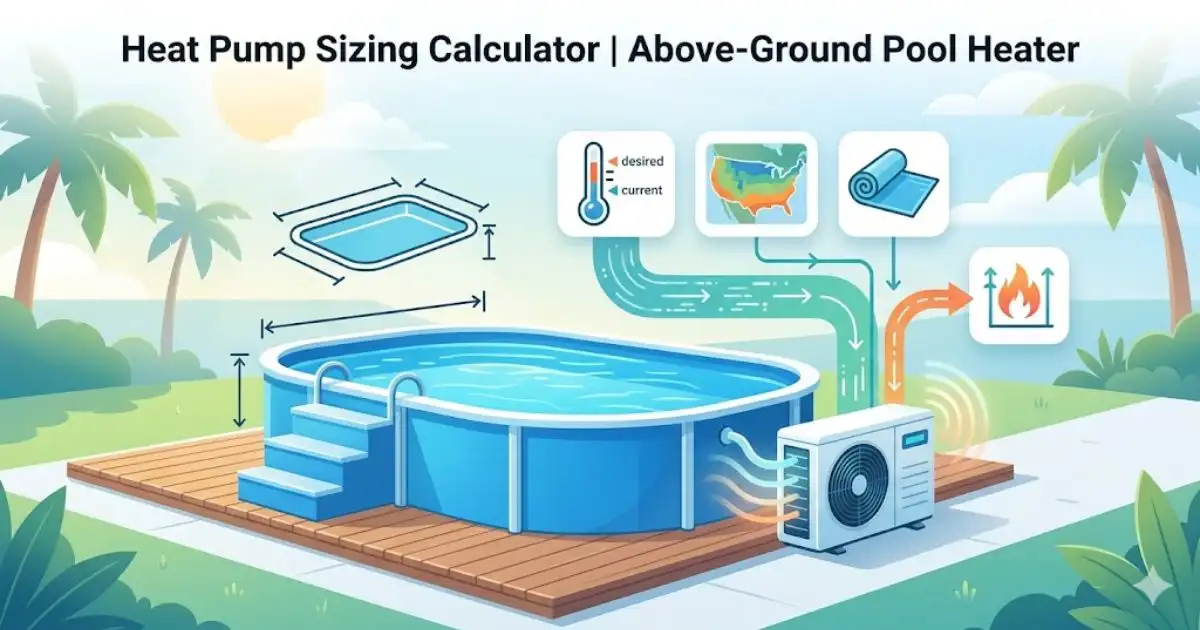
Choosing the right pool heat pump size is crucial for efficient heating and energy savings. An undersized unit will struggle to maintain your desired water temperature, while an oversized one will waste energy and money. Our calculator considers your pool’s volume, climate conditions, desired temperature, and heating timeframe to recommend the perfect size.
Key Factors That Determine Heat Pump Size
- Pool Volume: Larger pools require larger heating capacity. Your pool’s volume is calculated based on its dimensions and depth.
- Temperature Rise Needed: The greater the difference between current and desired water temperature, the more BTU capacity is required.
- Desired Heating Time: Wanting to heat your pool faster requires a larger heat pump with greater BTU output.
- Climate Conditions: Cold climates experience greater heat loss through evaporation and radiation, requiring larger systems.
- Pool Cover Usage: Using a pool cover significantly reduces heat loss and can allow you to use a smaller heat pump.
How Pool Heat Pump Sizing Works
Our calculator uses industry-standard BTU calculation methods based on ASHRAE (American Society of Heating, Refrigerating and Air-Conditioning Engineers) guidelines. Here’s how the calculation works:
Step 1: Calculate Pool Volume
We calculate your pool’s total volume in gallons using the appropriate formula for your pool shape:
- Rectangle: Length × Width × Depth × 7.5
- Round: Diameter × Diameter × Depth × 5.9
- Oval: Length × Width × Depth × 6.7
Step 2: Determine Temperature Rise
We calculate the difference between your current water temperature and desired temperature. Each degree of temperature rise requires additional heating capacity.
Step 3: Calculate Heat Loss
We estimate heat loss from your pool based on surface area, ambient air temperature, wind exposure, sun exposure, and whether you use a cover. Heat loss is expressed as a percentage of total heating requirement.
Step 4: Apply Climate Adjustment
Different regions experience varying heat loss rates. Cold climates may require 50-100% more capacity than warm climates for the same pool.
Step 5: Calculate Required BTU/Hour
Using the formula: (Pool Volume × Temperature Rise × 8.33) + Heat Loss = BTU/Hour
Step 6: Recommend Appropriate Heat Pump Size
We then recommend the closest heat pump size from industry-standard options: 50K, 75K, 95K, 110K, 125K, or 140K BTU.
Why BTU Matters in Heat Pump Sizing
BTU (British Thermal Unit) is the standard measurement of heating capacity. One BTU is the amount of heat energy needed to raise one pound of water by one degree Fahrenheit. When selecting a pool heat pump, you’re essentially choosing how much thermal energy the system can deliver per hour.
Understanding BTU Output
A 75,000 BTU heat pump can deliver 75,000 BTUs of heat energy per hour under ideal conditions. Higher BTU ratings mean faster heating and ability to maintain temperature in colder climates. However, they also consume more energy, so sizing appropriately for your needs is essential.
Oversizing vs. Undersizing
Oversized Systems: Use unnecessary electricity, increase operating costs, and may cause temperature fluctuations. They also have shorter lifespans due to short-cycling.
Undersized Systems: Cannot maintain desired temperatures, especially in cold weather. They run continuously without reaching goals, wasting energy and frustrating you with cold water.
Above Ground vs Inground Pool Heating
Above ground and inground pools have different heating requirements due to construction differences and environmental factors.
Above Ground Pools
- Exposed to more direct sunlight and wind exposure
- Generally smaller than inground pools (50-30,000 gallons)
- Experience faster temperature fluctuations
- Can use smaller heat pump systems (50K-95K BTU)
- Heat loss rates typically 8-12% per hour
- More affordable to heat with proper sizing
Inground Pools
- Often larger (20,000-40,000+ gallons)
- Some protection from ground surrounding them
- More stable water temperature
- Usually require larger heat pump systems (95K-140K+ BTU)
- Heat loss rates typically 5-8% per hour
- Higher initial heating needs but more stable once heated
How Climate Affects Pool Heating Requirements
Your geographic location and local climate significantly impact heat pump sizing. We categorize climates into three zones with different heating challenges:
Cold Climate Regions (Northern US)
States like Minnesota, Wisconsin, Michigan, and New York experience cold winters with low ambient air temperatures. Heat loss from pools is substantial, typically 50-100% higher than warm climates. You’ll need larger heat pump systems or to limit heating to summer months.
- Examples: New York, Pennsylvania, Michigan, Minnesota
- Heating capacity multiplier: 1.5-2.0x
- Best season: May-September
Moderate Climate Regions (Central US)
States like Tennessee, Texas, and Oklahoma experience moderate seasonal changes. Spring and fall heating is practical with standard-sized systems. Winter heating is possible but expensive.
- Examples: Texas, Oklahoma, Tennessee, Colorado
- Heating capacity multiplier: 1.0-1.3x
- Best season: April-October
Warm Climate Regions (Southern US)
States like Florida, Arizona, and Southern California maintain mild winters. Pool heating is year-round practical, even small heat pumps maintain temperature. Energy costs are minimal.
- Examples: Florida, Arizona, Southern California, Hawaii
- Heating capacity multiplier: 0.8-1.0x
- Best season: Year-round possible
Pool Cover Energy Savings
Using a pool cover is one of the most cost-effective ways to reduce heating requirements and energy costs. A quality pool cover can reduce heat loss by 30-50% depending on the type.
Types of Pool Covers
- Solar Covers: Add 5-10°F to water temperature while reducing heat loss. Most cost-effective for savings.
- Standard Covers: Reduce evaporation by 95% and heat loss by 30-40%. Essential for winter storage.
- Thermal Covers: Heavy-duty covers reducing heat loss by 35-50%. Best performance for nighttime.
Energy Savings with Pool Covers
By using a quality cover, you can often downsize your heat pump by one size category, reducing initial equipment costs by $500-$1,000 and monthly operating costs by 20-35%. In cooler climates, pool covers may make the difference between feasible and infeasible heating.
Cover Usage Tips
- Cover your pool when not in use, especially overnight
- During heating season, covers save the most money at night
- Replace worn covers to maintain effectiveness
- Use pump covers to minimize water circulation heat loss
Pool Heat Pump Sizing Chart
Use this reference chart to understand which heat pump size is recommended for different pool sizes and scenarios:
| Heat Pump Size | Small Pools | Medium Pools | Large Pools | Best For |
|---|---|---|---|---|
| 50,000 BTU | 10-15K gallons | — | — | Small above ground pools (warm climate) |
| 75,000 BTU | 15-20K gallons | 20-25K gallons (moderate) | — | Above ground pools (all climates) |
| 95,000 BTU | — | 25-30K gallons | 30K gallons (warm) | Standard above/small inground pools |
| 110,000 BTU | — | — | 30-35K gallons | Medium inground pools |
| 125,000 BTU | — | — | 35-40K gallons | Large inground pools (moderate climate) |
| 140,000 BTU | — | — | 40K+ gallons | Large inground pools, cold climates |
Note: This chart is a general reference. Always use our calculator for accurate sizing based on your specific conditions, or consult a professional HVAC technician.
Frequently Asked Questions
For a 24-foot round pool, the size recommendation depends on your desired temperature rise and climate. A 24-foot round pool is typically 12,000-15,000 gallons. In warm climates, a 75,000 BTU unit is usually sufficient. In moderate climates, you may need 95,000 BTU. In cold climates, 110,000 BTU is recommended. Use our calculator with your specific parameters for an exact recommendation.
Operating costs depend on your heat pump size, local electricity rates, usage hours, and climate. A typical 95,000 BTU unit running 6 hours daily costs $400-$800 monthly in moderate climates, and $200-$400 monthly in warm climates. Our calculator estimates your specific monthly cost based on 24/7 operation; actual costs will be lower with limited usage.
While not absolutely necessary, a pool cover is highly recommended. It reduces evaporation by up to 95%, reduces heat loss by 30-50%, prevents debris from entering your pool, and can reduce chemical usage. For pool heating specifically, a cover allows you to use a smaller heat pump and saves significant energy costs. Over a heating season, a cover pays for itself through energy savings.
Heating time depends on pool size, heat pump capacity, and heat loss. A 20,000-gallon pool with a 95,000 BTU heat pump typically takes 18-24 hours to heat 12 degrees. A 30,000-gallon pool may take 30-40 hours. Our calculator provides a precise estimate for your specific pool size and conditions.
COP measures heat pump efficiency by comparing the heat output to the electrical energy input. A COP of 5.0 means the heat pump delivers 5 units of heat for every 1 unit of electrical input. Higher COP means better efficiency and lower operating costs. Modern pool heat pumps typically have COP values of 4.0-7.0 depending on air temperature and system design.
Yes, heat pumps work in cold climates, but require larger sizes (higher BTU) because of increased heat loss and lower efficiency in cold air temperatures. Most heat pumps operate effectively down to 50-55°F air temperature. Below that, efficiency drops significantly. In very cold climates, a larger heat pump or supplemental heating (gas heater) may be needed. Spring and fall heating is most cost-effective.
This is a personal choice. A larger heat pump heats faster but costs more initially and to operate. A smaller heat pump costs less but heats slower. Most pool owners prefer moderate sizing that achieves comfort in 24-48 hours without excessive energy consumption. Consider: Do you want to heat 2-3 times weekly (smaller unit), or year-round (larger unit). Our calculator helps you optimize for your needs.
Heat Pumps: Efficient, 4-7x more cost-effective than gas, work in all climates (though slower in cold), environmentally friendly, quiet, long lifespan (10-15 years).
Gas Heaters: Fast heating (2-4 hours), high upfront energy use, higher monthly costs, best for quick heating needs, shorter lifespan (5-8 years), require gas line installation.
For most above-ground pools, heat pumps are more economical over time. Many pool owners use both for flexibility.
Our calculator uses industry-standard ASHRAE formulas used by professional HVAC technicians. However, actual performance varies based on: exact pool dimensions, surrounding landscape, actual wind patterns, equipment condition, and plumbing system efficiency. If results seem off, verify your pool volume measurement, temperature inputs, and climate selection. For complex installations, consult a licensed pool heating professional.
Yes! The Basic Calculator provides standard recommendations for typical residential pools. The Advanced Calculator includes additional factors like wind exposure, sun exposure, pool usage frequency, and ambient air temperature for more precise sizing. Both use industry-standard calculations; the Advanced version simply provides more granular customization for specialized scenarios.
Know More
- Best Above Ground Pool Heaters
- Pool heat pump efficiency guide
- Above ground pool heat pump installation
- Electric pool heater buyers guide
- Solar pool heater reviews and types
- Gas pool heater BTU guide
- Pool Heater Size Calculator Free