
Learn 7 proven cooling methods, ideal temperatures, pump schedules, and chemical management to keep your above-ground pool comfortable all summer long.
The best way to cool an above-ground pool in summer is to run your pump and aerator at night (10 PM–6 AM), remove solar covers during heat waves, add shade over the pool, and consider a pool aerator ($30–$80) for evaporative cooling.
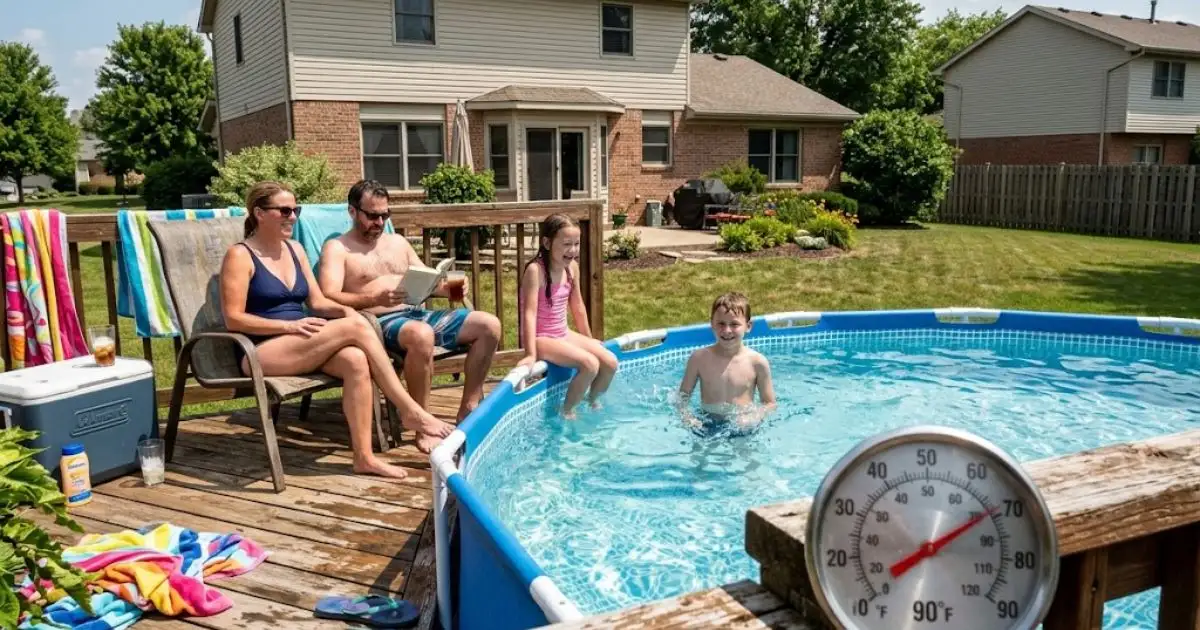
For extreme heat, a reverse-cycle heat pump with cooling mode can lower temperatures by up to 15°F. Keep your pool between 78°F and 82°F for comfortable swimming, and never let it climb above 90°F for extended periods.
Table of Contents
Quick Reference: Cooling Methods at a Glance
| Method | Cost | Setup Effort | Temp Drop | Best For |
|---|---|---|---|---|
| Night Pump Runtime | Free | 5 min | 2–4°F | Everyone |
| Pool Aerator | $20–$100 | 15 min | 2–8°F | Dry climates |
| Shade Structure | $100–$2,000 | 1–2 days | 2–3°F prevention | Long-term savings |
| Reflective Cover | $200–$600 | 5 min | 5–10°F prevention | Hot/dry climates |
| Mechanical Chiller | $5,000–$7,000 | Professional install | Up to 10°F | Extreme heat zones |
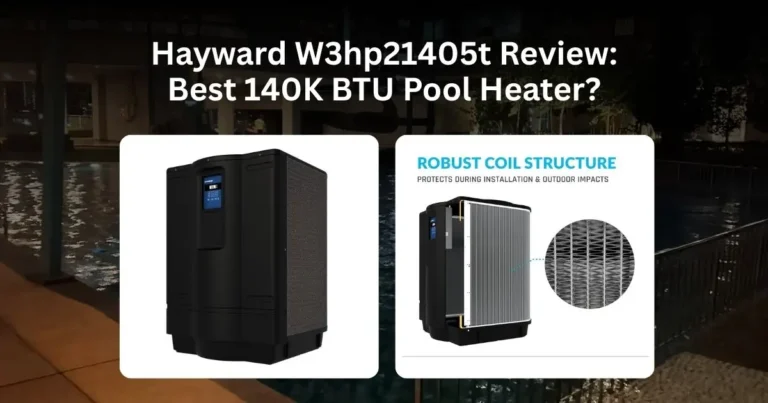
| Heat/Cool Heat Pump | $8,000–$10,000 | Professional install | Up to 15°F | Year-round control |
Why Above-Ground Pools Overheat Faster Than Inground Pools
The Science of Above-Ground Heat Gain
Above-ground pools are thermal heat traps. Unlike inground pools that benefit from ground insulation, above-ground pools have exposed sidewalls that conduct heat directly into the water.
Here’s why they heat up faster:
- No Ground Insulation: The earth naturally moderates temperature. Above-ground pools sit exposed to full sun on all sides.
- Shallower Water: Most above-ground pools are 4–6 feet deep. Shallow water heats 30–50% faster than deeper pools because there’s less volume to absorb solar radiation.
- Metal Wall Heat Conduction: Steel and aluminum walls conduct heat directly into water. Even resin walls absorb and transfer heat efficiently.
- Full Sun Exposure on Walls AND Surface: A 24-foot round above-ground pool has ~1,500 sq ft of exposed surface area. Every square foot is absorbing solar radiation.
Key Insight: Above-ground pools can gain 5–10°F on a single hot day. Without active cooling, they’ll hit 90°F+ within 3–5 days of intense heat.
How Hot Is Too Hot? Safe Swimming Temperatures
Not all pool temperatures are safe. The CDC and American Red Cross have clear guidelines based on activity type and age.
| Pool Use / Population | Safe Range | Danger Zone |
| Recreational swimming (adults) | 78–82°F | Above 90°F |
| Children learning to swim | 84–88°F | Above 90°F |
| Seniors / Physical therapy | 86–90°F | Above 94°F |
| Water aerobics & exercise | 78–84°F | Above 88°F |
| Vigorous activity (max safe) | Up to 88°F | Above 88°F |
Health Warning: Water above 90°F can cause dehydration, heat exhaustion, and reduced chlorine effectiveness (chlorine loses 90% potency in just a few hours at temperatures above 85°F). Limit swim sessions to 15–20 minutes and take frequent hydration breaks.
7 Proven Ways to Cool Your Above-Ground Pool (Ranked by Cost)
1. Run Your Pump at Night – FREE
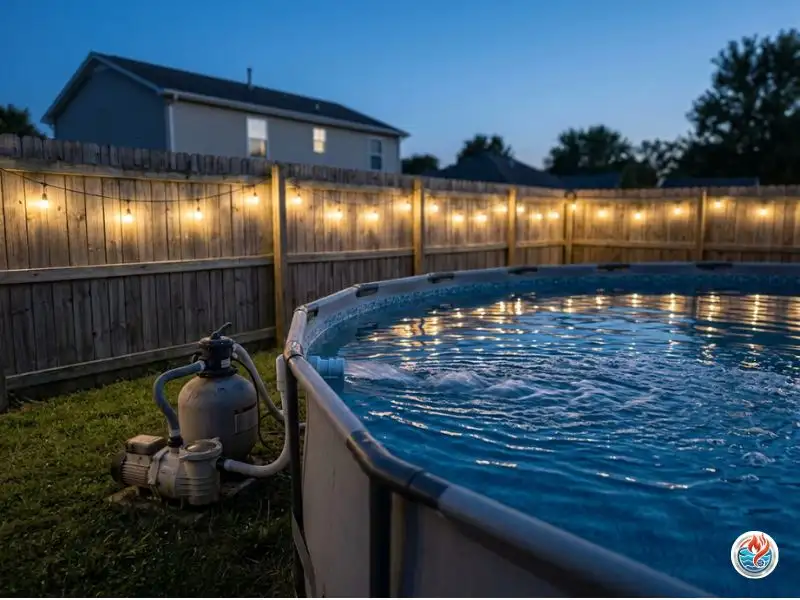
Why it works: Nighttime air is 10–20°F cooler than daytime. When you circulate pool water through your pump and filter at night, the water loses heat through evaporation and air exposure.
How to Set Your Pump Timer for Cooling:
- Set pump to run from 10 PM to 6 AM (8 hours minimum)
- Turn off during the hottest daylight hours (10 AM–6 PM)
- Run for 4–6 hours during midday for filtration and chemical mixing
- Use the 10° Rule: Air temperature ÷ 10 = minimum pump hours. At 100°F air temp, run 10+ hours.
Pro Tip – Variable Speed Pumps: If you have a variable speed pump, run high speed for 3–4 hours (filtration) and low speed for 8–9 hours (circulation/cooling). This saves 20–30% on electricity while maximizing cooling.
Expected Temperature Drop: 2–4°F within 24 hours at zero additional cost (only electricity for pump operation, which is minimal on low speed).
2. Install a Pool Aerator – $20–$100
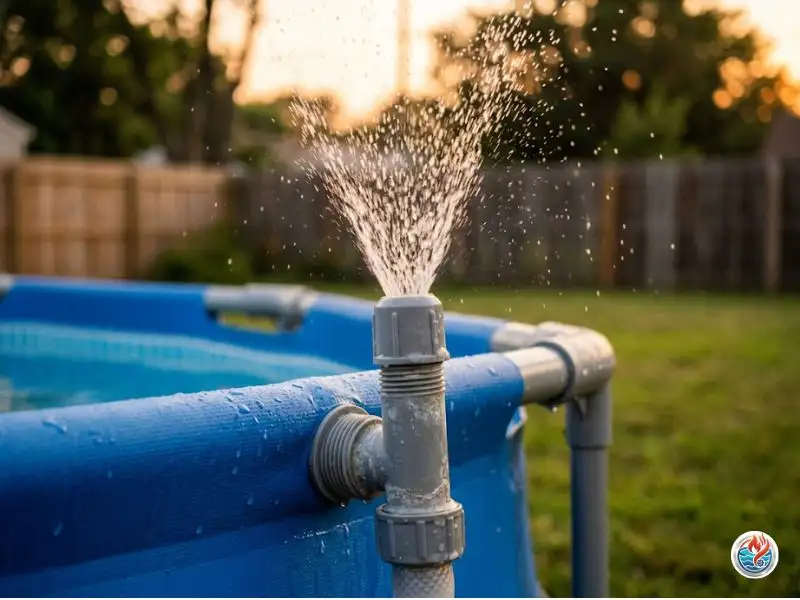
How evaporative cooling works: An aerator breaks water into fine droplets that spray above the pool surface. As water droplets fall, they absorb latent heat from the air. The effect: rapid evaporative cooling.
DIY Installation (5 minutes):
- Attach the aerator to your pool pump’s return jet (the intake that pushes water back)
- Angle the jet upward at 45°
- Run pump in evening (6 PM–10 PM) or early morning (6 AM–10 AM)
- Important: Run aerator ONLY at night and early morning when air is cooler. Daytime aeration circulates hot air and is counterproductive.
Humidity Caveat: Aerators work best in dry climates (Arizona, Nevada, Southern California). In humid climates (Florida, Texas Gulf Coast), evaporation is slower, so combine aeration with extended pump runtime.
Expected Temperature Drop: 2–8°F within 24 hours depending on climate humidity.
3. Remove or Switch Your Pool Cover – IMMEDIATE
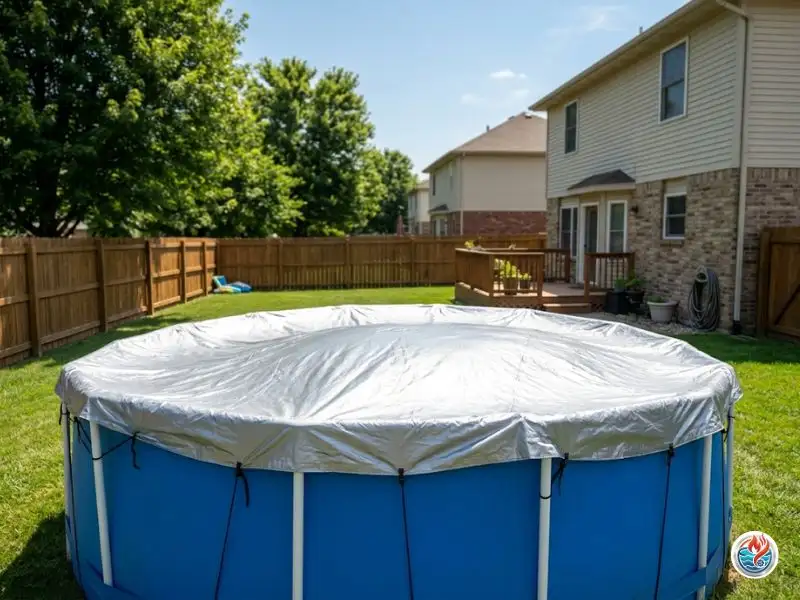
This is the fastest emergency cooling tactic during heat waves.
Solar Covers: Your Enemy in Summer
Solar covers are designed to trap heat. They work like a greenhouse, preventing surface evaporation (which is your primary cooling mechanism). Remove them during heat waves immediately.
Reflective Covers: Your Friend in Extreme Heat
Unlike solar covers, reflective covers (like CoolGuard Ultra) have a white or silver surface that reflects 70–80% of solar radiation. They prevent heat gain without trapping existing heat.
Best Practice: During 90°F+ temperatures, use a reflective cover during the day (10 AM–6 PM) to prevent heat absorption. Remove it at night to allow evaporative cooling.
Expected Effect: Prevents 5–10°F of additional heat gain (not a cooling method, but heat prevention).
4. Add Shade Over Your Pool – $100–$2,000
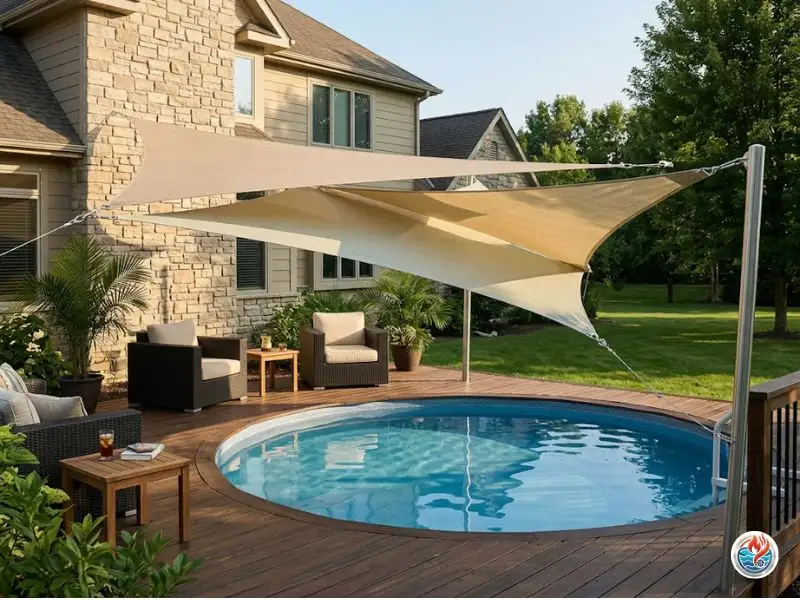
Permanent shade structures reduce solar heat absorption by 60–80%. Options:
- Shade Sails: Fabric covers that stretch between posts. Cost: $300–$800. Easy DIY installation.
- Pergolas: Semi-permanent wood structures with adjustable slats. Cost: $800–$2,000. Professional install recommended.
- Cantilever Umbrellas: Large umbrella structures. Cost: $400–$1,200. Movable and flexible.
- Natural Shade (Trees): Free but takes years to grow. Plant deciduous trees 15–20 feet away to avoid leaf debris.
Engineering Tip: Orient shade to block 10 AM–4 PM direct sun. Morning and late-afternoon sun is gentler and allows some evaporative cooling.
Expected Effect: Prevents 2–3°F of additional heat gain. Best viewed as long-term investment combined with other cooling methods.
5. Use Water Features Strategically – $50–$300
Fountains and waterfalls increase surface area and encourage evaporation.
Critical Timing: Run water features ONLY at night (6 PM–10 AM). Daytime operation circulates hot air and increases evaporation without cooling benefit. You’ll lose water and waste energy.
Best Options: Solar-powered floating fountains ($80–$200) eliminate electricity costs. Attach to your return jet to recirculate existing water.
Expected Temperature Drop: 1–3°F, combined with visible cooling effect (guests appreciate the aesthetic).
6. Install a Mechanical Pool Chiller – $5,000–$7,000
For extreme heat situations (105°F+ air temps), a mechanical chiller is the most cost-effective premium solution.
How Mechanical Chillers Work:
The chiller extracts water from your pool, runs it through a refrigeration cycle (similar to an air conditioner), and returns cooled water. One-way operation: only cools, doesn’t heat.
Installation Requirements:
- Professional plumber/electrician required
- 240V electrical line
- Plumbing bypass kit (includes check valves, isolation valves)
- Typically takes 4–6 hours to install
Operating Cost: $50–$100/month during peak summer (depends on usage and local electricity rates). Not ideal for occasional use; best for pools in extreme climates.
Expected Temperature Drop: Up to 10°F. Time to cool a pool from 92°F to 82°F: 12–18 hours depending on chiller size and pool volume.
7. Upgrade to a Heat/Cool Heat Pump – $8,000–$10,000
The premium solution for year-round temperature control.
Reverse-Cycle Heat Pump Technology:
A reverse-cycle heat pump can both heat (winter) and cool (summer). In summer mode, it operates like a chiller. In winter mode, it heats. One device, two functions.
Key Advantages:
- Set-and-forget automatic temperature control (81°F target = pump cycles on/off as needed)
- Energy-efficient (uses 3–4x less electricity than electric resistance heaters)
- Year-round value (heat in spring/fall, cool in summer)
- Quieter than chillers
- Long lifespan (10–15 years typical)
Best Investment for Multi-Season Pools: If you use your pool spring through fall, a heat/cool pump pays for itself through energy savings over 5–7 years.
Expected Temperature Drop: Up to 15°F. Maintains stable temperature year-round.
What NOT to Do: Common Cooling Myths Debunked
❌ Myth 1: ‘Just Add Ice to the Pool’
The Math: You need roughly 500 lbs of ice to drop 10,000 gallons by 1°F. A 24-foot round pool holds ~13,000 gallons. To drop the temperature 5°F, you’d need 3,250 lbs of ice ($150–$200 from gas stations). The ice melts in 2–3 hours. Cost-to-benefit ratio is terrible.
❌ Myth 2: ‘Run the Pump During the Day to Cool’
Why it backfires: Daytime air is hotter than water. Circulating water during the hottest part of the day (12 PM–5 PM) exposes water to hot air, which adds heat. This is the opposite of what you want.
Exception: If you have a solar cooling panel system, daytime pumping through the cooler panel can work.
❌ Myth 3: ‘A Solar Cover Will Keep It Cool in Summer’
Reality: Solar covers trap heat intentionally. They’re designed for winter heating, not summer cooling. In summer, they’ll make your pool hotter, not cooler. Uncover immediately during heat waves.
❌ Myth 4: ‘Draining and Refilling Is the Best Fix’
Why it’s wasteful:
- Temporary relief (new water is room temperature initially, then heats back up)
- Expensive water bills (400 sq ft pool = ~13,000 gallons × $3–5 per 1,000 gallons)
- Damages vinyl liner if done repeatedly (stretches and weakens)
- Wastes chemicals (you’re discarding balanced water and rebalancing)
Use only in emergencies.
Summer Pool Chemistry: Managing Heat’s Impact
Why Chlorine Disappears in Hot Weather
Heat and UV rays are chlorine’s worst enemies:
- UV Photodegradation: UV rays break down chlorine molecules. At 85°F+, chlorine loses up to 90% of its potency in just a few hours of direct sunlight.
- Heat Accelerates Bacteria Growth: For every 10°F above 70°F, bacteria multiply exponentially. This increases chlorine demand.
- Organic Load Increases: Sunscreen, sweat, and algae spores increase in summer. Chlorine must work harder.
Your Summer Chemical Checklist
Download the Complete Pool Summer Checklists PDF
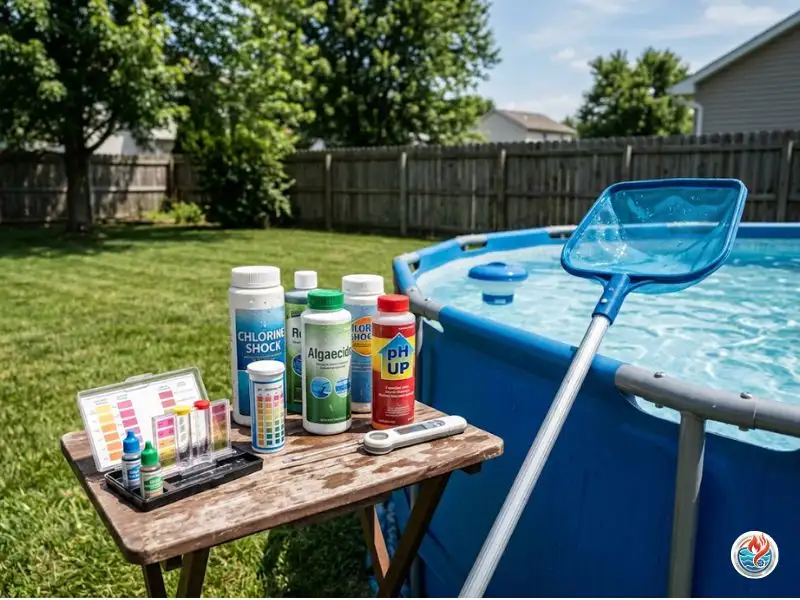
- Test water 2x per week minimum (daily during heat waves)
- Maintain Cyanuric Acid (CYA) at 30–50 ppm (UV shield for chlorine)
- Keep chlorine at 3–5 ppm (5–7 ppm during heat waves)
- Shock pool after sunset, never during day (UV degrades shock chemicals)
- Monitor pH daily in extreme heat (rises naturally in warm water)
- Add algaecide weekly as preventative
- Brush all surfaces weekly (rough surfaces harbor algae)
- Backwash filter 2x per week in summer (more debris in warm water)
Heat Wave Emergency Protocol
When temperatures hit 95°F+ and pool water reaches 88°F+:
- Test Immediately: Check chlorine, pH, alkalinity, and CYA
- Shock to 10 ppm: Double your normal shock dosage
- Brush All Surfaces: Algae thrives in heat; remove any visible growth
- Run Pump 16–24 Hours: Maximum circulation during heat wave
- Retest in 24 Hours: Ensure chlorine and pH stabilized
If algae blooms form: Add algaecide immediately, shock, and run pump 24/7 until water clears (may take 48–72 hours). Close pool temporarily if algae is severe (green or black).
Pump Runtime & Filtration in Extreme Heat
The 10° Rule: Calculate Your Summer Pump Time
Formula: Air Temperature (°F) ÷ 10 = Minimum Pump Hours
| Air Temperature | Minimum Pump Hours | Schedule Example |
|---|---|---|
| 80°F | 8 hours | 6 AM–2 PM + 6 PM–10 PM |
| 90°F | 9 hours | 6 AM–3 PM + 6 PM–9 PM |
| 100°F | 10+ hours | 24-hour low speed + 4 hrs high |
| 105°F+ (Heat Wave) | 12–16 hours | 10 PM–6 AM + 4 AM–8 AM + reduced daytime |
Best Pump Schedule for Cooling by Climate
| Climate | Daytime Runtime | Nighttime Runtime | Total Hours |
|---|---|---|---|
| Hot/Dry (AZ, NV) | 4 hrs (10 AM–2 PM) | 8 hrs (10 PM–6 AM) | 12 hrs |
| Hot/Humid (FL, TX) | 6 hrs (8 AM–2 PM) | 6 hrs (6 PM–12 AM) | 12 hrs |
| Moderate (Southeast, CA) | 4 hrs (10 AM–2 PM) | 4 hrs (10 PM–2 AM) | 8 hrs |
| Variable (TX, Midwest) | 4–6 hrs (adjust daily) | 4–6 hrs (adjust daily) | 8–12 hrs |
Variable Speed Pump Settings for Summer
If you have a variable speed pump, optimize for efficiency:
- High Speed (3000–3500 RPM): 3–4 hours per day. Use for filtration (removes particles), chemical mixing, and initial cooling.
- Low Speed (1000–1500 RPM): 8–9 hours per day. Circulates water gently, allows evaporative cooling, uses 80% less electricity than high speed.
- 24/7 Low Speed Option: Surprising cost advantage. 24 hours at low speed costs less than 8 hours at high speed + 4 hours off. Maintains consistent temperature and water quality.
Energy Savings: Variable speed pumps reduce summer energy costs by 20–50% compared to single-speed pumps while providing better cooling and filtration.
Understanding & Managing Summer Evaporation
How Much Water Are You Really Losing?
| Climate Type | Daily Loss | Monthly Loss | Annual Loss |
|---|---|---|---|
| Dry (Arizona, Nevada) | 1/2 inch | ~12 inches | 20,000+ gallons |
| Humid (Florida, Texas Gulf) | 1/4 inch | 6–8 inches | 10,000 gallons |
| Moderate (Most USA) | 1/4 inch | 5–7 inches | 8,000 gallons |
Context: A 400 sq ft above-ground pool loses 60–120 gallons per day in summer. That’s $180–$360 per month in water costs at average USA rates.
The Bucket Test: Leak vs. Evaporation
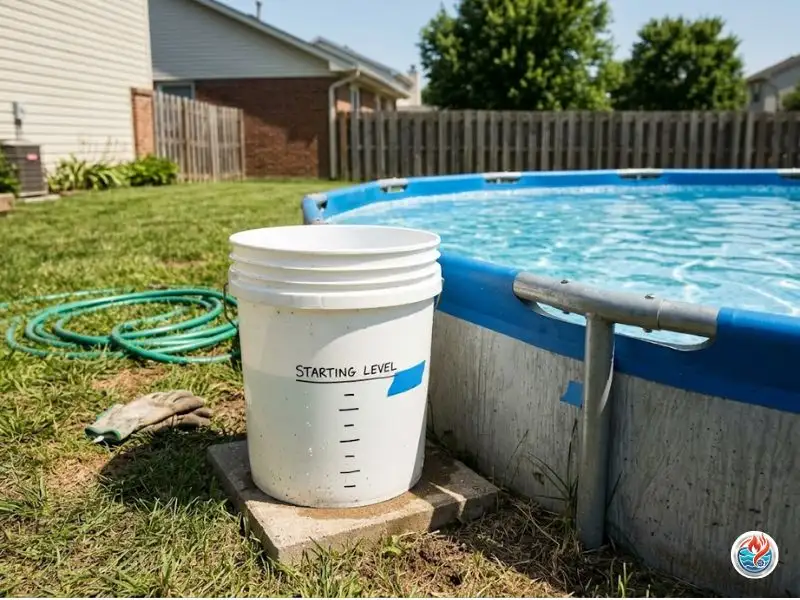
Not sure if you’re leaking or just evaporating?
- Place a bucket filled with pool water on the pool deck (in the sun)
- Measure the water level in the bucket after 24 hours
- Measure the pool water level drop after 24 hours
- If pool drops MORE than the bucket: You likely have a leak. Call a professional.
- If pool and bucket drop equally: It’s normal evaporation. No leak.
Reducing Evaporation Without Trapping Heat
- Liquid Solar Covers: Film that floats on water surface, reducing evaporation 15–40%. Doesn’t trap heat like solid covers.
- Mesh Covers: Lightweight covers with holes. Reduce evaporation 50–80%, allow some water through (prevents standing water/debris).
- Windbreaks: Fences, hedges, or shade sails on the windward side. Wind increases evaporation 3x. Reducing wind dramatically reduces water loss.
- Turn Off Water Features: Fountains and waterfalls INCREASE evaporation. Eliminate during drought or when water costs are high.
Cost-Benefit: In dry climates (Arizona, Nevada), a liquid solar cover ($50–$100) saves $300–$500 in annual water costs. Investment pays for itself in 2–3 months.
Regional Guide: Cooling Strategies by Climate
🌵 Dry Heat Climates (Arizona, Nevada, Inland California)
Challenge: Extreme temperatures (105–115°F), rapid evaporation (1/2 inch daily), intense UV rays.
Best Strategy: Reflective covers + mechanical cooling + extended nighttime pumping.
- Use reflective (white) covers during day to prevent heat absorption
- Run pump 10 PM–6 AM for maximum cooler-air circulation
- Consider mechanical chiller or heat/cool pump if pool hits 90°F+ consistently
- Install shade sail to reduce solar load by 60–70%
- Manage evaporation aggressively (water costs are high)
💧 Humid Heat Climates (Florida, Gulf Coast, Southeast)
Challenge: High humidity slows evaporative cooling, afternoon thunderstorms introduce contaminants, algae risk is highest in USA.
Best Strategy: Extended pump runtime + chemical vigilance + filtration.
- Run pump 12+ hours daily (evaporative cooling is less effective)
- Test chemistry 2x daily during summer (algae grows rapidly)
- Add algaecide weekly as preventative
- Shock more frequently (weekly minimum, every 3 days in heat waves)
- Keep CYA at 30–50 ppm to protect chlorine from UV
🌞 Variable Climates (Texas, Midwest, Northeast)
Challenge: Unpredictable heat waves alternating with mild days, requires flexible response.
Best Strategy: Multi-method flexible approach with adjustable equipment.
- Use a programmable pump timer (adjust based on daily temperatures)
- Keep aerator on hand for emergency cooling during heat spikes
- Stock shade structures (shade sails) that can deploy quickly
- Monitor weather and increase pump runtime before predicted heat waves
- Maintain standard chemical routine (algae risk is lower than humid climates)
Above-Ground Pool Heat Management Checklist
Daily (During Heat Waves / Temps Above 90°F)
- Check water level (fill if below skimmer intake)
- Test chlorine and pH (at least once, twice if temp above 95°F)
- Empty skimmer basket (more debris in warm water)
- Verify pump is running on correct nighttime schedule
- Check water temperature (record for trending)
Weekly Management Checklist
- Test complete chemical panel (chlorine, pH, alkalinity, CYA)
- Brush pool walls and floor (algae prevention)
- Backwash/clean filter (summer requires 2x weekly)
- Inspect equipment for overheating (pump, filter, motor)
- Add algaecide (preventative measure)
Monthly Management Checklist
- Deep clean filter (remove algae buildup)
- Inspect liner for stretch, wrinkles, or tears (heat stresses vinyl)
- Review electricity costs (spike in summer)
- Adjust pump schedule based on temperature trends
- Calibrate thermometer (check accuracy)
When to Call a Professional
DIY management works for most above-ground pools. Call a certified pool operator (CPO) if:
- Water consistently stays above 92°F despite all cooling efforts
- Recurring algae blooms that don’t clear within 48 hours
- Equipment (pump, filter, chiller) overheats or shuts down repeatedly
- Bucket test confirms a leak (water drops faster than evaporation rate)
- Considering chiller or heat/cool pump installation
- Vinyl liner showing permanent stretch marks or wrinkles from heat exposure
- Water chemistry stays unbalanced despite regular treatment
Cost of Professional Service: Service calls average $150–$250. Annual maintenance contracts: $400–$800. Investment pays off through equipment longevity and water quality.
FAQ – Above-Ground Pool Summer Heat Management
What is the fastest way to cool an above-ground pool?
Run your pump with an aerator attached from 10 PM to 6 AM. This can drop temperatures 2–8°F within 24 hours at zero additional cost. For faster results, combine with: removing solar covers (immediately), running pump 16+ hours, and setting up a shade structure if available. For emergency situations (90°F+ water), consider a mechanical chiller (fastest: up to 10°F drop in 12–18 hours).
Is 90-degree pool water dangerous?
Water above 90°F can cause dehydration, heat exhaustion, and reduced chlorine effectiveness. The CDC recommends keeping vigorous activity pools below 88°F. Limit swim sessions to 15–20 minutes and require frequent hydration breaks. Children are especially vulnerable; keep children’s pools below 88°F. For seniors or those with medical conditions, consult a doctor before swimming in water above 88°F.
Should I run my pool pump during the day or night in summer?
For cooling: Run primarily at night (10 PM–6 AM) when air is cooler. For filtration and chemical distribution: Include 4–6 hours during midday. The ideal schedule is 4–6 hours midday (for filtration) + 8 hours overnight (for cooling). Use the 10° Rule: air temperature ÷ 10 = minimum pump hours.
Do solar covers make pools hotter in summer?
Yes. Solar covers are designed to trap heat. Remove them immediately during heat waves (above 85°F). Use reflective covers (white or silver) if you need evaporation control without heat gain. Reflective covers prevent 5–10°F of additional heat absorption while allowing nighttime cooling.
How much does a pool chiller cost for an above-ground pool?
Mechanical chillers: $5,000–$7,000 installed. Heat/cool heat pumps: $8,000–$10,000 installed. Pool aerators: $20–$100 (DIY installation). For budget-conscious buyers, start with free methods (night pumping) + aerator combo. Upgrade to chiller/heat pump only if pool consistently exceeds 90°F.
Can a pool heat pump cool water too?
Only if it’s a reverse-cycle (heat/cool) model. Standard heat pumps only heat. Look for ‘H&C,’ ‘Heat & Cool,’ or ‘Dual Function’ designation. Reverse-cycle heat pumps cost $8,000–$10,000 but provide year-round temperature control and are energy-efficient compared to electric resistance heaters.
How often should I shock my pool in summer?
Standard schedule: Weekly. During heat waves (90°F+ water): Every 3–4 days. Always shock after sunset when UV won’t immediately degrade the shock chemicals. Never shock during the day; you’ll lose 50%+ of the chemical to UV degradation.
Why does my chlorine disappear so fast in hot weather?
UV rays break down chlorine (up to 90% loss in just hours at temperatures above 85°F). Heat also accelerates bacteria growth, increasing chlorine demand. Maintain cyanuric acid (CYA) at 30–50 ppm as a UV shield. In extreme heat, increase chlorine to 5–7 ppm (vs. standard 3–5 ppm).
How much water should my pool lose to evaporation in summer?
Normal is 1/4 inch per day. In hot, dry climates, up to 1/2 inch per day. A 400 sq ft pool loses 60–120 gallons daily. Use a bucket test to confirm it’s evaporation (not a leak). Use a cover to reduce evaporation by 70–95%.
Will an aerator work in humid climates like Florida?
Yes, but less effectively. In humid air, evaporation is slower, so cooling is reduced. Combine aeration with extended pump runtime (12+ hours daily) and strong filtration for best results. Prioritize chemical management over evaporative cooling in humid climates.
What pool temperature is too hot for kids?
Keep children’s pools below 88°F. Kids overheat faster than adults due to less efficient thermoregulation. If water exceeds 90°F, limit swim sessions to 15–20 minutes with hydration breaks. For toddlers (under 3), keep pool at 84–88°F.
Can I use ice to cool my pool for a party?
Technically yes, but it’s impractical. You need roughly 500 lbs of ice to drop 10,000 gallons by 1°F. For a 10,000-gallon pool, that’s $150–$200 in ice that melts in 2–3 hours. Instead, use aeration and night pumping starting 24 hours before the party. Much more cost-effective.
🏊 Meet Your Above-Ground Pool Expert Team
Every article on AboveGroundPoolHeater.com is backed by multi-regional, certified expert data. Our team has tested products across five distinct US climates and maintains a shared ‘Warm Water Data Lab’ for verified results.
Our Process: Mike uploads solar efficiency logs → David adds electrical safety ratings → Jim contributes durability scores → Rob calculates cost-of-operation → Chris synthesizes into final guides. Every review is backed by multi-regional, expert-verified data.
Keep Your Above-Ground Pool Comfortable Year-Round
Start with free methods (night pumping). Scale up to affordable solutions (aerators, covers) as needed. For year-round temperature control, explore heat/cool heat pumps that work spring through fall.
Explore Above-Ground Pool Heaters & Cooling Solutions
Final Thoughts: Enjoy Your Pool, Even in the Heat
Above-ground pools can absolutely stay comfortable in summer. Success comes from:
- Consistency over intensity: Running your pump on a fixed nighttime schedule beats sporadic heroic efforts.
- Start free, scale up: Night pumping is free. Add aerator ($20–$100) if that’s not enough. Invest in chillers/heat pumps only if needed.
- Chemistry is half the battle: Even if temperature is perfect, poor chemistry ruins the experience. Test regularly.
- Regional adaptation matters: Texas strategies don’t work in Florida. Adjust methods to your climate.
- Monitor and adjust: Track water temperature weekly. Adjust pump schedules based on trends, not guesses.
Your above-ground pool is an investment. A few hours of summer maintenance ensures it stays crystal clear, safe, and comfortable for months of family enjoyment.
You’ve got this!
Start with one cooling method (night pumping), monitor results for 3 days, then add another method if needed. Most pool owners find the combination of night pumping + aerator + weekly chemical management handles 95% of summer heat challenges.
Disclaimer: This article is for informational purposes. For medical concerns related to pool water temperature, consult a healthcare provider. For equipment installation, hire a licensed professional.
Last Updated: May 2026 | Fact-Checked by: Certified Pool Operators (Mike Sullivan, David Miller, James Taylor, Robert Thompson, Christopher Anderson)
Transparency: AboveGroundPoolHeater.com tests products without bias. We do not accept free samples for reviews. All product recommendations are based on verified expert data.