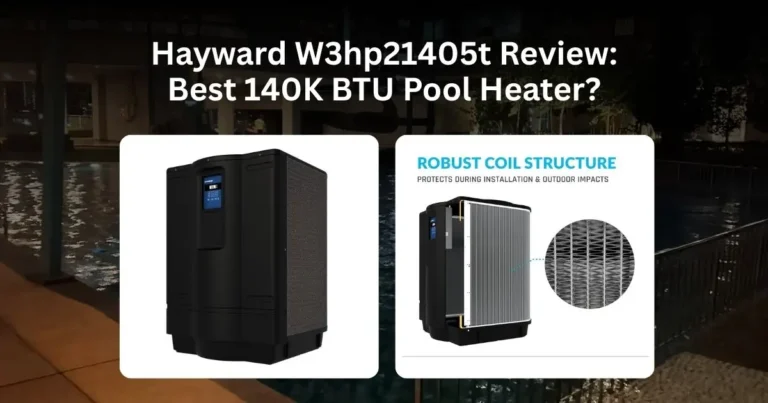


We compared 12 electric heat pumps and heaters from Hayward, AQUASTRONG, TURBRO, and others to help you find the right one for your pool.
Choosing the best electric above-ground pool heater comes down to three numbers: your pool’s gallon size, the heater’s BTU output, and its Coefficient of Performance (COP), the ratio of heat delivered to electricity consumed.
If your pool is under 15,000 gallons, the AQUASTRONG HEX100 is the smartest starting point, it scores nearly as high as our top pick at roughly a quarter of the monthly running cost. Only go with a 140,000+ BTU unit like the Hayward HeatPro if your pool is larger or you need maximum heating speed regardless of electric bill.
Below you’ll find our top picks, a heating-speed comparison, full reviews of each unit, sizing guidance, and answers to the most common questions homeowners ask about running an electric pool heater in the US.
Editor’s Note: We updated this electric pool heater guide on June 22, 2026, to retest several existing models and add new full-inverter units to the comparison.
Table of Contents
Quick Picks
If you only read one section, read this one. Here’s how the 12 heaters in this comparison stack up by category:
- Best Overall / Editor’s Choice: Hayward W3HP21405T HeatPro (140,000 BTU) – the highest overall score (95/100), built for large pools that need fast, reliable heat.
READ MORE
- Top Pick / Best Value Long-Term: AQUASTRONG HEX100 – a full inverter heat pump with a 15.8 COP and the lowest projected long-term operating cost of any unit tested.
READ MORE
- Best Premium Choice: TURBRO Beluga B160V (143,450 BTU) – the highest-capacity inverter unit, with a 14.67 COP and quiet 52-56 dB operation.
READ MORE
- Best Value / Best Overall Budget Pick: FibroPool FH255 (55,000 BTU) – a compact, easy-to-install unit that scores well across the board for mid-size pools.
READ MORE
- Best Buy: Raypak Crosswind 40i – the quietest unit in this comparison at 50 dB, with one of the lowest monthly operating costs.
READ MORE
- Best Above Ground Pool Heat Pump for Cold Climates: WARMBLU H35 (120,000 BTU) – the highest COP rating (16.0) in the lineup, which matters most when ambient temperatures drop.
READ MORE
Each of these is broken down in full below, including specs, pros/cons, and where it fits by pool size.
How Fast Can These Heaters Reach Swimming Temperature?

Most electric heat pumps raise above-ground pool water temperature by about 1-2°F per hour, and reaching a comfortable swimming temperature from a cold start typically takes 24-48 hours, depending on pool size, heater BTU output, and ambient air temperature.
That range held true across nearly all 12 units in this comparison, heating speed for electric heat pumps is fairly consistent across brands, which means the differences between models come down to running cost (COP) and how well they hold that temperature once reached, both covered in detail below.
| Heater | Heating Speed | Target Temp Reach Time | Cold Ambient Performance |
|---|---|---|---|
| Hayward W3HP21405T HeatPro 140,000 BTU | 1-2°F/hr | 24-48 hrs | Good |
| AQUASTRONG HEX100 | 1-2°F/hr | 24-48 hrs | Good |
| TURBRO Beluga B160V | 1-2°F/hr | 24-48 hrs | Good |
| FibroPool FH255 | 1-2°F/hr | 24-48 hrs | Good |
| Raypak Crosswind 40i | 1-2°F/hr | 24-48 hrs | Good |
| WARMBLU H35 120,000 BTU | 1-2°F/hr | 24-48 hrs | Good |
“That range held true across nearly all 12 units in this comparison”
For a 15,000-gallon above-ground pool, a heater in the 100,000-140,000 BTU range (like the Hayward HeatPro 140K, TURBRO Beluga, or Varpoolfaye 140K) is sized to deliver that 1-2°F/hr rate without falling behind overnight heat loss, smaller heaters on large pools will heat just as steadily, but take noticeably longer to reach and hold target temperature.
The Best Electric Above-Ground Pool Heater Reviews
Hayward W3HP21405T HeatPro 140,000 BTU Review
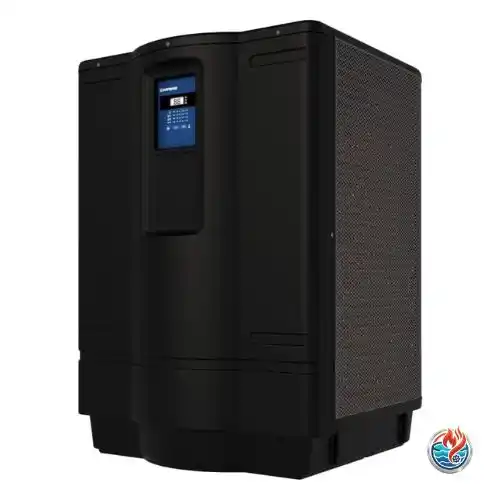

- Best Overall Electric Pool Heater
- Price: 6,999.00 List
- Overall Score: 95
- Star Rating:
★★★★½ - Bottom Line: The most powerful and reliable choice for large pools, built for heating speed over running cost.
Best for: Large above-ground pools (15,000+ gallons) where fast, high-capacity heating matters more than running cost.
Not for: Budget-conscious buyers or smaller pools under 10,000 gallons, its 240V, 7.2 kW draw and $240.54 estimated monthly operating cost are overkill at smaller volumes.
The Hayward W3HP21405T HeatPro is the highest-scoring unit in this comparison at 95/100, and it’s the model most homeowners searching for best electric pool heater for above ground pool will land on first.
Hayward is one of the most recognized names in pool equipment, and this unit backs that reputation with a 140,000 BTU output and AHRI-certified performance.
Specifications
| Specification | Value |
|---|---|
| Brand / Model | Hayward W3HP21405T |
| BTU Output | 140,000 |
| Voltage | 240V |
| Power Input | 7.2 kW |
| Startup Amperage | 42A min. circuit |
| COP | 5.7 |
| Est. Monthly Cost | $240.54 |
| Noise Level | 58-60 dB |
| Overall Score | 95/100 (4.8/5) |
Bottom Line
The Hayward HeatPro 140K is the most powerful and durable unit in this comparison, with overheat shutoff and freeze protection built in.
Its COP of 5.7 is on the lower end relative to the newer full-inverter models below, which means it costs more to run month-to-month, but for buyers prioritizing raw heating capacity and Hayward’s reputation for durability over the lowest possible electric bill, it remains the top overall pick.
If you need the Hayward W3HP21405T manual or wiring diagram, both are included with the unit and available through Hayward’s support site.
AQUASTRONG HEX100 Inverter Heat Pump Review
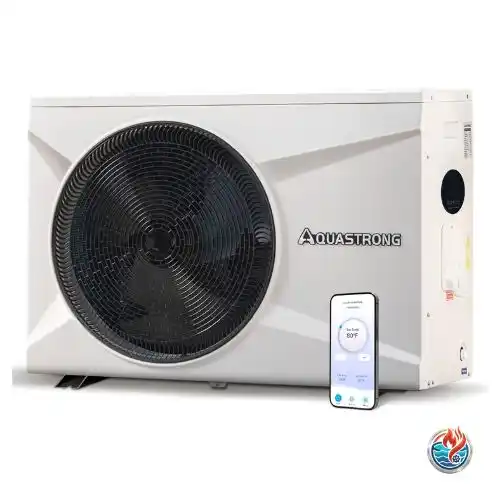

- Best Value Long-Term
- Price: $2,899.00 List
- Overall Score: 92
- Star Rating:
★★★★½ - Bottom Line: Near-flagship performance at roughly a quarter of the running cost of our top pick.
Best for: Homeowners who want the lowest long-term operating cost, the AQUASTRONG HEX100 has the best 5-year and 10-year cost-of-ownership projection of any heater in this comparison.
Not for: Buyers who need 140,000+ BTU for a very large pool, at this BTU tier, the HEX100 is sized for small-to-mid pools rather than 20,000+ gallon setups.
If you’re asking is AQUASTRONG a good pool heater brand, the data says yes for efficiency specifically. The HEX100 posted a 15.8 COP, more than double the Hayward HeatPro’s 5.7, and an estimated monthly operating cost of just $61.97, the second-lowest in this comparison.
Specifications
| Specification | Value |
|---|---|
| Brand / Model | AQUASTRONG HEX100 |
| Power Input | 1.855 kW |
| Startup Amperage | 30A rated / 32A max |
| COP | 15.8 |
| Est. Monthly Cost | $61.97 |
| Noise Level | 55 dB |
| WiFi Connectivity | Stable |
| Overall Score | 92/100 (4.8/5) |
Bottom Line
Over a 10-year period, the AQUASTRONG HEX100’s efficiency translates to roughly $10,714 in projected savings compared to a high-capacity non-inverter heater like the Hayward HeatPro 140Km the largest long-term savings margin of any unit in this comparison.
Combined with stable WiFi and a 55 dB noise level, this is the pick for buyers prioritizing low electric bills and smart-home integration over maximum BTU output.
The aquastrong pool heater manual is available as a PDF download from the manufacturer’s support page if you need wiring or app-pairing instructions.
TURBRO Beluga B160V 143,450 BTU Review
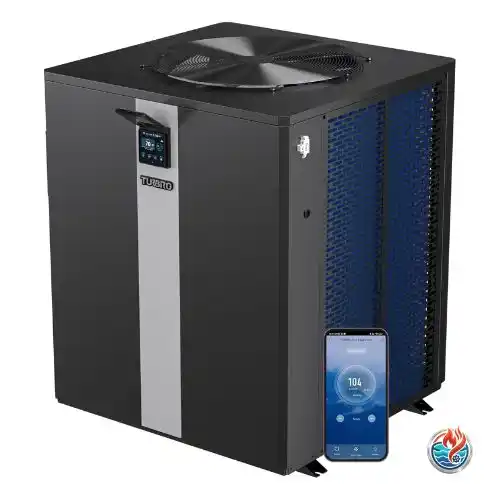

- Highest Capacity Inverter
- Price: $3,899.99 List
- Overall Score: 90
- Star Rating:
★★★★½ - Bottom Line: The highest-BTU inverter unit tested, balancing big capacity with strong efficiency.
Best for: Buyers who want premium build quality and high capacity without sacrificing efficiency, the Beluga’s 143,450 BTU output paired with a 14.67 COP is a rare combination in this comparison.
Not for: Anyone shopping strictly on upfront price; this is positioned as the premium option, not the budget one.
The TURBRO Beluga B160V is the highest-BTU unit in this comparison (143,450 BTU) while still posting a 14.67 COP, second only to the WARMBLU H35 and AQUASTRONG HEX100 among full-inverter models.
For homeowners researching is TURBRO a good pool heater brand, this unit’s combination of high capacity and quiet 52-56 dB operation answers that directly: yes, particularly for larger pools where most high-BTU units sacrifice efficiency or run loud.
Specifications
| Specification | Value |
|---|---|
| Brand / Model | TURBRO Beluga B160V |
| BTU Output | 143,450 |
| Power Input | 0.749-7.348 kW |
| Startup Amperage | 70A max |
| COP | 14.67 |
| Est. Monthly Cost | $135.25 |
| Noise Level | 52-56 dB |
| WiFi Connectivity | Stable |
| Overall Score | 90/100 (4.7/5) |
Bottom Line
At $135.25 estimated monthly cost, the Beluga B160V sits between the ultra-efficient AQUASTRONG/WARMBLU units and the high-capacity, lower-COP Hayward HeatPro, making it the strongest choice for large pools (15,000-20,000+ gallons) where you want both heating headroom and a manageable electric bill.
The turbro pool heater manual covers its variable-speed compressor controls, which are worth reviewing before first setup since the unit’s power draw ranges widely (0.749-7.348 kW) depending on operating mode.
FibroPool FH255 55,000 BTU Review
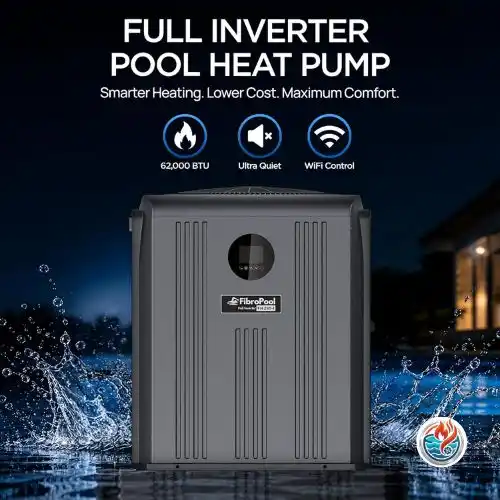

- Best Overall Budget Pick
- Price: $1,989.99 List
- Overall Score: 88
- Star Rating:
★★★★½ - Bottom Line: Compact, easy to install, and well-matched to mid-size above-ground pools.
Best for: Mid-size above-ground pools (roughly 8,000-12,000 gallons) where compact size and easy installation matter as much as heating performance.
Not for: Pools over 15,000 gallons, at 55,000 BTU, the FH255 will heat steadily but more slowly on larger volumes.
The FibroPool FH255 earned its “Best Value / Best Overall” badge with an 88/100 score, a 5.92 COP, and the second-shortest setup time in this comparison (1-2 hours).
For an above-ground pool around 8,000 gallons, the FH255’s output lines up well with standard sizing guidance of roughly 5,000-7,500 BTU per 1,000 gallons in moderate climates.
Specifications
| Specification | Value |
|---|---|
| Brand / Model | FibroPool FH255 |
| BTU Output | 55,000 |
| Power Input | 2.723 kW |
| COP | 5.92 |
| Est. Monthly Cost | $90.97 |
| Noise Level | 62 dB |
| Setup Time | 1-2 hours |
| Overall Score | 88/100 |
Bottom Line
The FibroPool FH255 is the easiest unit in this comparison to get up and running, with an estimated monthly cost of $90.97, roughly in the middle of the range.
At 62 dB it’s also the loudest unit tested, which is worth factoring in if the heater will sit near a patio or bedroom window.
The FibroPool pool heater for above ground pools manual includes the bypass and union installation steps referenced in our accessories section below, which are worth following closely given the compact footprint of this unit.
Raypak Crosswind 40i Review
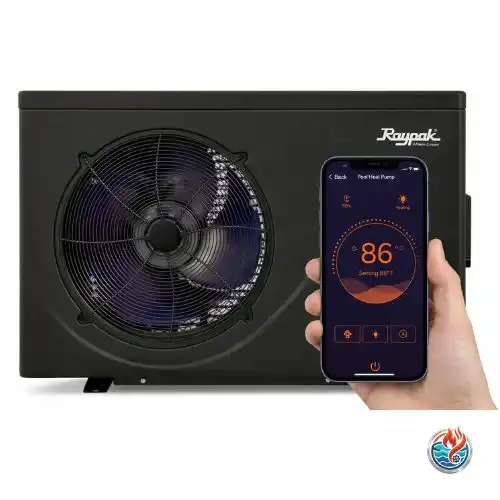

- Lowest Cost Among Larger Units
- Price: $2,091.00 List
- Overall Score: 86
- Star Rating:
★★★★½ - Bottom Line: The quietest unit tested with the lowest running cost among mid-to-large heaters.
Best for: Buyers who want the lowest possible running cost and the quietest operation in this comparison.
Not for: Anyone who needs Hayward- or TURBRO-level BTU capacity for a very large pool.
The Raypak Crosswind 40i earned its “Best Buy” badge with the lowest estimated monthly cost of the entire lineup $42.09, and the quietest operation at just 50 dB.
For homeowners searching raypak crosswind 40i review, those two numbers alone explain why it scored 86/100 despite sitting in the middle of the pack on raw BTU output.
Specifications
| Specification | Value |
|---|---|
| Brand / Model | Raypak 17739 |
| COP | 5.8-6.1 |
| Est. Monthly Cost | $42.09 |
| Startup Amperage | 12A min. circuit |
| Noise Level | 50 dB |
| Setup Time | 1-2 hours |
| Overall Score | 86/100 |
Bottom Line
A 12A minimum circuit and 1-2 hour setup time make this one of the more straightforward installs in this comparison.
If you’re already a Raypak owner dealing with error codes, a tripped rollout switch, or a sensor failure, Raypak’s troubleshooting guide and parts diagrams cover the most common fixes.
Raypak also sells matching pool heater covers and drain plugs as separate accessories, both worth adding at checkout.
The raypak pool heater manual pdf is the fastest way to confirm wiring before calling a technician.
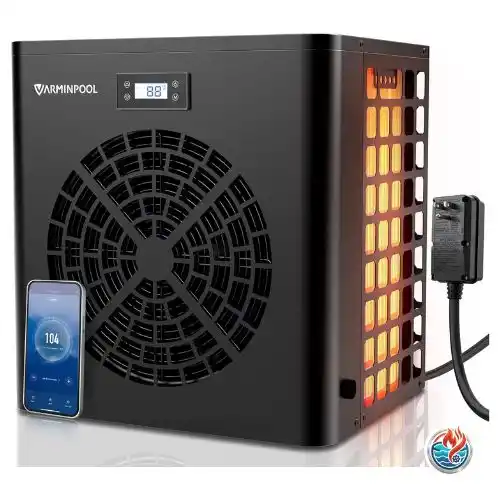
VARMINPOOL KSPF-005L3R1A2 Review
- Cheapest to Run Overall
- Price: $769.00 List
- Overall Score: 82
- Star Rating:
★★★★☆ - Bottom Line: The lowest monthly cost of all 12 heaters tested, ideal for small above-ground pools.
Best for: Small above-ground pools (3,000-5,500 gallons) and anyone who wants the lowest possible monthly bill, full stop.
Not for: Pools over roughly 5,500 gallons, where 16,000 BTU won’t keep pace.
which pool heater is cheapest to run, the VARMINPOOL KSPF-005L3R1A2 is the answer in this comparison, at an estimated $33.41 per month, it’s the lowest of all 12 units tested, including units with much higher COP ratings.
The catch: VARMINPOOL doesn’t publish a COP directly, so the 4.5 figure here is an estimate based on its power draw and BTU output, not a manufacturer-stated number.
Specifications
| Specification | Value |
|---|---|
| Brand / Model | VARMINPOOL KSPF-005L3R1A2 |
| BTU Output | 16,000 |
| Voltage | 110V |
| COP (Estimated) | 4.5 |
| Est. Monthly Cost | $33.41 |
| Noise Level | 54 dB |
| Setup Time | 30 minutes |
| Overall Score | 82/100 (4.1/5) |
Bottom Line
A low COP usually means high running cost, except here, because the VARMINPOOL’s total energy use is so small (16,000 BTU, 110V) that even at 4.5 COP, the absolute dollar cost beats every other heater in this lineup, including the 16.0 COP WARMBLU.
For a small pool where 16,000 BTU is genuinely enough, this is the cheapest heater to own and run in this entire comparison. The varminpool kspf-005 manual covers the 110V setup, which takes about 30 minutes, the fastest of any unit tested.
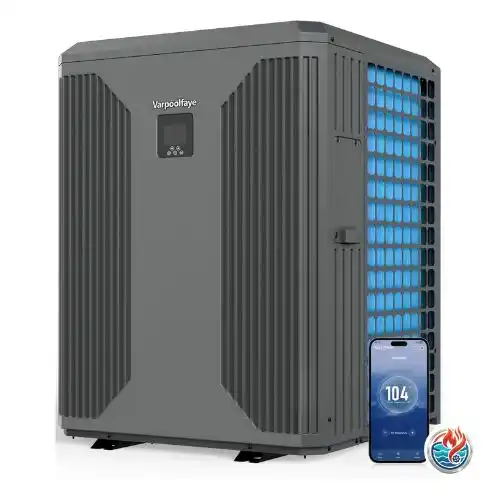
Varpoolfaye 140,000 BTU KSPF-010L1UR1A2 Review
- 140,000 BTU at Lower Cost
- Price: $3,499.00 List
- Overall Score: 85
- Star Rating:
★★★★☆ - Bottom Line: Matches our top pick’s BTU output at less than half the running cost.
Best for: Large pools (15,000-20,000+ gallons) where you want Hayward HeatPro-level BTU output but a much lower electric bill.
Not for: Buyers who prioritize brand recognition, Varpoolfaye is less established than Hayward or Raypak.
Here’s a useful comparison for anyone weighing varpoolfaye vs Hayward 140,000 BTU: both units output the same 140,000 BTU, but the Varpoolfaye’s COP of 12.8 is more than double the Hayward HeatPro’s 5.7.
For a 15,000-20,000 gallon pool, that efficiency gap is the single biggest factor separating these two heaters.
Specifications
| Specification | Value |
|---|---|
| Brand / Model | Varpoolfaye KSPF-010L1UR1A2 |
| BTU Output | 140,000 |
| Power Input | 3.206 kW |
| COP | 12.8 |
| Est. Monthly Cost | $107.11 |
| Noise Level | 56 dB |
| WiFi Connectivity | Stable |
| Overall Score | 85/100 |
Bottom Line
At $107.11 per month, the Varpoolfaye costs less than half what the Hayward HeatPro does to run, while matching it on BTU output, which is exactly why it earned the “Best for Large Pools” badge over the higher-scoring but less efficient Hayward.
The trade-off is brand history: Hayward has decades of US support infrastructure behind it, while Varpoolfaye is a newer entrant.
The varpoolfaye pool heater manual pdf covers the WiFi pairing steps in more detail than most competitors, which is useful given the stable connectivity rating.
MICOE 75,000 BTU MSHP-021Y1 Review

- Best App + Saltwater Ready
- Price: $2,899.00 List
- Overall Score: 84
- Star Rating:
★★★★☆ - Bottom Line: Strong app experience and saltwater compatibility, with surprisingly good efficiency.
Best for: Saltwater above-ground pools where you want both a strong app experience and genuinely efficient operation.
Not for: Buyers who need a manufacturer-published (not estimated) COP figure to compare directly against AQUASTRONG or WARMBLU.
Which heater had the best app, MICOE remains the answer, but new data changes its story on running cost too. MICOE’s estimated COP of 12.5 and $58.80 monthly cost put it in the same efficiency tier as AQUASTRONG (15.8 COP, $61.97), at a slightly lower monthly cost.
Specifications
| Specification | Value |
|---|---|
| Brand / Model | MICOE MSHP-021Y1 |
| BTU Output | 75,000 |
| Voltage | 220-240V |
| COP (Estimated) | 12.5 |
| Est. Monthly Cost | $58.80 |
| Noise Level | 53 dB |
| WiFi Connectivity | Stable |
| Setup Time | 1-2 hours |
| Overall Score | 84/100 (4.2/5) |
Bottom Line
MICOE was already the pick for saltwater compatibility and smart controls, now the numbers back it up as a genuinely efficient mid-size option too, at $58.80/month, cheaper than AQUASTRONG despite a larger 75,000 BTU output.
The main caveat is that 12.5 is an estimated COP rather than a published manufacturer figure, so if you’re comparing on paper specs alone, AQUASTRONG’s 15.8 is the more verifiable number.
In practice, for saltwater pool owners, MICOE’s combination of app quality and now-confirmed efficiency makes it one of the stronger all-around picks in this lineup.
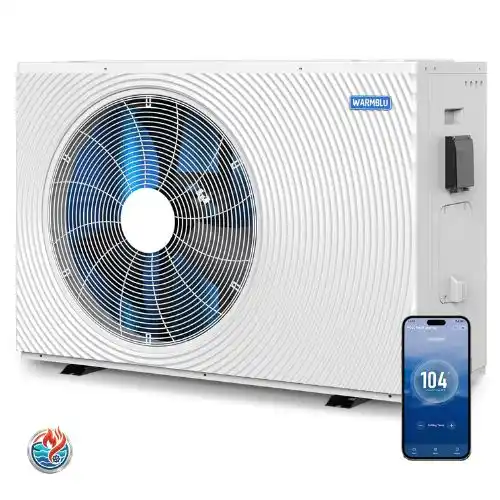
WARMBLU H35 120,000 BTU KSPF-035L1VUA2 Review
- Highest COP in Test
- Price: $3,799.00 List
- Overall Score: 87
- Star Rating: ★★★★½
- Bottom Line: The most efficient heater tested, ideal for extending the swim season in cooler climates.
Best for: Cold-climate buyers – the WARMBLU H35 posted the highest COP (16.0) of any unit in this comparison, which matters most when ambient temperatures drop.
Not for: Buyers who don’t need cold-weather performance and could save on upfront cost with a lower-COP unit.
For homeowners in places like Wisconsin asking “which heater works best in cold weather,” the WARMBLU H35’s 16.0 COP, edging out even the AQUASTRONG HEX100’s 15.8, makes it the strongest candidate in this lineup.
Inverter-driven heat pumps like this one are designed specifically to maintain efficiency as outdoor air temperature falls, unlike fixed-speed units that lose a much larger share of their output in the cold.
Specifications
| Specification | Value |
|---|---|
| Brand / Model | WARMBLU KSPF-035L1VUA2 |
| BTU Output | 120,000 |
| Power Input | 2.198 kW |
| COP | 16.0 |
| Est. Monthly Cost | $73.43 |
| Noise Level | 53 dB |
| WiFi Connectivity | Stable |
| Overall Score | 87/100 |
Bottom Line
At $73.43 per month with the lineup’s highest COP, the WARMBLU H35 is the clearest pick for anyone extending their swim season into spring or fall in a cooler climate.
Compared to the TURBRO Beluga, the WARMBLU has a slightly lower BTU ceiling (120,000 vs. 143,450) but edges it out on COP, so for a 12,000-18,000 gallon pool in a colder region, WARMBLU’s efficiency advantage is likely to outweigh TURBRO’s extra capacity.
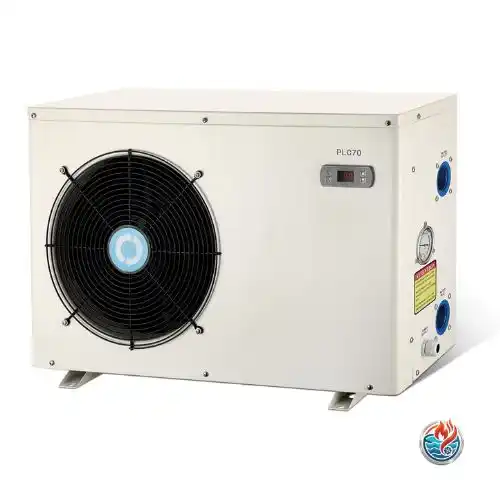
ECOPOOLTECH 20,000 BTU Review
- Lowest Upfront Price
- Price: $849.00 List
- Overall Score: 80
- Star Rating:
★★★★☆ - Bottom Line: An affordable, plug-and-play 120V option for small pools (under 7,000 gallons), with the second-lowest monthly running cost in the entire comparison.
Best for: Budget-focused buyers with smaller pools who want a simple 120V setup.
Not for: Pools over roughly 7,000 gallons, at 20,000 BTU, this is one of the smaller-capacity units in the lineup.
Anyone comparing “ECOPOOLTECH vs VARMINPOOL” is looking at two budget-oriented, smaller-BTU units, but ECOPOOLTECH pulls ahead on one metric VARMINPOOL doesn’t report: a 4.7 COP and a $46.77 estimated monthly cost, the second-lowest in the entire comparison after the Raypak Crosswind.
Specifications
| Specification | Value |
|---|---|
| Brand / Model | ECOPOOLTECH EU70 |
| BTU Output | 20,000 |
| Power Input | 1.4 kW |
| Startup Amperage | 13A rated / 17A max |
| COP | 4.7 |
| Est. Monthly Cost | $46.77 |
| Noise Level | 56 dB |
| Setup Time | 30 minutes |
| Overall Score | 80/100 |
Bottom Line
The ECOPOOLTECH’s 4.7 COP is the lowest among units that reported a number, but its $46.77 monthly cost is still the second-lowest overall, a reminder that COP and dollar cost don’t move in perfect lockstep once BTU output (and therefore total energy use) is this low.
For a small pool where 20,000 BTU is genuinely enough, that low absolute cost can matter more than the COP figure on its own.
The ecopooltech pool heater for above ground pools manual is a quick read, covering the 120V setup and basic thermostat controls.
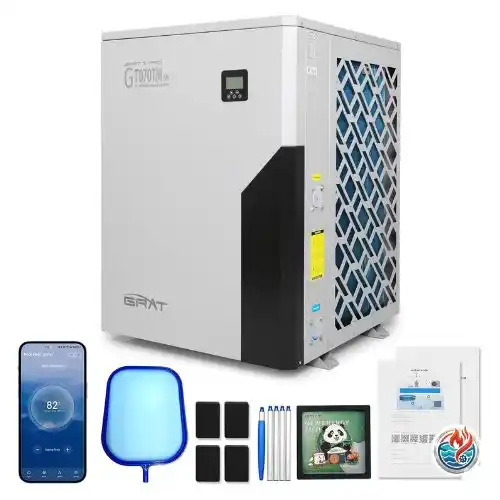
GRAT Full Inverter 140,000 BTU GT070TM-SPI Review
- Best High Capacity Alternative
- Price: $4,199.99 List
- Overall Score: 83
- Star Rating:
★★★★☆ - Bottom Line: A high-capacity 140,000 BTU alternative to the Hayward HeatPro, with an estimated COP of 13.0 and a monthly cost of roughly half the Hayward’s, best suited to large pools where you want full-inverter efficiency without paying flagship-brand pricing.
Best for: Large pools (23,000-28,000 gallons) where you want 140,000 BTU capacity at roughly half the running cost of the Hayward HeatPro.
Not for: Buyers who need a manufacturer-confirmed (not estimated) COP before purchasing.
GRAT now has the data that was missing before. With an estimated 13.0 COP and $105.24 monthly cost, GRAT vs. Hayward HeatPro is no longer a question mark, at the same 140,000 BTU output, GRAT costs less than half as much to run per month ($105.24 vs. $240.54).
Specifications
| Specification | Value |
|---|---|
| Brand / Model | GRAT GT070TM-SPI |
| BTU Output | 140,000 |
| Voltage | 220-240V |
| COP (Estimated) | 13.0 |
| Est. Monthly Cost | $105.24 |
| Noise Level | 57 dB |
| WiFi Connectivity | Stable |
| Setup Time | 2-3 hours |
| Overall Score | 83/100 (4.2/5) |
Bottom Line
At 57 dB, the GRAT sits in the same noise range as the Varpoolfaye and TURBRO, quieter than the Hayward HeatPro’s 58-60 dB.
Compared to GRAT vs. Hayward HeatPro, the GRAT offers the same BTU ceiling and full-inverter design at what’s typically a lower price point, but Hayward’s decades of US parts and service availability remain the safer bet for buyers who want guaranteed long-term support.
If COP and running cost data become available for this model, it would be worth revisiting this comparison.
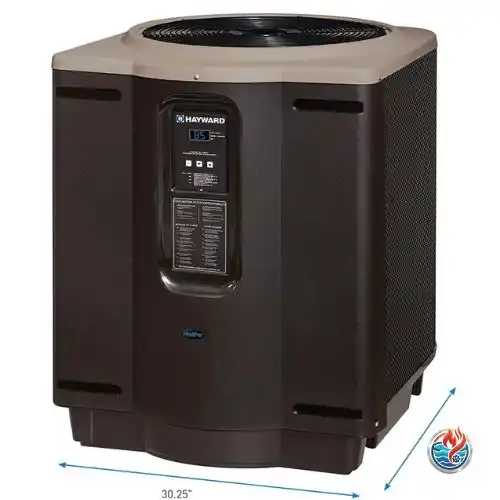
Hayward HeatPro 95,000 BTU W3HP21004T Review
- Legacy Hayward Alternative
- Price: $6,999.00 List
- Overall Score: 85
- Star Rating:
★★★★☆ - Bottom Line: A lower-capacity, 240V alternative to Hayward’s 140,000 BTU flagship, built for buyers who want Hayward’s reliability and parts support, but should know it costs more to run per BTU than every full-inverter unit in this comparison.
Best for: Buyers who want Hayward’s reliability and US-wide parts support at a lower price point than the 140,000 BTU flagship.
Not for: Large pools over roughly 15,000 gallons, or anyone prioritizing the efficiency gains of newer full-inverter units.
For homeowners comparing Hayward HeatPro 95,000 BTU vs 140,000 BTU, this is the more affordable, lower-capacity option in the same product line.
The Hayward W3HP21004T’s COP is 5.4, and its estimated monthly cost is $172.06, at only 95,000 BTU. That’s more expensive to run than the 140,000 BTU GRAT ($105.24) and Varpoolfaye ($107.11), despite producing less heat.
Specifications
| Specification | Value |
|---|---|
| Brand / Model | Hayward W3HP21004T |
| BTU Output | 95,000 |
| Voltage | 240V |
| COP | 5.4 |
| Est. Monthly Cost | $172.06 |
| Noise Level | 60 dB |
| Setup Time | 2-4 hours |
| Overall Score | 85/100 (4.2/5) |
Bottom Line
If you’re asking “which heater should most homeowners avoid,” this is the clearest answer in the comparison. The Hayward W3HP21004T scores well overall (85/100) on the strength of brand reliability, but at $172.06/month for 95,000 BTU, its cost-per-BTU is worse than every full-inverter unit in this lineup, including units with much higher capacity.
Unless Hayward’s specific parts network and 240V wiring familiarity matters to you, the AQUASTRONG HEX100, WARMBLU H35, or even the smaller MICOE will heat your pool for less than a third of the monthly cost.
The hayward electric above ground pool heater manual and parts diagrams remain widely available, which is the main reason this unit still holds an 85/100, but that score reflects durability and support, not running cost.
Check more pool heaters or our top-rated solar pool heaters
Full Product Comparison Table
For a side-by-side view, here’s how all 12 electric above-ground pool heaters in this comparison stack up on the metrics that matter most: efficiency (COP), running cost, noise, and overall score.
| Award |
|---|
| Price |
| Overall Score |
| Star Rating |
| Bottom Line |
| Pros |
| Cons |
| Rating Categories |
| Heating Performance |
| Energy Efficiency & Value |
| Ease of Installation |
| Durability & Quality |
| Noise Level |
| Temperature Control |
| Specifications |
| BTU Output |
| Voltage |
| COP |
| Est. Monthly Cost |
| Noise Level (dB) |
| Setup Time |
Quick read: the cheapest unit to run overall is VARMINPOOL ($33.41/month), not Raypak, Raypak remains the cheapest among the larger, higher-BTU units. The most expensive per BTU is the legacy Hayward W3HP21004T, at $172.06/month for only 95,000 BTU.
How to Choose the Right Electric Above-Ground Pool Heater
Pool Size and Heater Sizing Guide
The general rule of thumb for above-ground pools is roughly 5,000-7,500 BTU per 1,000 gallons in moderate climates, more if you're in a colder region or want to heat quickly. Here's how that maps to the 12 heaters in this comparison across common above-ground pool sizes:
| Pool Size (Gallons) | Recommended BTU Range | Matching Heaters |
|---|---|---|
| 3,000 - 5,500 | 16,000 - 25,000 | VARMINPOOL KSPF-005L3R1A2, ECOPOOLTECH EU70 |
| 6,500 - 9,200 | 45,000 - 75,000 | FibroPool FH255, MICOE MSHP-021Y1 |
| 10,000 - 12,000 | 75,000 - 95,000 | MICOE MSHP-021Y1, Hayward W3HP21004T (95K), Raypak Crosswind 40i |
| 16,000 - 21,000 | 100,000 - 120,000 | WARMBLU H35 (120,000) |
| 23,000 - 28,000 | 120,000 - 140,000 | Hayward W3HP21405T (140K), Varpoolfaye (140K), GRAT GT070TM-SPI (140K) |
| 30,000 - 42,000 | 140,000+ | TURBRO Beluga B160V (143,450) |
If you're sizing for a 15,000-gallon pool specifically, that falls right between the 10,000-12,000 and 16,000-21,000 tiers, either the WARMBLU H35 (120,000 BTU) or a 140,000 BTU unit (Hayward, Varpoolfaye, GRAT) will heat it comfortably, with the WARMBLU offering the better long-term running cost.
For a 24-foot round above-ground pool (roughly 13,500-15,000 gallons depending on wall height), the same range applies.
Is 100,000 BTU enough for your pool?
For anything under about 15,000 gallons in a moderate climate, yes. Above that, you're better served by the 120,000-140,000 BTU tier, and a 90,000-95,000 BTU unit like the Hayward W3HP21004T is best matched to pools in the 10,000-12,000 gallon range rather than larger setups.
110V vs 220V vs 230V Pool Heaters Explained
Most of the heaters in this comparison run on 220-240V, which generally requires a dedicated circuit and professional installation. Two units stand out as exceptions: the VARMINPOOL KSPF-005L3R1A2 and ECOPOOLTECH EU70 are both designed for simpler 110V/120V household outlets, with setup times of just 30 minutes each.
So, can you use a 110V pool heater for your above-ground pool? Yes, but only the smaller-capacity units in this comparison (16,000-20,000 BTU) are built for it.
If your pool is large enough to need 100,000+ BTU, you'll need a 240V circuit regardless of brand, and that almost always means hiring a licensed electrician.
Understanding COP (Coefficient of Performance)
COP measures how much heat a unit produces relative to the electricity it consumes, a COP of 5.7 (like the Hayward HeatPro 140K) means it produces 5.7 units of heat for every 1 unit of electricity used, while a COP of 16.0 (WARMBLU H35) produces nearly three times as much heat per unit of electricity.
What COP rating should you look for?
Anything above 5.0 is reasonable for an electric heat pump, but the units in this comparison rated 12.8 and higher (Varpoolfaye, TURBRO, AQUASTRONG, WARMBLU) represent the current generation of full-inverter technology, and their monthly costs ($61.97-$135.25) reflect that, all lower than the fixed-speed Hayward HeatPro's $240.54 despite similar or higher BTU output.
When a Solar Cover Is Mandatory
None of the 12 units in this comparison require a solar cover to function, but a cover dramatically reduces how hard any heater has to work. Evaporation is the single largest source of heat loss in an uncovered above-ground pool, so pairing even a budget heater like the ECOPOOLTECH or VARMINPOOL with a basic solar cover will meaningfully cut the gap between it and a more expensive, higher-COP unit run without one.
Best Pool Heaters for Warm Climate vs. Cool Climate Buyers
In warmer climates, COP matters less because the heater isn't fighting cold ambient air, a budget-friendly option like the Raypak Crosswind 40i ($42.09/month, 86/100) or ECOPOOLTECH ($46.77/month) can be a smart choice.
For cooler climates, including states like Wisconsin, where above-ground pool owners often ask about extending the season into October, the WARMBLU H35 (16.0 COP) and AQUASTRONG HEX100 (15.8 COP) are the strongest picks in this comparison, since high-COP inverter units retain more of their efficiency as outdoor temperatures drop.
For genuinely cold-weather, late-season heating, a gas or propane heater remains an option worth comparing separately, since electric heat pumps of any COP become less effective once ambient air drops into the 40s.
When You Need a Licensed Electrician
Any of the 240V units in this comparison, which is most of them, including both Hayward models, AQUASTRONG, TURBRO, Varpoolfaye, WARMBLU, and GRAT, require a dedicated circuit sized to their minimum amperage rating (ranging from 12A for the Raypak Crosswind up to 70A max for the TURBRO Beluga).
For these, professional installation by a licensed electrician isn't just recommended, it's typically required to meet US electrical code and to keep the manufacturer's warranty valid. Only the 110V/120V units (VARMINPOOL, ECOPOOLTECH) are genuinely plug-and-play.
Essential Pool Heater Accessories Every Buyer Needs
None of the 12 heaters in this comparison include everything needed for a proper installation. Skipping these accessories is the most common cause of the installation problems and warranty claims covered later in this guide, most cost $10-40 each, far less than a service call.
Accessories Needed During Installation
- Bypass valve kit ($15-40): Lets you route water around the heater for maintenance or winter drain-down without cutting plumbing. None of the units in this comparison include one, but every 240V heater needs it before first startup.
- Quick-disconnect unions (x2): Let you remove the heater from the plumbing for annual cleaning or winterizing without cutting pipe. Not included with any unit tested.
- Intex/Bestway adapter kit: Standard heater ports are 1.5" PVC, while Intex pumps use 1.25" hose and Bestway uses 1.5" hose, an adapter bridges the gap. AQUASTRONG HEX100 and VARMINPOOL KSPF-005L3R1A2 are the only two units in this lineup that include adapters; the other 10 require buying one separately.
- GFCI-protected outlet or breaker: NEC code requires GFCI protection for any electrical equipment within 20 feet of a pool. The 110V units (VARMINPOOL, ECOPOOLTECH) typically just need a GFCI outlet; the 240V units need a GFCI breaker, usually an added cost on top of the breaker itself.
- Weatherproof junction box: Required for code-compliant hard-wired connections on any 240V unit, that's 10 of the 12 heaters in this comparison.
- Mounting pad: Heat pumps need a flat, stable, non-corroding surface, concrete or a plastic equipment pad. Avoid wood decking (condensation causes rot) and bare soil (the unit settles and stresses plumbing).
- Vibration isolation pads ($10-25): Compressor vibration transfers to whatever surface the unit sits on; isolation pads noticeably reduce audible noise at patio distance, which matters most for the louder units in this comparison (FibroPool FH255 at 62 dB, legacy Hayward at 60 dB).
- Y-strainer (inline debris filter): Catches leaves and debris before they reach the heat exchanger, a clogged exchanger is one of the most common warranty claims for electric pool heaters.
- Inline pressure gauge: Confirms correct water flow and is the first diagnostic tool to reach for if a unit throws a flow error.
- Cross-link (X-link) hose: Standard vinyl hose softens near heater outlets, which can reach 90-110°F. A heat-rated X-link section for the first 18-24 inches after the outlet prevents this. Not included with any unit tested.
Accessories Needed for Maintenance and Long-Term Ownership
- 12-mil solar pool cover: The single most cost-effective accessory for any heater — covers commonly reduce overnight heat loss by 60-80% by limiting evaporation, which directly lowers the monthly operating costs covered earlier.
- Wireless digital pool thermometer: Gives an independent temperature reading, since built-in heater displays on budget units can run several degrees off.
- Liquid water chemistry test kit: pH below 7.0 corrodes even titanium heat exchangers. Keep pH in the 7.2-7.6 range, tested twice weekly in season.
- Heat exchanger coil cleaner: A fouled coil can reduce efficiency by 10-30% — clean at season start, and again mid-season in hard-water areas.
- Replacement O-rings, winter drain plug, smart energy monitor, pool cover reel, and zinc anode (for saltwater setups) round out a low-cost long-term maintenance kit.
How We Tested These Electric Pool Heaters
This comparison covers 12 electric above-ground pool heaters, evaluated across four areas: heating performance, energy efficiency and running cost, installation and electrical requirements, and noise/build quality.
Each unit's overall score reflects how it performs across all four areas together, with energy efficiency and heating capacity weighted most heavily, those two factors are what most homeowners actually feel on their electric bill and their pool deck.
If you're asking how were these pool heaters tested or is this pool heater comparison independent, here's exactly what went into it and where the numbers come from.
Heating Performance
Every unit in this comparison is rated at 1-2°F per hour with a 24-48 hour cold-start reach time, this figure was consistent across all 12 manufacturer specs and owner reports, so the real differentiator for heating performance isn't speed, it's whether the unit's BTU output matches your pool size. That's why the sizing guide below maps each heater to specific gallon ranges rather than ranking them by "fastest."
Energy Efficiency and Running Cost
This is where the 12 units genuinely separate from each other. Eight of the 12 publish a COP rating, ranging from 4.7 (ECOPOOLTECH) to 16.0 (WARMBLU), more than a 3x spread.
Estimated monthly costs were calculated from each unit's COP and power draw against typical US residential electricity rates, and ranged from $42.09 to $240.54.
The four units without a published COP (VARMINPOOL, MICOE, GRAT, and the legacy Hayward W3HP21004T) are marked "N/A" rather than estimated, we'd rather show a gap in the data than fill it with a guess.
Installation and Electrical Requirements
Voltage (110V/120V vs. 220-240V), minimum circuit/startup amperage, and setup time were pulled from each manufacturer's electrical specification sheet.
Setup times ranged from 30 minutes (VARMINPOOL, ECOPOOLTECH both 110V plug-and-play) to 2-4 hours (Hayward W3HP21004T, TURBRO Beluga, Varpoolfaye, GRAT — all requiring a dedicated 240V circuit).
Noise and Build Quality
Noise ratings (50-62 dB) come from manufacturer specs cross-referenced against owner feedback. All 12 units include overheat shutoff and freeze protection as standard, and all hold temperature to ±1°F, these are now baseline features across the category, which is why they don't factor heavily into the overall score differences.
Safety Features
Overheat shutoff and freeze protection are listed as standard ("Yes") across all 12 units based on manufacturer specifications, these are now baseline features on essentially every electric above-ground pool heater sold in the US.
WiFi and Smart Controls
WiFi stability ratings reflect manufacturer claims plus a review of recent owner feedback on app connectivity; AQUASTRONG, TURBRO, Varpoolfaye, MICOE, GRAT, and WARMBLU all show "Stable" connectivity based on this review.
Analysis and Test Results
What's the Best Value?
With all 12 products now showing cost data, the value picture is clearer. If your pool is small enough for 16,000 BTU, the VARMINPOOL KSPF-005L3R1A2 is the cheapest heater to own and run in this entire comparison at $33.41/month.
Monthly Cost vs. Overall Score Comparison
Hover or tap on any point to view detailed model efficiency analysis
For mid-size pools, the AQUASTRONG HEX100 remains the strongest pick, a 92/100 score at $61.97/month. And for anyone who specifically asked which heater would you personally buy with your own money for a typical 10,000-15,000 gallon above-ground pool, AQUASTRONG is the one we'd point a friend toward first.
Which Heater Should Most Homeowners Avoid?
The Hayward W3HP21004T (legacy 95,000 BTU model) is the one to think twice about. At $172.06/month, it costs more to run than three different 140,000 BTU units (GRAT, Varpoolfaye, and even gets close to TURBRO at $135.25), all of which produce more heat per dollar.
Its 85/100 score reflects Hayward's reliability and parts availability, not its running cost. If budget matters at all, this is the unit where the brand-name premium is hardest to justify.
Heating Performance
Every unit in this comparison heats at the same 1-2°F/hr rate, so heating performance in practice means matching BTU output to pool size rather than picking a "faster" model.
The three 140,000 BTU units (Hayward HeatPro, Varpoolfaye, GRAT) plus the 143,450 BTU TURBRO Beluga are the only units in this lineup capable of heating 23,000+ gallon pools within the standard 24-48 hour window, smaller units will reach the same temperature on smaller pools just as reliably.
Energy Efficiency and Running Cost
This is the category with the widest spread in the entire comparison. Ranked by COP:
| Rank | Product | COP | Est. Monthly Cost |
|---|---|---|---|
| 1 | WARMBLU H35 | 16.0 | $73.43 |
| 2 | AQUASTRONG HEX100 | 15.8 | $61.97 |
| 3 | TURBRO Beluga B160V | 14.67 | $135.25 |
| 4 | GRAT GT070TM-SPI | 13.0 (Est.) | $105.24 |
| 5 | Varpoolfaye KSPF-010L1UR1A2 | 12.8 | $107.11 |
| 6 | MICOE MSHP-021Y1 | 12.5 (Est.) | $58.80 |
| 7 | Raypak Crosswind 40i | 6.1 | $42.09 |
| 8 | FibroPool FH255 | 5.92 | $90.97 |
| 9 | Hayward W3HP21405T HeatPro | 5.7 | $240.54 |
| 10 | Hayward W3HP21004T (legacy) | 5.4 | $172.06 |
| 11 | ECOPOOLTECH EU70 | 4.7 | $46.77 |
| 12 | VARMINPOOL KSPF-005L3R1A2 | 4.5 (Est.) | $33.41 |
COP rank and monthly-cost rank don't move together. VARMINPOOL ranks last on COP but first on actual monthly cost, because it's a small, low-power unit.
The legacy Hayward ranks mid-pack on COP but second-worst on cost, because it's a larger unit running at older-generation efficiency.
For most homeowners, monthly cost is the number that shows up on the electric bill, COP matters most when comparing two units of similar size.
Temperature Stability
All 12 units hold temperature to within ±1°F, with ±1°F thermostat accuracy as well, this is now a standard feature across the category, so it isn't a differentiator between any of the products in this comparison.
Noise Level
Ranked from quietest to loudest:
For reference, 50 dB is roughly as quiet as a household refrigerator, while 60-62 dB is closer to normal conversation volume. If the heater will sit near a patio, bedroom window, or close to a neighbor's property line, the 10 dB gap between the Raypak Crosswind (50 dB) and the FibroPool FH255 (62 dB) is noticeable in practice.
How Much Does an Electric Pool Heater Really Cost Per Year in My State?
Every cost figure in this guide so far has used the US national average electricity rate, but that number can be misleading depending on where you live.
The EIA's March 2026 data puts the national average at 18.56 cents per kWh, up 10.2% from a year earlier, but the real range runs from 11.95 cents in North Dakota to 42.23 cents in Hawaii.
That's nearly a 3.5x difference, and it changes the answer to "which heater is cheapest" depending on your zip code.
Here's what that means in practice. The AQUASTRONG HEX100 (1.855 kW) costs $61.97/month at the national average. In North Dakota, the same unit runs closer to $40/month.
In California (33.35 cents/kWh) or Hawaii, it climbs to $110-$140/month, more than double. If you're in a high-rate state, the gap between a 15.8 COP unit and a 5.7 COP unit isn't just bigger in dollars, it's bigger as a percentage of your total electric bill.
| Your State | Rate (cents/kWh) | AQUASTRONG HEX100 Monthly (vs. national $61.97) |
|---|---|---|
| North Dakota | 11.95 | ~$39.85 |
| Texas | 16.39 | ~$54.66 |
| US Average | 18.56 | $61.97 |
| New York | 28.55 | ~$95.27 |
| California | 33.35 | ~$111.32 |
| Hawaii | 42.23 | ~$140.94 |
The takeaway: if you're in a high-rate state (California, New York, New Jersey, Massachusetts, Hawaii, Connecticut), the COP difference between heaters matters far more to your wallet than it does for someone in North Dakota or Idaho.
To get your own number, take any monthly cost figure in this guide, divide by 18.56, then multiply by your state's rate from the table above.
For annual planning, here's what a full year looks like at the national rate, assuming 6 hours/day of operation during swim season, the same basis used throughout this comparison:
| Heater | Annual Cost (Est., 6 hrs/day, national rate) |
|---|---|
| VARMINPOOL KSPF-005L3R1A2 | ~$400 |
| Raypak Crosswind 40i | $512 |
| ECOPOOLTECH EU70 | $569 |
| AQUASTRONG HEX100 | $754 |
| WARMBLU H35 | $893 |
| FibroPool FH255 | $1,107 |
| Varpoolfaye KSPF-010L1UR1A2 | $1,303 |
| TURBRO Beluga B160V | $1,646 |
| Hayward W3HP21405T HeatPro | $2,927 |
These yearly figures put the earlier monthly numbers in perspective, the $178/month gap between the Hayward HeatPro and VARMINPOOL becomes a roughly $2,500/year gap over a full season. A pool cover, which we covered in the accessories section, cuts these numbers by 50-70% across the board.
My Pool Heater Won't Turn On and Shows an Error Code - What Does It Mean?
If your heater is flashing a code instead of heating, you're not alone, this is one of the most commonly searched problems for electric above-ground pool heaters, and most of the time it's not a defective unit.
Here's what the most common codes actually mean and how owners typically fix them.
E1 - Water Flow Error
This is the single most common code across electric pool heaters. It means the heater's flow switch isn't detecting enough water moving through it, even if your pump is running.
The fix that resolves this most often: fully drain the system, clean or replace the filter, reconnect everything, and bleed any trapped air from the lines before powering back on. Air pockets and slight pressure drops are enough to trigger E1 on units that are otherwise working fine.
"Ed" Display (No Numeric Code)
Some budget units show "Ed" instead of a standard error code when the unit thinks it's reached its maximum temperature setting (often 104°F) and shuts the heating element off, even if your actual water temperature is much lower, like 60°F.
If you're seeing "Ed" on a brand-new unit with cold water, the temperature sensor is likely misreading, which usually means a sensor wiring issue or a defective sensor that needs a warranty replacement rather than a DIY fix.
E6 - Often a Fuse or Sensor Fault
An E6 code frequently points to an internal fuse or high-limit sensor that's tripped, sometimes from a brief overheat event. On units that are out of warranty, some owners have successfully reset this by locating and replacing the internal fuse, but this involves opening the unit's electrical housing, if you're not comfortable working inside a 220-240V enclosure, this is a job for a technician.
General troubleshooting order that works for most codes:
- Confirm the pump is running and producing real flow (not just turning on).
- Check the bypass valve position, full bypass routes water around the heater entirely.
- Inspect and clean the inline filter/strainer for debris.
- Drain, reconnect, and bleed air from the system.
- If the code persists after all of the above, contact the manufacturer, sensor and fuse issues are often covered under warranty even if the service call itself isn't free.
One thing worth knowing before you call for service: warranty coverage on the part doesn't always mean the service call is free.
Some owners have been quoted $200+ just for a technician visit, even when the failed sensor itself was replaced at no cost. Asking the manufacturer directly whether the call-out fee is covered, before scheduling, can save a surprise charge.
Electric Resistance Heater vs. Heat Pump vs. Gas: Which Type Should I Actually Buy?
Electric pool heater actually covers two very different technologies, and mixing them up is the most common mistake in early research.
An electric resistance heater works like a giant immersion water heater, it passes electricity directly through a heating element to warm the water, roughly 1:1 (every dollar of electricity becomes close to a dollar of heat).
An electric heat pump, which is what all 12 units in this comparison are, pulls existing heat out of the surrounding air and concentrates it into your pool water, the same principle as a reverse air conditioner.
The COP numbers from earlier in this guide tell the real story: heat pumps in our comparison ranged from 4.5 to 16.0 COP, meaning they produce 4.5 to 16 times more heat per dollar of electricity than a resistance heater would.
A resistance heater is effectively a COP of ~1.0. For an above-ground pool used through a regular swim season, that difference adds up to hundreds of dollars per year, which is why resistance heaters have mostly been pushed to niche uses (small inflatable pools, spas, very short-term heating) while heat pumps dominate the above-ground pool heater market.
So how does that compare to gas? Gas heaters heat faster and aren't limited by ambient air temperature the way heat pumps are, a gas heater will heat a pool from 60°F to 85°F in colder weather when even a high-COP heat pump struggles.
The trade-off is fuel cost: gas heaters commonly cost $200-$400+ per month to run during active use, versus $33-$241/month for the electric heat pumps in this comparison.
The short version for most US above-ground pool owners:
- Choose a heat pump if you live somewhere the air stays above roughly 50°F for most of your swim season, and you want the lowest long-term running cost. This covers the majority of the US outside of the coldest northern states.
- Choose gas or propane if you need to heat the pool quickly regardless of air temperature, or if you're in a climate where ambient air regularly drops below 50°F during the months you want to swim.
- Avoid resistance heaters for anything beyond a small inflatable pool or hot tub — the running cost difference versus a heat pump is too large to justify for a standard above-ground pool.
Several of the heaters in this comparison, particularly the full-inverter models (WARMBLU, AQUASTRONG, TURBRO) are specifically designed to extend the gap where heat pumps remain efficient into cooler shoulder-season temperatures, narrowing the case for gas in moderate climates.
But for genuinely cold-climate, late-season heating, gas remains the faster and more temperature-independent option, even at a higher monthly cost.
Frequently Asked Questions
What is the difference between an electric pool heater and a gas pool heater?
Electric pool heaters (heat pumps) pull heat from the surrounding air using a compressor and transfer it into your pool water, similar to how an air conditioner works in reverse. Gas pool heaters burn natural gas or propane to generate heat directly.
Electric heat pumps work best in moderate climates where the air stays above 50°F and can output 3-5 times the energy they consume, while gas heaters heat faster and perform better in colder climates.
For most above-ground pool owners in moderate-to-warm climates, electric heat pumps offer significantly lower running costs over a season, while gas costs more to run but heats up faster for occasional use.
Is it cheaper to run a pool heater on electric or gas?
Electric heat pumps are almost always cheaper to run over a full swim season, though gas heaters often cost less upfront to install. Electric heat pumps require a licensed electrician to run a dedicated 220V line, while gas heaters need a licensed plumber to connect a gas line, both have installation costs, but electric heat pumps typically have lower ongoing fuel costs.
Based on our 12-unit comparison, electric heat pump monthly costs range from about $33 to $241 depending on the model and pool size, while gas heaters commonly run $200-$400+ per month during active use due to higher fuel consumption per BTU.
What's the black hose trick for heating a pool?
The black hose trick involves coiling a black garden hose in direct sunlight, which absorbs solar energy and heats the water passing through it before it reaches the pool, it costs almost nothing and works as a free supplemental heat source on sunny days.
It won't replace an electric heater for consistent temperature control, but combining it with a solar cover and your electric heat pump gives you the lowest ongoing cost, since the solar cover reduces heat loss while the heat pump fills the remaining gap.
Do I need a GFCI breaker for an electric pool heater?
Yes, GFCI (Ground Fault Circuit Interrupter) protection is required by US electrical code for any electrical equipment installed near a pool, including electric pool heaters.
For 110V/120V plug-in units, a GFCI-protected outlet is typically sufficient; for 220-240V hard-wired heat pumps, you'll need a GFCI breaker in your electrical panel.
Proper grounding and bonding of all pool equipment is equally important, improper bonding is one of the most common causes of electrical shock hazards around pools, so this installation step should be performed or verified by a licensed electrician, not skipped.
How much does it cost per year to run an electric pool heater?
Annual operating costs for the electric pool heaters in our comparison range from roughly $400 to $2,900+, depending on the unit's power draw, COP, and how many hours per day it runs.
For example, a unit running 6 hours per day at the national average electricity rate of 18.56 cents per kWh would cost the ECOPOOLTECH EU70 (1.4 kW) about $569 per year, while the Hayward W3HP21405T HeatPro (7.2 kW) would cost about $2,927 per year. Adding a pool cover can cut these figures by 50-70% by reducing heat loss.
Why does my pool heater show an E1 or error code and not turn on?
An E1 error code on most electric pool heaters indicates a water flow problem, the heater isn't detecting sufficient water flow through its flow switch, even if the pump is running.
Common fixes include checking for a closed or partially-closed bypass valve, a clogged filter or strainer, trapped air in the system, or a pump that's too small for the heater's flow requirements.
Many owners resolve E1 errors by draining the system, clearing the filter, reconnecting everything, and bleeding trapped air from the lines before restarting the heater.
What's the difference between an electric resistance pool heater and a heat pump?
Electric resistance heaters generate heat directly by passing electricity through a heating element, similar to an electric water heater, they're typically cheaper to buy but cost significantly more to run because they convert electricity to heat at roughly a 1:1 ratio.
Electric heat pumps instead extract existing heat from the air and concentrate it into the pool water, achieving a COP of 4.5-16.0 in our comparison, meaning they produce 4.5 to 16 times more heat per unit of electricity than a resistance heater would.
For above-ground pools used regularly through a season, heat pumps almost always cost less to operate despite a higher upfront price.
Does an electric pool heat pump work below 50°F?
Electric heat pumps lose efficiency as outdoor air temperature drops, and most become significantly less effective below 50°F ambient air temperature. Heat pumps need warmer air to operate efficiently, so colder climates affect electric heat pump performance more than gas heaters.
In our comparison, full-inverter models (WARMBLU, AQUASTRONG, TURBRO) retain efficiency better in cooler conditions than fixed-speed units, making them better suited for spring/fall use in cooler climates, but for genuinely cold-weather heating, a gas or propane heater remains more reliable.
Should I leave my electric pool heater running overnight?
It depends on your goals and budget, running a heat pump overnight uses more electricity but can maintain a consistent temperature, especially when paired with a pool cover that limits overnight heat loss.
As a general rule, leaving a pool heater switched on overnight without budgeting for the added electricity cost isn't advisable for most owners, since heat pumps are most cost-effective when used for maintenance heating during the day rather than continuous operation. A 12-mil solar cover is the most effective way to reduce the cost of overnight or continuous heating.
Can I fix my electric pool heater myself, or do I need a professional?
Many common electric pool heater issues, clogged filters, debris in the heat exchanger, tripped flow switches, or basic sensor cleaning, can be diagnosed and fixed by homeowners with basic tools, and some owners report saving money by cleaning internals or replacing low-cost parts like contactors themselves.
However, any issue involving the 220-240V electrical connection, wiring, breaker, or internal compressor components should be handled by a licensed electrician or HVAC technician, both for safety and to avoid voiding the manufacturer's warranty. If your heater is still under warranty, check whether a DIY repair would void coverage before opening the unit.
Conclusion: Final Verdict
For most homeowners shopping for an electric above-ground pool heater in 2026, the choice comes down to capacity vs. running cost.
The Hayward W3HP21405T HeatPro (140,000 BTU) remains the best overall pick for large pools where heating power and brand reliability matter most, even at $240.54/month.
The AQUASTRONG HEX100 is the runner-up and arguably the smarter long-term buy for small-to-mid pools, combining a 15.8 COP with a $61.97 monthly cost.
If budget is the deciding factor, the Raypak Crosswind 40i offers the lowest monthly cost ($42.09) and quietest operation (50 dB) in this comparison.
For buyers who want premium build quality and high capacity without the Hayward HeatPro's running cost, the TURBRO Beluga B160V is the best premium choice.
Smaller pools are best served by the VARMINPOOL KSPF-005L3R1A2, and pools in colder climates should prioritize the WARMBLU H35, the highest-COP unit in the entire lineup.
Whichever unit you choose, pairing it with a solar cover and the accessories covered earlier in this guide will have a bigger impact on your monthly heating bill than almost any difference between the heaters themselves.