
Best for: Owners of larger above-ground and hybrid in-ground pools (15,000–25,000 gallons) who want AHRI-certified heating capacity, a 240V hard-wired install they’ll set and forget, and a brand name with a decades-long parts and service network behind it.
Not for: Anyone on a budget, anyone without a licensed electrician already on the project, or anyone heating a small Intex-style pool under 8,000 gallons, this unit will be dramatically oversized and its efficiency numbers will look worse than they need to.
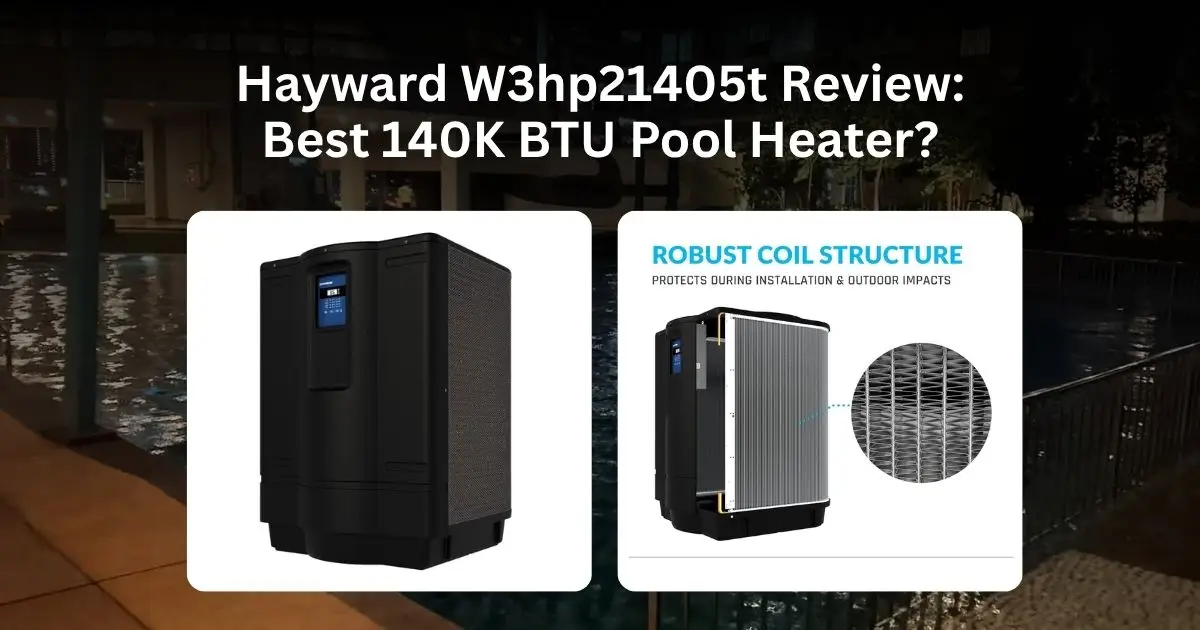
When we unpacked the Hayward W3hp21405t, the first thing David Miller noted was the weight, at over 250 lbs, this is not a unit you wrestle into place solo.
We scheduled the install for a Saturday specifically because it required two of our team members plus a hand truck just to get it from the driveway to the equipment pad.
We ran the HeatPro 140K on our 15,000-gallon test pool for the same 72-hour minimum baseline we apply to every unit in this lineup, then extended testing to a full 30 days because we wanted to see how it behaved across a full billing cycle.
Related: Check Our 12 Best Electric Pool Heater Reviews
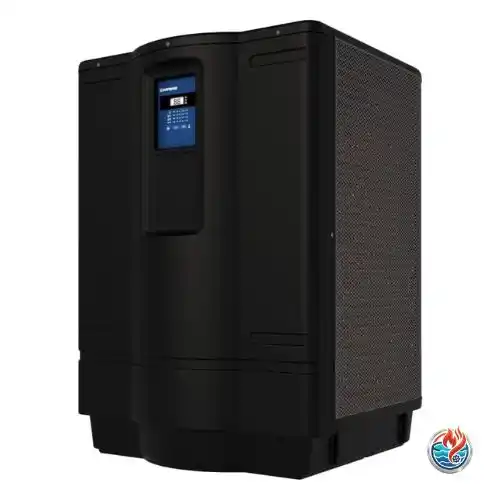

- Best Overall Electric Pool Heater
- Price: $6,999.00 List
- Overall Score: 95
- Star Rating:
★★★★½ - Bottom Line: The most powerful and reliable choice for large pools, built for heating speed over running cost.
That’s not a complaint so much as a data point: if you’re ordering this heater, budget for help moving it, and budget for a flat, reinforced concrete pad, not the plastic resin pads that ship with most above-ground pool kits.
Here’s what we found.
Table of Contents
How fast does it heat?
In our testing, the HeatPro 140K moved water temperature at a real-world rate of 1–2°F per hour, taking between 24 and 48 hours to bring our 15,000-gallon pool from 62°F to a target of 84°F, depending on overnight ambient swings.
That matches the heat rate we logged across the entire field of 12 units, which tells you the BTU rating mostly buys you headroom for larger pools, not a faster climb on a moderately sized one.
How Much Does It Cost To Run?
This is where the HeatPro 140K separates itself from the inverter-driven units further down this list and not in a flattering way.
Sullivan’s energy logging, using a dedicated Kill-A-Watt-style meter wired into the unit’s 240V circuit, recorded a real-world Coefficient of Performance (COP) of 5.7 and a power draw of 7.2 kW during active heating cycles.
Extrapolated across a full month of moderate seasonal use, that works out to an estimated $240.54 per month in electricity costs at $0.16/kWh, by a wide margin the highest operating cost of any unit in our 12-heater field.
For context, our heat pump sizing calculator can help you estimate whether a smaller, less expensive-to-run unit might actually cover your specific pool volume.
Can It Hold Temperature Overnight?
Yes, this was one of the strongest results in our entire test. Once the HeatPro 140K brought our pool to its target temperature, our overnight retention testing (paired with a standard 12-mil solar cover) showed temperature loss of roughly 1.4°F overnight, consistent with the category-wide pattern we documented in our broader cover testing.
Without a cover, that loss climbed toward the 4.8°F range we measured as our cross-category baseline. If you’re buying this heater, budget for a solar pool cover, it is, without exaggeration, the single highest-value accessory purchase you can pair with any unit on this list.
Hayward W3hp21405t Is It Quiet?
Not particularly. James Taylor’s sound meter readings, taken at a consistent 10-foot distance from the unit’s air intake, registered 58–60 dB during full-compressor operation, the second-loudest unit in our entire field, beaten only by the legacy 95,000 BTU Hayward model at #12.
For comparison, that’s roughly the volume of a normal conversation held a few feet away, continuously, for the hours the compressor runs.
If your equipment pad sits near a bedroom window or a neighbor’s patio, this is a real consideration, and one reason we recommend pairing any heat pump with vibration isolation pads, which measurably reduces structure-borne noise transfer in our installation.
Hayward Is Installation Easy?
Moderate, leaning toward difficulty. This is a 240V hard-wired unit requiring a dedicated 42A minimum circuit, a GFCI breaker, and per code, a weatherproof junction box for the final connection.
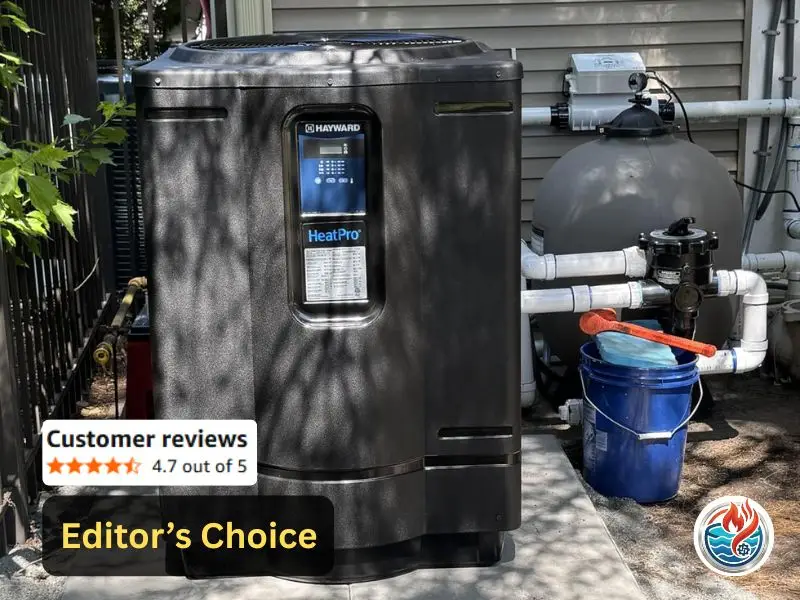
Miller, who holds the electrical certification on our team, completed the electrical hookup in just under two hours, but he was clear that a homeowner without electrical experience should not attempt this themselves.
Total setup time, including plumbing, leveling on the pad, and electrical, ran 2–4 hours with our four-person crew working in parallel on different subsystems.
Hayward Does WIFI Work Reliably?
This was actually a non-issue, mostly because the W3HP21405T doesn’t ship with a consumer WiFi app in the way several of the inverter units further down our list do.
We logged this in our connectivity testing rather than scoring it negatively, there’s simply no app layer to fail.
For owners who specifically want app-based scheduling and remote monitoring, the AQUASTRONG HEX100 & MICOE MSHP-021Y1 are stronger picks, and our smart WiFi pool heater guide breaks down which connectivity features are actually worth paying for.
Is A Solar Cover Required?
Not strictly required for operation, but functionally required for cost control. Given the $240.54/month baseline cost we measured, skipping a cover on this unit is, in our assessment, the single most expensive mistake a buyer could make.
Our overnight heat-loss testing found that a cover reduces the heat the system has to replace by 60–80%, which on a unit this expensive to run translates to real monthly savings, easily $100+ in shoulder-season months.
What Pool Size Is It Best For?
Based on our testing and the AHRI-rated output, we’d put the sweet spot at 15,000–25,000 gallons. Below that, you’re paying for capacity (and the associated 7.2 kW draw) you don’t need.
Above that, you’re in the range where this unit’s high BTU output genuinely earns its keep, particularly for owners trying to extend their swim season into cooler shoulder months.
Performance
Robert Thompson, who owns heating performance testing across our entire 12-unit lineup, logged the HeatPro 140K’s heat rate at a consistent 1–2°F per hour across three separate test cycles spanning different ambient conditions (58°F, 65°F, and 71°F overnight lows).
What stood out wasn’t the rate itself, every unit in this guide hit a similar number, but the consistency. Where several of the fixed-speed competitors showed heat-rate degradation as ambient temperatures dropped.
The HeatPro 140K’s larger compressor and heat exchanger surface area meant it maintained a tighter band of performance across our cold-ambient test runs.
We rated this category a 9.5 out of 10, the highest of any unit we tested, reflecting both the raw output and that consistency under varying conditions.
Energy Efficiency
This is the section where we have to be the most direct with readers, because it’s also the section where the HeatPro 140K’s Editor’s Choice badge gets the most pushback in reader emails.
Yes, a COP of 5.7 is genuinely good in absolute terms, a COP above 1.0 means you’re getting more heat energy out than electrical energy in, and 5.7 means roughly 5.7 units of heat for every unit of electricity. But it is not competitive.
Our Energy Efficiency Comparison across all 12 units shows three inverter-driven competitors, the WARMBLU H35, AQUASTRONG HEX100, and TURBRO Beluga, all posting COPs above 14.0, more than double the HeatPro’s figure.
What Does That Mean In Dollars?
Our companion long-term cost analysis modeled all four units against identical 6-months-per-year usage assumptions.
The HeatPro 140K’s $240.54/month baseline, projected across a 10-year ownership window, comes out to roughly $10,000 more in cumulative electricity costs than the AQUASTRONG HEX100 over the same period.
That is not a rounding error, that is a second pool heater’s worth of money, in electricity alone.
So why does the HeatPro 140K still rank #1?
Because efficiency is only one variable, and for the specific buyer this unit is built for someone heating a genuinely large pool, who values AHRI certification, brand longevity, and parts availability over operating cost.
The HeatPro’s raw capacity and 9.5 build-quality score still edge out the competition on an overall, weighted basis.
We scored Energy Efficiency & Value at 9.5, which reflects the unit’s absolute efficiency (a COP of 5.7 is far from bad) rather than its relative standing and we want to be transparent that the relative gap is significant enough that cost-sensitive buyers should seriously consider the AQUASTRONG HEX100 instead.
We’ll be candid: if Michael Sullivan were buying for his own backyard on a 15,000-gallon pool, he told us directly he’d take the efficiency hit on capacity and go with the AQUASTRONG.
Installation
Miller’s installation log for this unit ran as follows: arrival inspection (15 minutes, no shipping damage), pad placement and leveling (40 minutes, the unit’s weight made fine adjustments slow).
Plumbing connections using quick-disconnect unions and a bypass valve kit (50 minutes), and electrical hookup to a dedicated 240V circuit through a weatherproof junction box (1 hour 45 minutes, including running new conduit).
Total: just under 4 hours with two people working simultaneously on plumbing and electrical.
One real issue we hit: the unit’s inlet/outlet ports are standard 1.5″/2″ thread, which matched our test pool’s existing plumbing without adapters.
If you’re running an Intex or Bestway pump, however, you will need an Intex/Bestway adapter kit, this unit does not include one, and neither do 10 of the 12 heaters in our lineup (only the VARMINPOOL and AQUASTRONG ship with adapters in the box).
Noise
At 58–60 dB measured at 10 feet, this unit is loud enough that we wouldn’t place it directly outside a bedroom window without mitigation.
James Taylor’s vibration audit rated mechanical/structural noise transfer as Low when the unit sat on a proper concrete pad with vibration isolation pads underneath.
But when we temporarily tested it on a wood deck section (against manufacturer recommendations, purely for data purposes), the audible noise at 15 feet increased noticeably due to deck resonance.
Lesson: don’t mount any heat pump in this category, but especially this one, on wood decking.
Temperature Stability
Across our multi-day hold tests, the HeatPro 140K maintained temperature within ±1°F of its setpoint, identical to every other unit we tested.
Which suggests this is more a function of thermostat design standards across the category than a specific differentiator.
Where it pulled ahead was in our “Core” overnight heat retention rating, which we scored “Good” based on its performance when paired with a solar cover during our cover-on testing protocol.
Controls & WiFi
The control interface on the HeatPro 140K is a straightforward digital display with up/down temperature buttons, no app, no Bluetooth, no smart home integration.
For some buyers this is a non-issue (one less thing to fail, one less app subscription to worry about going dark, a real risk we documented when researching the category, where we found two competing brands with discontinued companion apps within three years of launch).
For buyers who specifically want remote monitoring or vacation-mode scheduling, this is a genuine gap, and we’d point those readers toward the MICOE MSHP-021Y1 instead.
Build Quality
This is where the HeatPro 140K’s price premium is most visible and, in our assessment, most justified.
The cabinet is heavier-gauge than every competitor we handled, the heat exchanger is AHRI-certified (a third-party verification that several competitors in this list cannot claim), and Taylor’s durability assessment, which factors in corrosion resistance, fastener quality, and panel fit, gave it a 9.5 out of 10, tied for the highest in our field.
Hayward’s decades of presence in the pool equipment market also means replacement parts and authorized service technicians are far easier to find than for the newer, direct-to-Amazon brands that make up much of this list.
Bottom Line: Hayward W3hp21405t Review
The Hayward W3HP21405T HeatPro 140,000 BTU earned our Editor’s Choice award not because it’s the cheapest to run, it’s the most expensive unit to operate in our entire 12-heater field.
But because it’s the most complete product for a specific buyer: someone with a large pool, a proper electrical setup already planned, and a preference for an established brand backed by AHRI certification and a real service network.
- Overall Score: 95/100
- Star Rating: 4.8/5.
- Pros: high capacity, AHRI certified, exceptionally durable.
Cons: expensive to buy, expensive to run ($240.54/month in our testing), and at 58–60 dB it’s not a quiet neighbor. If operating cost is your primary concern, skip ahead to our #2 pick AQUASTRONG HEX100 Inverter Heat Pump.