

Most pool heating advice tells you what to buy. We tell you why you’re about to waste money, and how to stop.
The Problem Nobody Talks About
Table of Contents
The Internet Has a Pool Heater Problem – And It’s Costing You Real Money
Here’s what actually happens when most U.S. pool owners try to buy a heater:
They Google it. They find 10 blog posts. Every single one says the same thing, same product specs, same “Top 10” list, same generic advice that sounds like it was written by someone who has never owned a pool in their life.
Then they buy. And then, 4 weeks later, they’re standing next to a heater that cost them $600, $800, maybe $1,100, and their pool is still 62°F on a Saturday morning in April.
“The problem isn’t lack of information. It’s information with zero context, spec sheets dressed up as advice.”
Chris Anderson, Lead Editor, AboveGroundPoolHeater.com
A 120V electric heater will heat your pool if your pool is under 5,000 gallons and your ambient temperature stays above 55°F. Put that same heater on a 15,000-gallon pool in Dallas during a cold front? It won’t move the needle. Not even close.
That’s not bad luck. That’s bad guidance. And that’s exactly why this site exists.
Who We Are | ABOUT
We’re Not Bloggers. We’re People Who’ve Actually Installed These Things.
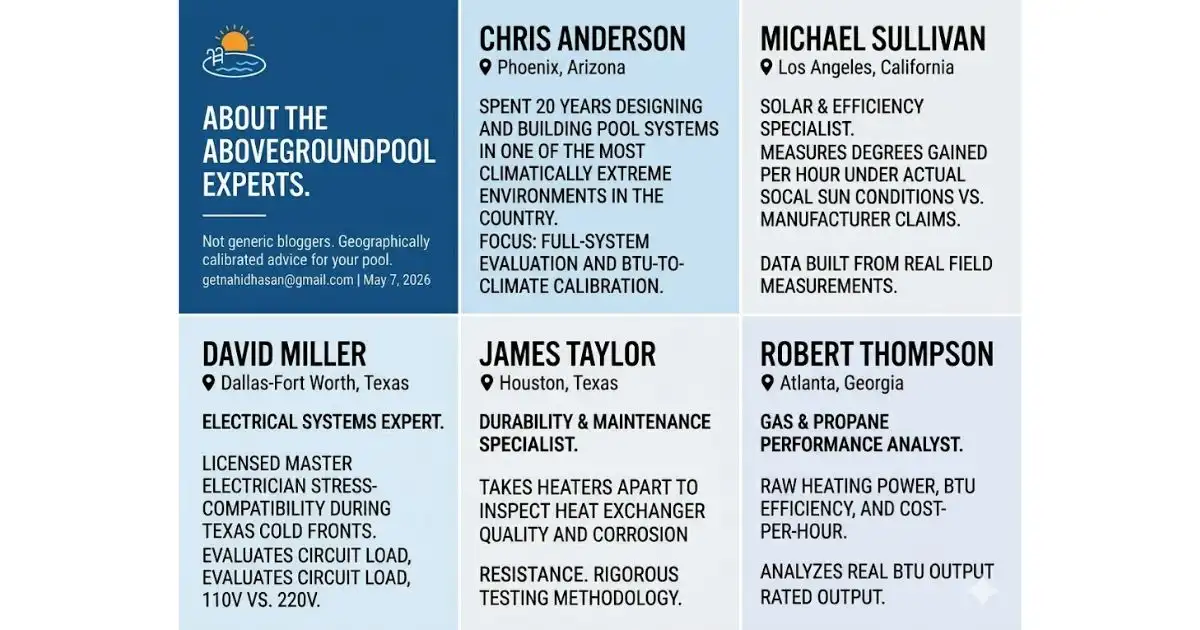
AboveGroundPoolHeater.com is a team of five pool heating specialists, a master electrician, a durability engineer, a solar efficiency analyst, a gas systems expert, and a lead editor, spread across four different U.S. climates.
That’s not a marketing line. That’s the setup we built deliberately, because climate changes everything when it comes to pool heating performance.
What works in Phoenix doesn’t work in Houston. What’s efficient in Los Angeles is underpowered in Atlanta. Our team is geographically distributed, so we can give you recommendations that are actually calibrated to where you live, not some average of everywhere.
- No Brand Sponsorships
- No Paid Rankings
- No Featured Placement Deals
- Amazon Affiliate – Disclosed
- Multi-Climate Testing
Check More:
- Meet the Full Team
- Our Editorial Policy
- Our Testing Methodology
Our Origin Story
This Site Started With a $800 Mistake We Watched Someone Else Make
Years ago, Chris watched a homeowner spend over $800 on a heater that looked bulletproof on paper. Correct BTU rating. Solid reviews on Amazon. Recommended by multiple pool forums.
The heater arrived. Got installed properly. And completely failed to do what was expected of it in real-world conditions.
The specs were technically correct.
The reviews were technically accurate.
The advice online was technically sound.
But none of it accounted for pool surface area heat loss, overnight ambient temperature drop, or the actual BTU demand of a 14,000-gallon pool in an exposed backyard.
Nobody online had thought to ask: what’s your actual situation?
That’s the gap we built this site to close. No more specs. Not more lists. A real decision framework that accounts for your pool, your climate, and your budget, and gives you a direct answer instead of a list of ten options to figure out yourself.
⚡ Our Contrarian Belief
Most sites optimize for “Best Heater Overall.” We think that phrase is meaningless. There is no best heater overall. There is only the right heater for your exact pool size, climate zone, and budget, and they’re often completely different products.
The Expert Team
Five Specialists. Four States. One Goal: Get Your Pool to the Right Temperature.
Here’s who’s actually behind the content on this site, what they specialize in, and why their specific location matters for the advice they give.
Chris Anderson
Lead Editor & System Architect | 📍 Phoenix, Arizona
Primary Focus: Full-system heater evaluation, pool size matching, BTU-to-climate calibration, and overall site editorial standards.
Chris has spent 20 years designing and building pool systems in one of the most climatically extreme environments in the country. Phoenix summers hit 115°F, which creates a counterintuitive problem: brutal UV degrades heater components fast, and cold desert nights in spring and fall require more heating capacity than most people expect.
He connects all the individual expertise on this team into clear, actionable guidance for pool owners.
Michael “Mike” Sullivan
Solar & Efficiency Specialist 📍 Los Angeles, California
Primary Focus: Real-world solar heater performance, degrees gained per hour under actual SoCal sun conditions vs. manufacturer claims.
Mike measures what most sites ignore: does the solar heater actually perform as advertised when you account for cloud cover, pool surface area, shading, and ambient temperature? His data on solar above-ground pool heaters is built from real field measurements, not manufacturer spec sheets.
He’s also the team’s expert on solar ROI: when does solar actually pay for itself vs. electric, and when is it just wishful thinking?
David Miller
Electrical Systems Expert 📍 Dallas-Fort Worth, Texas
Primary Focus: Answering the question most buyers miss: Will this heater actually work safely in your home’s electrical setup?
David is a licensed Master Electrician. He stress-tests electric above-ground pool heaters during Texas cold fronts, some of the most demanding performance conditions in the country for residential pool heaters. His evaluations cover circuit load compatibility, 110V vs. 220V real-world performance gaps, and safe wiring requirements.
If a 120V heater will fail in your setup, David will tell you before you buy it, not after.
James “Jim” Taylor
Durability & Maintenance Specialist 📍 Houston, Texas
Primary Focus: Long-term durability, because humidity destroys bad equipment, and Houston is one of the most unforgiving environments in the U.S. for pool hardware.
Jim literally takes heaters apart. He inspects heat exchanger quality, tests for corrosion resistance, and evaluates build quality at the component level, not from the outside of the box. His goal: help you buy something that lasts 5–10 years, not something that fails after two seasons.
His testing methodology for long-term durability is the most rigorous on our team. If a heater has a weak heat exchanger or corrodes quickly in humid conditions, it shows up in his reviews before it shows up in your backyard.
Robert “Rob” Thompson
Gas & Propane Performance Analyst 📍 Atlanta, Georgia
Primary Focus: Raw heating power, BTU efficiency, combustion safety, and cost-per-hour operation for gas and propane heaters.
Rob focuses on high-BTU gas and propane pool heaters, the type of heater that large pool owners need when electric simply can’t keep up. He analyzes real BTU output vs. rated output, combustion safety in residential settings, and cost-per-hour comparisons between natural gas and propane across different U.S. gas price regions.
If you have a pool over 15,000 gallons, Rob’s insights will likely save you serious money on both the heater purchase and your monthly operating costs.
How We Test
The Warm Water Data Lab™, Our Multi-Stage Evaluation System
We don’t publish reviews based on Amazon star ratings or manufacturer claims. Every heater recommendation on this site goes through a structured, multi-stage evaluation process we call the Warm Water Data Lab™.
- Efficiency Testing: We measure actual degrees gained per hour under controlled conditions, and compare that against rated BTU output to find the gap between spec-sheet claims and real-world performance.
- Electrical & Safety Analysis: David Miller tests real-world circuit compatibility, not just rated voltage. This catches the 120V heaters that will trip breakers, fail in cold weather, or require wiring upgrades that your home may not have.
- Durability Inspection: Jim Taylor physically disassembles units to inspect heat exchanger quality, O-ring integrity, corrosion-resistance of internal components, and build quality at the part level, not just the exterior.
- Multi-Climate Simulation: Heaters are tested across our four team locations: desert heat (Phoenix), coastal UV (Los Angeles), humid summers and cold fronts (Texas), and moderate shoulder seasons (Atlanta). The same heater can behave very differently across these environments.
- Cost-of-Operation Modeling: We don’t just calculate the purchase price. We model daily, monthly, and seasonal operating costs for each heater type based on current U.S. energy prices, so you know the true cost of ownership before you buy.
Editorial Integrity
Why You Can Trust What We Publish
We earn revenue through Amazon affiliate commissions. That means if you click a link on this site and make a purchase, we receive a small percentage, at no additional cost to you.
Here’s what that doesn’t mean: we don’t rank products by commission rate. We don’t accept payment from brands to appear in our guides. We don’t write positive reviews in exchange for free products. We don’t change our conclusions based on what a manufacturer wants us to say.
“We recommend what works, even when it pays us less. Long-term trust is worth more than short-term commissions.”
AboveGroundPoolHeater.com Editorial Policy
🚫
No Sponsored Content
Brands cannot pay to appear in our recommendations.
🚫
No Paid Rankings
Products rank on performance, not commission rate.
✅
Affiliate Disclosed
Brands cannot pay to appear in our recommendations.
✅
Independent Testing
Our testing process is the same regardless of brand or price point.
How We Actually Help
We Build Decision Systems, Not Just Product Lists
Most pool heater sites hand you a list of products and call it a “buying guide.” We approach it differently.
Every piece of content on this site is built around a decision problem, the actual question a pool owner is trying to answer when they’re figuring out how to heat their pool. When you read our content, you get:
- Real-world heating expectations, not marketing promises
- Exact pool-size-to-heater-sizing logic (with our free sizing calculator)
- Cost-per-hour breakdowns: electric vs. gas/propane vs. solar vs. heat pumps
- Climate-based recommendations (Texas ≠ , California ≠ , Georgia)
- A direct recommendation – not a list of 10 things you have to figure out yourself
Real example: A reader from Dallas emailed us after buying a 120V heater from Amazon.
“It barely raised my pool 2 degrees,” he wrote.
That wasn’t bad luck. That was bad guidance. We walked him through why 120V heaters fail during cold fronts, what BTU output he actually needed for his pool size, and how to calculate heat loss overnight.
He switched systems. He hit 85°F consistently by mid-April.
That’s the difference between content and expertise.
That kind of outcome is what we’re optimizing for, not click-throughs.
Start Here
Not Sure Where to Begin? Start With Your Pool’s Actual Needs.
The biggest mistake pool owners make is starting with the heater. Start with your pool. Pool size, climate zone, and how often you want to swim in the shoulder season determine everything else.
Here’s where we recommend starting:
- Pool Heater Size Calculator
- Heat Pump Sizing Calculator
- Best Heaters 2026 – All Types
- Electric Heaters Guide
- Solar Heaters Guide
- Heat Pump Guide
- Gas & Propane Guide
- All Product Reviews
- Side-by-Side Comparisons
- Accessories Hub
Don’t Waste Money Guessing
Use our system. Learn what actually works. And get a pool that’s warm when you want it, not just in July.
Find the Right Heater for Your Pool →
Explore more: